I'll show you how the 10 best AI lip sync generators and APIs in 2026 handle one studio product demo, ordered by what each endpoint is built for and what a 10-second clip costs on fal.
The test shot shows a presenter at a light oak table holding up an insulated travel mug, with one short voiceover pitching it to all ten models.
TL;DR
- H3 Max Lip Sync is my top pick for product presenters built from a single still, with output from 480P to 2K at $0.05 to $0.32 per second of video on fal.
- For footage you've already shot, sync-3 brings Sync Labs' newest lip sync model at $8 per minute, and HeyGen Lipsync Precision adds captions plus start and end times for partial syncs at $0.10 per second.
- Of the ten, only Sync React-1 takes an emotion setting, on clips of 15 seconds or less at $10 per minute.
- Among the ten, Kling LipSync is the lowest-cost option for a 10-second clip at $0.14, with LatentSync charging $0.20 for anything up to 40 seconds, per fal's model pages as of November 6, 2026.
- PixVerse Lipsync can voice a typed script with 14 built-in voices when no recording exists yet.
- fal is the best place to run H3 Max Lip Sync alongside the other nine, since one API key reaches every endpoint here and billing is per use with no monthly plan.
What is the best AI lip sync generator?
H3 Max Lip Sync is the best AI lip sync generator in 2026 for product presenter videos, turning one image and one audio track into a talking clip at up to 2K on fal.
For footage that already exists, sync-3 and HeyGen Lipsync Precision round out my top three.
All ten models below run through the same fal API:
| AI Model | Input | Best For | Price on fal | 10-second clip at my settings | Tuning fields beyond the inputs |
|---|---|---|---|---|---|
| H3 Max Lip Sync | Image and audio | Product presenters from one still, up to 2K | $0.05 to $0.32 per second (480P to 2K) | $1.60 at 1080P | resolution, enable_transcription, seed |
| sync-3 | Video and audio | Re-voicing finished footage with Sync Labs' newest model | $8 per minute | About $1.33 | sync_mode, options |
| HeyGen Lipsync Precision | Video and audio | Dubs that need captions or a partial-range fix | $0.10 per second | $1.00 | Captions, music removal, speech enhancement, dynamic duration, start and end times |
| Sync Lipsync 2 Pro | Video and audio | Close-ups where teeth and facial detail need to hold | $5 per minute | About $0.83 | sync_mode |
| Sync React-1 | Video and audio | Changing emotion and head motion along with the lips | $10 per minute | About $1.67 | emotion (required), model_mode, lipsync_mode, temperature |
| VEED Lipsync | Video and audio | High-volume UGC and social clips | $0.07 per second | $0.70 | None |
| Kling LipSync Audio-to-Video | Video and audio | Short clips of 10 seconds or less on a tight budget | $0.014 per input second, in 5-second steps | $0.14 | None |
| PixVerse Lipsync | Video, plus audio or text | Syncing a script when no voiceover exists yet | $0.04 per second, plus $0.24 per 100 characters of text | $0.40 with your own audio | text, voice_id |
| LatentSync | Video and audio | Open-source syncing of clips up to 40 seconds | $0.20 per video up to 40 seconds | $0.20 | guidance_scale, seed, loop_mode |
| VEED Fabric 1.0 | Image and audio | Talking photos at 480p or 720p | $0.08 to $0.15 per second (480p to 720p) | $1.50 at 720p | resolution (required) |
Note: prices are list rates from each model's page on fal as of November 2026.
For the 10-second column, I used my test settings of 1080P on H3 Max Lip Sync and 720p on VEED Fabric 1.0.
As Kling LipSync bills on input length, its figure covers 10 seconds of source video.
⚠️ How I picked and ordered the best AI lip sync generators:
- Live on fal with a listed price: each pick is a callable endpoint with a public schema and a rate on its model page, so none of the ten is here to fill a slot.
- Fit for ecommerce presenter work: I judged each endpoint against a studio product demo that needs a new read, starting with whether it works from a still or from finished footage.
- Control over the take: I gave extra credit to schema fields like an emotion setting or partial-range timing whenever the brief called for them.
- Cost of a 10-second clip: I worked from list rates at my test settings and kept launch promotions out of the math.
- Documented limits: I counted a length or resolution cap against a model only for jobs that would run past it.
I ordered the list on my own judgment for product presenter work, not on a published benchmark score.
The test: one studio presenter and one voiceover
I generated the starting still with Nano Banana 2.1 on fal at 16:9 and 2K, using this prompt:
Prompt: A 16:9 commercial studio photograph. A man in his late thirties with short curly black hair and a charcoal crewneck stands behind a light oak table against a warm grey paper backdrop, facing the camera with a relaxed half smile and his lips gently closed. He holds a matte sage-green insulated travel mug at chest height in his right hand, with the white wordmark "KESTREL" clearly visible on its side and a small round button on top of the flip lid. Soft key light falls from the front left with a gentle fill from the right. The camera frames him from the waist up at eye level, with sharp focus on his face and the mug. No other text in frame.
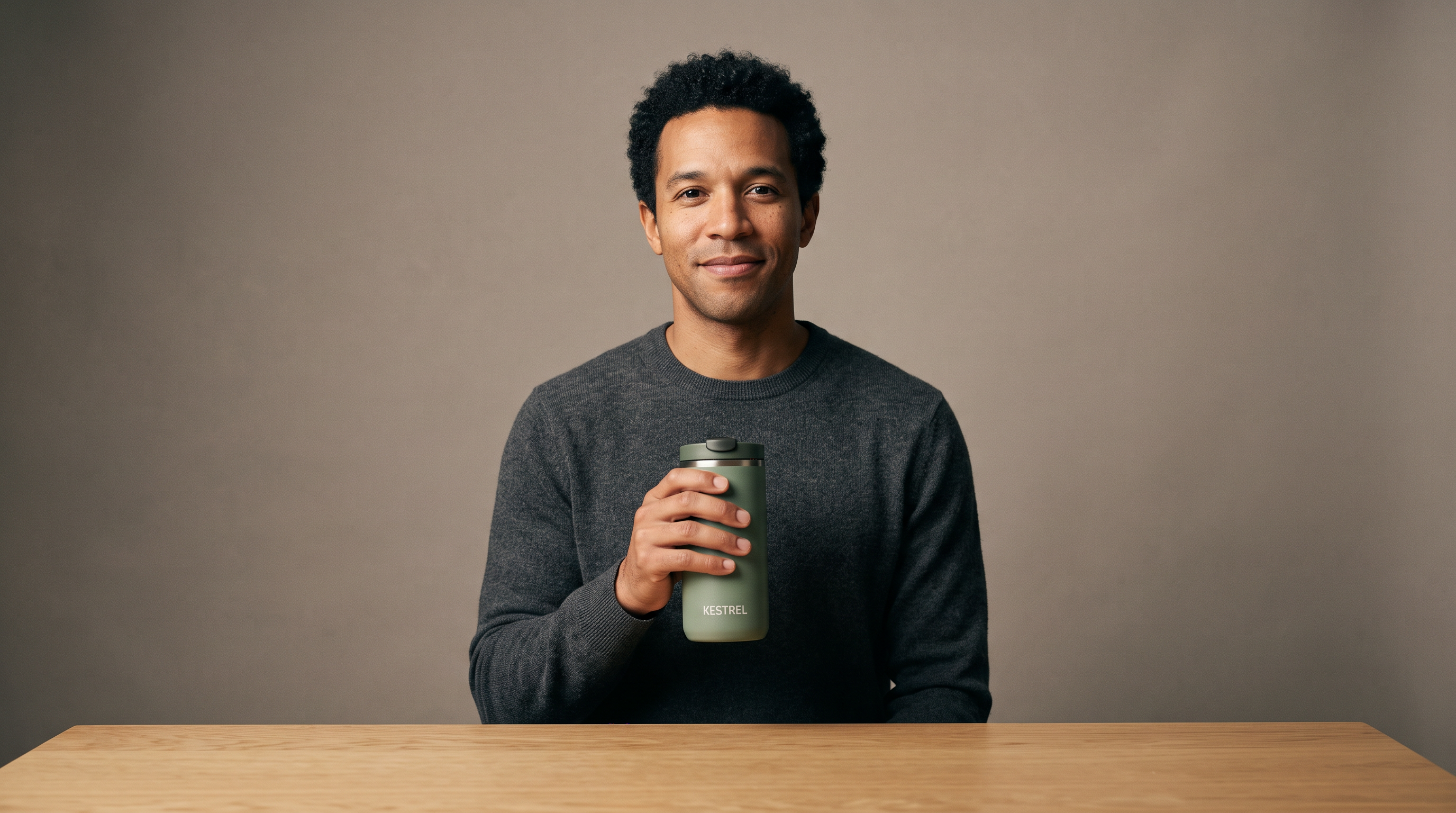
Generated using Nano Banana 2.1 on fal, an AI model from Google.
Try it in ChatGPT Try it in fal AgentOur Nano Banana API guide covers token pricing and the edit endpoint, which helps if you want a matching set of presenter stills for a catalog.
H3 Max Lip Sync and VEED Fabric 1.0 took that still directly, since both animate a single image.
For the eight video-input models, I turned the still into a silent 10-second clip with Wan 3.0 image-to-video at 1080p, because Wan 3.0 isn't one of the ten contestants.
I switched audio off and set the duration to 10 seconds at a 16:9 aspect ratio, then sent Wan 3.0 this motion prompt:
Prompt: The man speaks to the camera in a warm, conversational way while holding the travel mug at chest height. Halfway through, he presses the button on top with his thumb and the lid flips open. The camera stays locked off at eye level, and the grey backdrop stays unchanged behind him.
Generated using Wan 3.0 on fal, an AI model from Alibaba.
Try it in ChatGPT Try it in fal AgentIf you'd rather start from a different source model, our roundup of the best AI image-to-video generators ranks the other options on fal.
For the voiceover, I used MiniMax Speech 2.8 HD on its default voice settings.
You'll want to switch output_format to url, since the endpoint returns hex otherwise.
Script: Meet the Kestrel travel mug. One press of this button flips the lid open, and the double wall keeps your coffee hot past lunch.
Generated using MiniMax Speech 2.8 HD on fal, an AI model from MiniMax.
Try it in ChatGPT Try it in fal AgentI wrote the script to land a little under the clip's 10 seconds.
Before spending anything on lip sync, I'd normally check duration_ms in the response for the exact length.
Our guide to the best text-to-speech APIs ranks other voices you could audition for the same read.
Two of the ten models needed a value set by hand, since VEED Fabric 1.0 requires a resolution and Sync React-1 requires an emotion.
I picked 720p for VEED Fabric 1.0 and happy for Sync React-1 to suit the upbeat pitch.
I also raised H3 Max Lip Sync from its 768P default to 1080P so the presenter matched the clip the video endpoints received.
Every other field on all ten endpoints stayed at its default value.
Those defaults differ slightly across the Sync family, as sync-3 and Sync Lipsync 2 Pro start on cut_off for length mismatches while Sync React-1 starts on bounce.
HeyGen Lipsync Precision also lets the output duration adjust to the new audio by default, through a field called enable_dynamic_duration.
I ran all ten lip sync requests from Claude through our MCP server, following the same setup as our guide to generating AI videos with Claude and MCP.
At list rates, ten 10-second results come to about $9.37 combined, plus $2.00 for the 10-second Wan 3.0 source clip at 1080p.
#1: H3 Max Lip Sync
Best for: Ecommerce teams that want a talking presenter from one studio still, with output up to 2K and no source footage to manage.
Similar to: VEED Fabric 1.0, sync-3.
H3 Max Lip Sync is part of the H3 Max family that fal Research post-trained from MiniMax H3, and it animates one still image to any read you send.
You can pick from four resolution tiers between 480P and 2K, two more than VEED Fabric 1.0 offers for still images.
Performance
Generated using H3 Max Lip Sync on fal, a post-trained variant of MiniMax H3.
Try it in ChatGPT Try it in fal Agent- Resolution choice: for my run, I set 1080P to match the other endpoints' source clip, keeping the 2K tier in reserve for larger placements like a homepage header.
- Transcription guidance: with
enable_transcriptionon by default, H3 Max Lip Sync reads a transcript of your audio to guide lip shapes, but fal's schema recommends switching it off for music or singing. - Audio range: any read between 5 seconds and 15 minutes long is accepted, from a short teaser to a full product walkthrough.
- Image-input pricing: the 768P rate of $0.08 per second comes within a cent of VEED Lipsync's $0.07 for re-voicing footage, though 1080P doubles it to $0.16.
How to run H3 Max Lip Sync on fal
I send requests to minimax/h3-max/lip-sync/image-to-video with image_url for the still and audio_url for the read.
Without a resolution value, the endpoint renders at its 768P default.
A 16:9 still like mine fits inside the accepted aspect ratio window of 0.4 to 2.5 without cropping.
Our guide to lip syncing AI videos with an API builds a full H3 Max Lip Sync pipeline in Python and JavaScript, from translated reads to queued customer greetings.
Pricing
On its fal model page as of November 2026, H3 Max Lip Sync charges $0.32 per second of output at 2K, $0.16 at 1080P, $0.08 at 768P and $0.05 at 480P.
fal applies a 1.2x multiplier to videos longer than 15 seconds.
A 10-second clip at my 1080P test setting works out to $1.60.
#2: sync-3
Best for: Re-voicing finished product footage with Sync Labs' newest lip sync model and room for extra Sync.so settings.
Similar to: Sync Lipsync 2 Pro, HeyGen Lipsync Precision.
sync-3 is the most capable lip sync model Sync Labs has released so far.
A sync-3 request pairs a video with an audio track as usual, then adds an options object for further Sync.so generation settings.
Performance
Generated using sync-3 on fal, an AI model from Sync Labs.
Try it in ChatGPT Try it in fal Agent- Pass-through settings: the
optionsobject forwards additional Sync.so generation options, and async_modeset inside it overrides the top-level field. - Sync tier choice: based on my experience, sync-3 is the Sync tier to choose for a campaign's main video, priced between Sync Lipsync 2 Pro at $5 and Sync React-1 at $10 per minute.
How to run sync-3 on fal
The endpoint string is fal-ai/sync-lipsync/v3, and video_url and audio_url are the required pair.
It's worth setting sync_mode yourself when the read and the clip differ in length, choosing from cut_off (the default), loop, bounce, silence or remap.
Pricing
At $8 per minute of video, sync-3 works out to about $0.133 per second on fal, or $1.33 for my 10-second clip.
#3: HeyGen Lipsync Precision
Best for: Dubbing product clips that need captions or a fix to one stretch of the video.
Similar to: sync-3, VEED Lipsync.
HeyGen Lipsync Precision replaces or dubs the audio on an existing video using the higher-accuracy mode of HeyGen's lip sync.
With seven optional fields, it gives you more settings to work with than any other endpoint I tested.
Performance
Generated using HeyGen Lipsync Precision on fal, an AI model from HeyGen.
Try it in ChatGPT Try it in fal Agent- Partial-range syncing:
start_timeandend_timetake values in seconds, so a demo with one changed price or product name can be re-synced over just that stretch. - Captions in the output:
enable_captionadds captions to the output video, and the response can include acaption_filewhen HeyGen returns one. - Dynamic duration: because
enable_dynamic_durationdefaults to true, the output length adjusts to the new audio unless you switch it off. - Source cleanup:
disable_music_trackremoves the source video's background music, andenable_speech_enhancementimproves the replacement read.
How to run HeyGen Lipsync Precision on fal
Calls go to fal-ai/heygen/v3/lipsync/precision, where the optional title field is handy for labeling jobs in your own records.
For draft rounds, it's ideal to start with HeyGen Lipsync Speed at fal-ai/heygen/v3/lipsync/speed, which handles fast audio-only lip sync at half the per-second rate.
Pricing
HeyGen Lipsync Precision bills $0.10 per second of output video on fal, which puts a 10-second clip at $1.00.
falMODEL APIs
The fastest, cheapest and most reliable way to run genAI models. 1 API, 100s of models
#4: Sync Lipsync 2 Pro
Best for: Close-up product presenters where teeth and distinctive facial features need to hold through the re-sync.
Similar to: sync-3, VEED Lipsync.
The Pro tier of Sync Labs' lipsync-2 generation runs on fal as Sync Lipsync 2 Pro, with a model page that highlights natural teeth and unique facial features.
Compared with sync-3, Sync Lipsync 2 Pro costs $3 less per minute and keeps the same five sync_mode options.
Performance
Generated using Sync Lipsync 2 Pro on fal, an AI model from Sync Labs.
Try it in ChatGPT Try it in fal Agent- Detail retention: for a tight close-up of a presenter, I'd pick the Pro tier over the standard one because of that focus on teeth and facial detail.
- Standard tier: fal also serves Sync Lipsync 2.0 at $3 per minute, so the Pro tier costs roughly 1.67 times the standard rate.
How to run Sync Lipsync 2 Pro on fal
Requests for Sync Lipsync 2 Pro use fal-ai/sync-lipsync/v2/pro and the same two required fields as sync-3.
Pricing
Sync Lipsync 2 Pro runs $5 per minute of video on fal, or roughly $0.83 for a 10-second clip.
#5: Sync React-1
Best for: Product presenters whose delivery needs a new emotion or head motion as well as new lip shapes.
Similar to: sync-3, HeyGen Lipsync Precision.
Sync React-1 edits the facial performance along with the lips, using a required emotion field set to happy, sad, angry, disgusted, surprised or neutral.
The model caps both the source video and the audio at 15 seconds, which suits short ads and social cut-downs.
Performance
Generated using Sync React-1 on fal, an AI model from Sync Labs.
Try it in ChatGPT Try it in fal Agent- Emotion field: since React-1 currently accepts single-word emotions only, I chose happy for the upbeat mug pitch.
- Edit scope:
model_modedefaults to face for expressions without head movement, while lips keeps facial changes minimal and head adds natural talking-head motion. - Expressiveness:
temperatureruns from 0 to 1 and defaults to 0.5. - Length mismatch:
lipsync_modedefaults tobounceon React-1, withcut_off,loop,silenceandremapas the alternatives. - Detailed output: besides the video URL, the response reports fps, width, height, duration and frame count for a quick check before editing.
How to run Sync React-1 on fal
You'll find Sync React-1 at fal-ai/sync-lipsync/react-1, and our React-1 parameter guide goes deeper into how emotion and temperature combine.
Pricing
A 10-second clip on Sync React-1 costs roughly $1.67, based on the $10-per-minute rate on fal's model page.
#6: VEED Lipsync
Best for: Social and UGC-style product clips at volume, where a two-field request keeps the pipeline simple.
Similar to: Sync Lipsync 2 Pro, Kling LipSync.
On fal, VEED Lipsync runs at veed/lipsync/v2 and is listed as VEED's most advanced lip sync model yet, built for production-quality output.
VEED Lipsync needs only a source video and a new audio track, leaving nothing else to configure.
Performance
Generated using VEED Lipsync on fal, an AI model from VEED.
Try it in ChatGPT Try it in fal Agent- Nothing to tune: with two inputs and no settings, I put my effort into a front-facing source clip and an evenly leveled read.
- Original model: pipelines built around VEED's earlier lip sync model can keep using it on fal at veed/lipsync for $0.40 per minute.
How to run VEED Lipsync on fal
VEED Lipsync returns the synced file under video once you send video_url and audio_url.
When one campaign mixes footage and photos, I usually pair VEED Lipsync with VEED Fabric 1.0 (#10) from the same company.
Pricing
On fal, a second of VEED Lipsync output costs $0.07, putting a 30-second social cut at $2.10 and a 10-second clip at $0.70.
#7: Kling LipSync Audio-to-Video
Best for: Short product clips of 10 seconds or less where the cost per clip leads the decision.
Similar to: VEED Lipsync, LatentSync.
Kuaishou's Kling LipSync Audio-to-Video re-syncs a source clip of 2 to 10 seconds to a read of 2 to 60 seconds.
fal charges $0.014 per second of input video in 5-second steps, which makes a 10-second clip $0.14 and the lowest-cost run in this roundup.
Performance
Generated using Kling LipSync on fal, an AI model from Kuaishou.
Try it in ChatGPT Try it in fal Agent- Input window: the source video has to be an MP4 or MOV of up to 100MB at 720p or 1080p, with width and height between 720 and 1920 pixels.
- Audio limits: reads can run from 2 to 60 seconds, as long as the audio file stays under 5MB.
- Pre-flight check: Wan 3.0 reports width and height in its response, so I compared those against Kling's pixel window before sending the clip.
- Billing increments: because fal bills a 3-second clip as 5 seconds, trimming a source to exactly 5 or 10 seconds gets the most out of each step.
- Text-driven sibling: Kling LipSync Text-to-Video swaps the audio file for up to 120 characters of text and a Kling voice ID, on source clips of 2 to 60 seconds.
How to run Kling LipSync on fal
Turning off the safety checker at fal-ai/kling-video/lipsync/audio-to-video requires account authorization.
Pricing
fal's playground prices Kling LipSync at $0.014 per input video second, rounded up to the closest 5-second increment.
That puts a 3-second clip at $0.07 and my 10-second clip at $0.14.
#8: PixVerse Lipsync
Best for: Re-voicing AI-generated or stylized clips when the script exists but a recorded voiceover doesn't.
Similar to: Kling LipSync, VEED Lipsync.
PixVerse Lipsync can skip the audio file entirely and voice a typed script through its own text-to-speech.
That makes PixVerse Lipsync my pick when a silent clip and a typed script need to become a synced video in one request.
Performance
Generated using PixVerse Lipsync on fal, an AI model from PixVerse.
Try it in ChatGPT Try it in fal Agent- Built-in voices:
voice_idoffers 14 named voices, from Emily and James to Oliver and Ethan, plus an Auto default. - Test setup: I sent the shared MiniMax Speech 2.8 HD read through
audio_url, keeping the text-to-speech path and its charge out of my run.
How to run PixVerse Lipsync on fal
At fal-ai/pixverse/lipsync, video_url is the required field and audio_url stays optional for script-only runs.
Pricing
PixVerse Lipsync costs $0.04 per second of output when you bring your own audio, or $0.40 for a 10-second clip.
Voicing a script adds $0.24 for every 100 characters on top of that rate.
#9: LatentSync
Best for: Developers who want an open-source lip sync model with a low price for clips of up to 40 seconds.
Similar to: Kling LipSync, VEED Lipsync.
LatentSync started as open-source code from ByteDance on GitHub, and fal hosts it as a ready-made endpoint.
I pay $0.20 on fal for any video up to 40 seconds, which puts a 30-second clip at the same price as my 10-second test.
Performance
Generated using LatentSync on fal, an AI model from ByteDance.
Try it in ChatGPT Try it in fal Agent- Guidance control:
guidance_scaledefaults to 1 and sets how much guidance the model applies during inference. - Overrunning reads:
loop_modeaccepts pingpong or loop for cases where the audio runs longer than the video. - Reproducibility: leaving the seed empty picks a random one, so I'd set a fixed seed for any take you may want to regenerate later.
- Open code: teams that later want their own fork can deploy the public GitHub code on fal Serverless.
How to run LatentSync on fal
For inputs, LatentSync accepts MP4, MOV, WebM, M4V or GIF video at fal-ai/latentsync, paired with MP3, OGG, WAV, M4A or AAC audio.
Pricing
fal charges $0.20 per LatentSync video up to 40 seconds and $0.005 per second of output for longer ones.
#10: VEED Fabric 1.0
Best for: Talking-photo presenters at 480p or 720p for social placements and short product walkthroughs.
Similar to: H3 Max Lip Sync, PixVerse Lipsync.
With VEED Fabric 1.0, VEED applies its lip sync to a still image, so any photo can talk to an audio track at 480p or 720p.
fal also hosts Fabric 1.0 Fast for quicker results at a modest premium.
Performance
Generated using VEED Fabric 1.0 on fal, an AI model from VEED.
Try it in ChatGPT Try it in fal Agent- Resolution tiers: I tend to draft at 480p and move to 720p for the final, since the endpoint makes you pick a resolution on every request.
- Input formats: images can be JPG, PNG, WebP, GIF or AVIF.
- Script route: fal also lists
veed/fabric-1.0/text, which pairs the image with typed text and a short description of the voice you want. - Fast variant: Fabric 1.0 Fast keeps output quality unchanged for time-sensitive work at a higher price.
How to run VEED Fabric 1.0 on fal
The veed/fabric-1.0 endpoint needs image_url and audio_url along with the resolution field.
Pricing
VEED Fabric 1.0 is priced at $0.08 per second for 480p and $0.15 for 720p, which works out to $1.50 for a 10-second clip at my 720p setting.
Results from my run: how did all of the AI models do?
Here's how each of the ten models handled the Kestrel read, with every job sent from Claude through our MCP server:
| AI Model | Lip closures on m, p and b sounds (out of 5) | Output | Time to result | Cost at actual length |
|---|---|---|---|---|
| H3 Max Lip Sync | 5 | 1920×1080, 7.67 seconds | 23 seconds | About $1.23 |
| sync-3 | 3 | 1920×1080, 7.63 seconds | 100 seconds | About $1.02 |
| HeyGen Lipsync Precision | 3 | 1920×1080, 7.63 seconds | 141 seconds | About $0.76 |
| Sync Lipsync 2 Pro | 3 | 1920×1080, 7.63 seconds | 95 seconds | About $0.64 |
| Sync React-1 | 5 | 1920×1080, 7.63 seconds | 267 seconds | About $1.27 |
| VEED Lipsync | 3 | 1920×1080, 7.64 seconds | 42 seconds | About $0.53 |
| Kling LipSync Audio-to-Video | 4 | 1920×1072, 9.97 seconds | 242 seconds | $0.14 |
| PixVerse Lipsync | 3 | 1920×1080, 7.70 seconds | 71 seconds | About $0.31 |
| LatentSync | 1 | 1920×1080, 7.68 seconds | 146 seconds (93 of them queued) | $0.20 |
| VEED Fabric 1.0 | 3 | 1312×736, 7.60 seconds | 56 seconds | About $1.14 |
Note: times are wall-clock from submission to result, so they include any time a job spent waiting in the queue.
The lip closure score counts five m, p and b moments from the read, marking whether the lips fully closed on each one.
Costs use each model's list rate at the length it returned, apart from Kling LipSync, which bills on the 10 seconds of source video.
Kling LipSync kept the full length of the source clip at 1920×1072, while the other nine results ended with the roughly 7.6-second read.
All ten results together cost about $7.24 at list rates, below my $9.37 estimate because the read came in shorter than 10 seconds.
Can one SDK run all ten lip sync APIs?
The @fal-ai/client SDK runs all ten lip sync endpoints in this guide, and only the input fields change from model to model.
H3 Max Lip Sync and VEED Fabric 1.0 expect an image_url, while the remaining eight models need a video_url.
All ten endpoints return the finished clip under the same video.url field.
Sync React-1 and VEED Fabric 1.0 also reject any request that leaves out their required emotion or resolution field.
Here's the same batch written in JavaScript, sending all ten requests in parallel:
javascript
import { fal } from "@fal-ai/client";

const STILL = "https://your-cdn.example/kestrel-presenter.png";
const CLIP = "https://your-cdn.example/kestrel-presenter-1080p.mp4";
const READ = "https://your-cdn.example/kestrel-read.mp3";

const jobs = {
  "minimax/h3-max/lip-sync/image-to-video": { image_url: STILL, audio_url: READ, resolution: "1080P" },
  "veed/fabric-1.0": { image_url: STILL, audio_url: READ, resolution: "720p" },
  "fal-ai/sync-lipsync/v3": { video_url: CLIP, audio_url: READ },
  "fal-ai/heygen/v3/lipsync/precision": { video_url: CLIP, audio_url: READ },
  "fal-ai/sync-lipsync/v2/pro": { video_url: CLIP, audio_url: READ },
  "fal-ai/sync-lipsync/react-1": { video_url: CLIP, audio_url: READ, emotion: "happy" },
  "veed/lipsync/v2": { video_url: CLIP, audio_url: READ },
  "fal-ai/kling-video/lipsync/audio-to-video": { video_url: CLIP, audio_url: READ },
  "fal-ai/pixverse/lipsync": { video_url: CLIP, audio_url: READ },
  "fal-ai/latentsync": { video_url: CLIP, audio_url: READ },
};

const results = await Promise.all(
  Object.entries(jobs).map(async ([endpoint, input]) => {
    const { data } = await fal.subscribe(endpoint, { input });
    return { endpoint, url: data.video.url };
  }),
);

console.table(results);
For longer reads or bigger batches, our tutorial on generating AI videos with an API walks through queued requests and webhooks, and the same pattern carries over to these endpoints.
Which AI lip sync model fits product videos best?
H3 Max Lip Sync fits product videos best whenever a studio still of the presenter is available, since it removes the need to film a source clip at all.
Past that first choice, I'd match the model to the footage and the brief:
- Finished footage for a campaign's main video: sync-3, with Sync Lipsync 2 Pro as the lower-cost Sync option at $5 per minute.
- One changed line inside a longer demo: HeyGen Lipsync Precision, using
start_timeandend_timeto re-sync only that stretch. - A different emotional delivery from the same take: Sync React-1, on clips of up to 15 seconds.
- Batches of short social clips: Kling LipSync for sources up to 10 seconds and LatentSync for anything up to 40 seconds.
Recently Added













Lip sync every product video through one API with fal
fal now hosts still-image lip sync models like H3 Max Lip Sync next to re-sync models for finished footage, and 10-second clips run from $0.14 to $1.67 at my settings.
Sending one 10-second product demo through all ten comes to about $9.37 at list rates, before the source clip and the voiceover.
For a new presenter project, I'd recommend H3 Max Lip Sync first, bringing in sync-3 or HeyGen Lipsync Precision once real footage enters the brief.
FAQs
What is the cheapest AI lip sync API?
Kling LipSync Audio-to-Video is the cheapest AI lip sync API on this list for a 10-second clip, at $0.14 according to fal's model page as of November 6, 2026.
LatentSync charges $0.20 for any video up to 40 seconds, so it's the better-value pick once a clip runs past Kling LipSync's 10-second source limit.
PixVerse Lipsync comes next at $0.04 per second of output when you supply your own audio.
Can I make a product presenter photo talk with AI lip sync?
Yes, H3 Max Lip Sync and VEED Fabric 1.0 both animate a single photo of a presenter to an audio track.
The remaining eight models re-sync footage you've already shot or generated.
H3 Max Lip Sync covers 480P to 2K with long-form reads, whereas VEED Fabric 1.0 offers 480p and 720p output.
Can AI lip sync change a presenter's emotion?
Sync React-1 can change a presenter's emotion, editing the facial expression along with the lips through a required emotion field with six single-word options.
Setting model_mode to head adds natural talking-head movement on top, while temperature adjusts how expressive the result gets.
Which lip sync API works without a recorded voiceover?
PixVerse Lipsync works without a recorded voiceover, voicing a text script with one of its 14 built-in voices whenever no audio_url is provided.
For a short line, Kling LipSync Text-to-Video does the same job with up to 120 characters of text and a Kling voice ID.
Which lip sync models have length limits on fal?
Sync React-1 and Kling LipSync Audio-to-Video carry the tightest documented limits, at 15 seconds for React-1's inputs and 2 to 10 seconds for Kling's source video.
H3 Max Lip Sync needs a read of at least 5 seconds and caps it at 15 minutes, applying a 1.2x price multiplier to any video past 15 seconds.
Can you lip sync AI-generated video?
All eight video-input endpoints here accept AI-generated clips, and the source clip for my test came from Wan 3.0 image-to-video.
Kling LipSync is the model to check first, since its 720p or 1080p requirement and 720 to 1920 pixel window apply to generated footage as well.