![10 Best Text-to-Speech APIs in 2026 [Reviewed]](https://refinery.fal.media/url/https%3A%2F%2Fv3b.fal.media%2Ffiles%2Fb%2F0a9c366c%2FVrh-xdtEWo_Kt9Hf9xYeW_1780097087241.jpeg/tr:w-1920,q-80/Vrh-xdtEWo_Kt9Hf9xYeW_1780097087241.webp)
In this guide, I'll walk through the 10 best text-to-speech APIs in 2026, ranked by their Elo on the Artificial Analysis Speech Arena leaderboard where available, so you can pick the right one without burning hours in playgrounds.
Every model in this roundup is available on fal, which means you can plug into any of them through the same API and switch endpoints without rewriting your integration.
TL;DR
Gemini 3.1 Flash TTS (1,216 Elo): Top of the leaderboard, with inline audio tags like [laughing], [sigh], and [whispering] for script-level delivery control.
Inworld TTS-1.5 Max (1,200 Elo): Second-highest Elo in this guide at the lowest per-character price ($0.01 per 1K).
ElevenLabs Eleven v3 (1,182 Elo): ElevenLabs' most expressive model with inline audio tag control and 70+ language support.
fal offers a unified API for every TTS model in this guide, with a custom-built inference engine and pay-per-use pricing.
How can you access all of these text-to-speech APIs in this list?
fal offers the best place to generate speech from text with its unified API for every model in this guide, with its custom-built inference engine and pay-per-use pricing.
Instead of you having to create accounts with different AI model platforms, you can get access to all of these AI models without having to pay for monthly subscriptions: only pay when you need them using fal's API.
You integrate once with the @fal-ai/client SDK, and that same pattern works across every text-to-speech endpoint on the platform, plus the 600+ other models for image, video, voice cloning, and audio processing.
Your auth, error handling, queueing logic, and billing stay identical whether you generate with Gemini 3.1 Flash TTS for expressive narration, Inworld TTS-1.5 Max for high-volume batch jobs, or Chatterbox for character voices.
Your team can ship a voice feature using one model for drafts, let users upgrade to another for production output, and add a third for cloning, all without touching your integration code.
All you need is six lines to generate speech:
javascript
import { fal } from "@fal-ai/client";

const result = await fal.subscribe("fal-ai/elevenlabs/tts/eleven-v3", {
  input: { text: "Hello, this is generated on fal." },
});
What are the best text-to-speech APIs in 2026?
The best text-to-speech APIs in 2026 are Gemini 3.1 Flash TTS, Inworld TTS-1.5 Max, and xAI Text to Speech.
You can access these 3 models on fal on a pay-per-use model with no fixed costs, alongside the full shortlist of all 10 AI text-to-speech models:
| AI Model | Best For | Price on fal | Elo (May 2026) |
|---|---|---|---|
| Gemini 3.1 Flash TTS | Granular audio tag control with expressive delivery | $0.15 per 1K characters | 1,216 |
| Inworld TTS-1.5 Max | Top-tier quality at the lowest per-character rate | $0.01 per 1K characters | 1,200 |
| xAI Text to Speech | Real-time voice agents with expressive inline speech tags | $15 per 1M characters | 1,190 |
| ElevenLabs Eleven v3 | Most expressive ElevenLabs model with 70+ language support | $0.10 per 1K characters | 1,182 |
| MiniMax Speech 2.8 HD | 30+ languages with deep voice control and cloning | $0.10 per 1K characters | 1,167 |
| Maya1 | Text-prompt voice design with emotional expression | $0.002 per audio second | 1,053 |
| Chatterbox | Creative content with personality controls and voice cloning | $0.025 per 1K characters | 1,006 |
| Qwen3-TTS 1.7B | Voice design ecosystem with cross-output cloning | $0.09 per 1K characters | 928 |
| Kling TTS | Anime, gaming, and stylized character voices | $0.007 per generation | Not ranked |
| Index TTS 2.0 | Per-second pricing with emotional reference audio control | $0.002 per audio second | Not ranked |
#1: Gemini 3.1 Flash TTS
Best for: Teams that need granular control over audio tags (laughs, sighs, whispers, pauses) and multi-speaker dialogue from a single endpoint.
Similar to: Inworld TTS-1.5 Max, xAI Text to Speech.
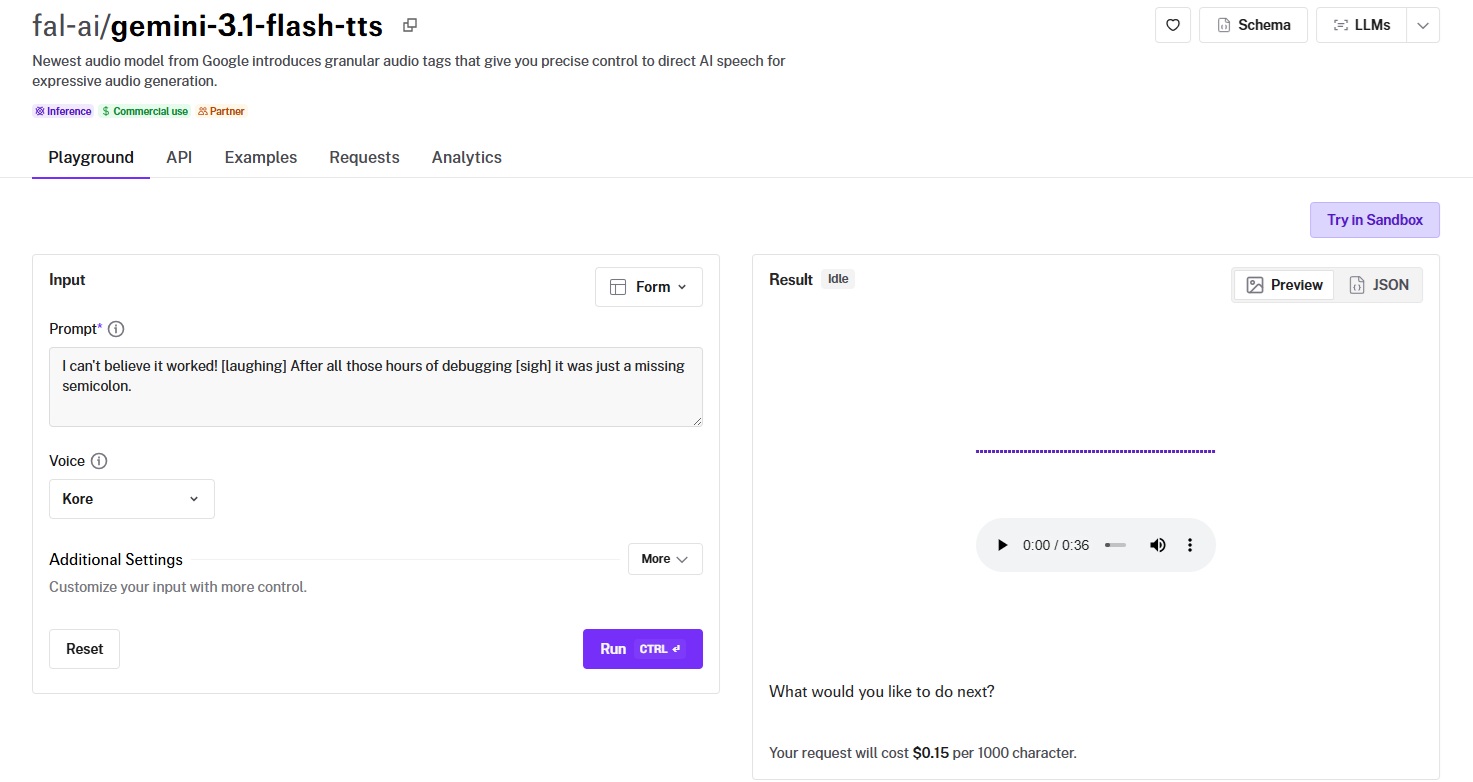
Gemini 3.1 Flash TTS is Google's newest text-to-speech model, and it currently holds the top spot on the Artificial Analysis Speech Arena with a 1,216 Elo.
The differentiator is the inline audio tag system: drop [laughing], [sigh], [whispering], or [short pause] directly into your prompt and the model executes those direction cues without separate parameter tuning.
Performance
Generated using Gemini 3.1 Flash TTS on fal, an AI model from Google.
Voice naturalness and expressiveness: Pauses land in spots a human speaker would naturally pause. The audio tag system isn't a gimmick either: a [laughing] insertion produces something that resembles an actual laugh.
Language and accent support: 24 primary languages with an extended catalog including Mandarin (China and Taiwan), Cantonese, Vietnamese, Arabic variants, and Indian regional languages (Hindi, Tamil, Telugu, Marathi, Gujarati, Punjabi). The language_code parameter steers pronunciation when text could be ambiguous.
Speed (real-time vs. batch): Fast enough for interactive applications, with output formats including MP3, WAV, and Ogg Opus. Handles both single-speaker generation and multi-speaker dialogue in one call.
Voice options and design: Ships with 30 named voices (Kore, Puck, Charon, Zephyr, Aoede, and more), each tuned for specific tonal and demographic profiles. The style_instructions parameter lets you describe voice delivery in natural language ("Speak warmly and slowly", "Read this as a dramatic newscast").
How to access Gemini 3.1 Flash TTS on fal
Gemini 3.1 Flash TTS is available through fal's API and playground.
The prompt field accepts your text with inline audio tags, and style_instructions lets you separate delivery direction from content.
For multi-speaker dialogue, define speakers in the speakers field with voice and speaker_id, then prefix lines in the prompt with the speaker alias.
Pricing
It costs $0.15 per 1,000 characters to use Gemini 3.1 Flash TTS on fal.
falMODEL APIs
The fastest, cheapest and most reliable way to run genAI models. 1 API, 100s of models
#2: Inworld TTS-1.5 Max
Best for: Teams that want top-tier voice quality at the lowest per-character rate in this guide.
Similar to: Gemini 3.1 Flash TTS, ElevenLabs Eleven v3.
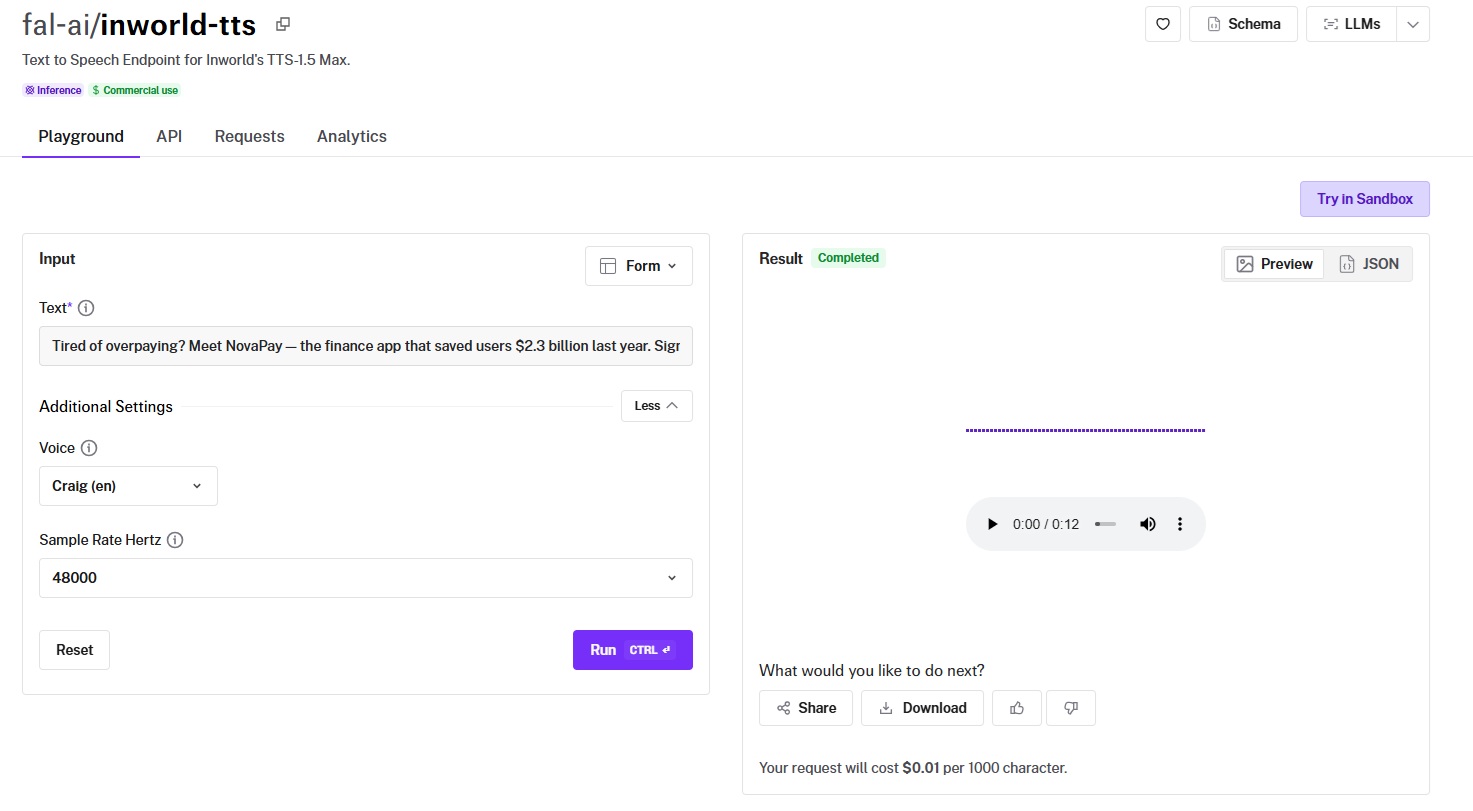
Inworld TTS-1.5 Max is the production version of Inworld's research-grade TTS lineup, and it pairs the second-highest Elo in this roundup (1,200) with the lowest per-character price ($0.01 per 1K).
That combination is what makes it the standout value pick if you care about quality per dollar.
Performance
Generated using Inworld TTS-1.5 Max on fal, an AI model from Inworld.
Voice naturalness and expressiveness: Inworld surprised me. For a model priced at a fraction of the premium tier, the output quality is genuinely competitive. The voices have warmth, the pacing feels deliberate, and the emotional range covers conversational, narrative, and announcement-style delivery without obvious mode-switching.
Language and accent support: 14+ languages out of the box, including English (with multiple voice variants), Mandarin, Dutch, French, German, Italian, Japanese, Korean, Polish, Portuguese, Spanish, Russian, Hindi, Hebrew, and Arabic.
Voice catalog: Dozens of named voices across languages and demographics, including Craig, Loretta, Aiden, Hana, Pippa, Tessa, Liam, Callum, and many more. Each voice maintains consistent identity across requests.
How to access Inworld TTS-1.5 Max on fal
You can run Inworld TTS-1.5 Max on fal with API access plus a browser playground.
You pick a voice from the catalog, set your sample_rate_hertz, and submit your text.
The endpoint accepts up to 2,000 characters per request, which works well for narration in chunks with concatenation for longer scripts.
Pricing
It costs $0.01 per 1,000 characters to use Inworld TTS-1.5 Max on fal.
#3: xAI Text to Speech
Best for: Real-time voice agents and applications that need expressive, tagged speech with multilingual delivery.
Similar to: Gemini 3.1 Flash TTS, ElevenLabs Eleven v3.
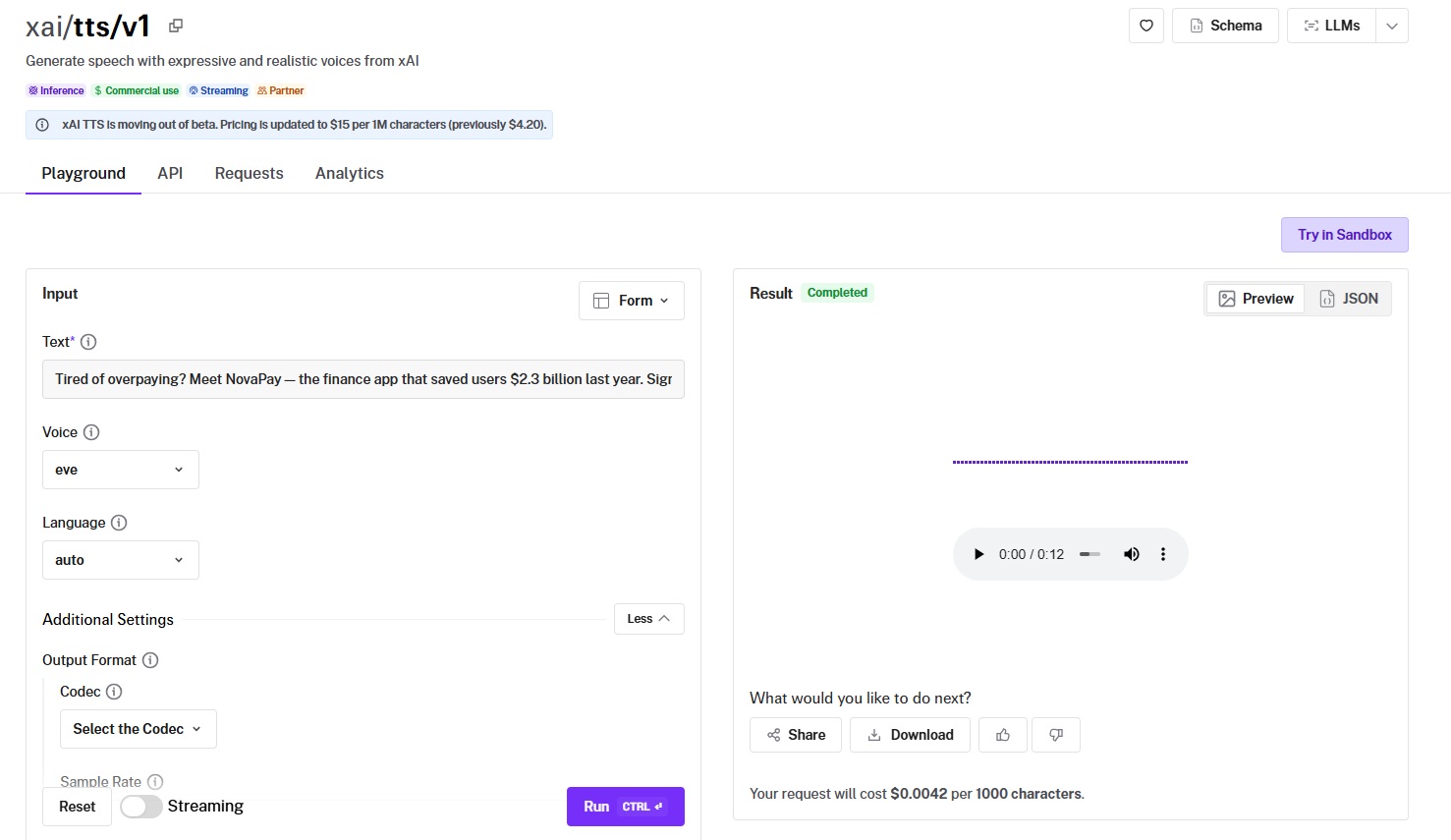
xAI Text to Speech delivers a 1,190 Elo with native streaming and a tagged-speech system that lets you control delivery using both inline tags ([laugh], [pause], [sigh]) and wrapping tags (<whisper>...</whisper>, <slow>...</slow>).
The five available voices each carry distinct personality cues, which are useful when you want a specific tone without designing a voice from scratch.
Performance
Generated using xAI Text to Speech on fal, an AI model from xAI.
Voice naturalness and expressiveness: The voices have character. Eve sounds genuinely upbeat in a way that doesn't read as forced, Ara has the warmth you'd want for hospitality or wellness applications, and Leo carries authority for announcement-style delivery. The wrapping tag system (<whisper>, <slow>) executes cleanly, which matters when you're scripting dialogue with mood changes.
Language and accent support: 20 languages, including English, Arabic (Egypt, Saudi Arabia, UAE), Bengali, Mandarin, French, German, Hindi, Indonesian, Italian, Japanese, Korean, Portuguese (Brazil, Portugal), Russian, Spanish (Mexico, Spain), Turkish, and Vietnamese. Auto language detection works when input language is mixed.
Speed (real-time vs. batch): Native streaming support means audio starts before generation completes. For voice agent applications, first-audio latency feels closer to a human conversation pause than a model output delay.
Voice options and design: Five distinct named voices (eve, ara, rex, sal, leo), each tuned for specific delivery styles. The inline speech tags layer on top of any voice for script-level direction.
How to access xAI Text to Speech on fal
API and playground are both available for xAI text to speech on fal.
The text field supports up to 15,000 characters per request, which works well for chapter-length narration in a single call.
Pick a voice, optionally set a language code (or use auto), and configure the output format (MP3, μ-law for telephony, or higher-fidelity options).
For streaming, you can use fal.stream in place of fal.subscribe.
Pricing
It costs $15 per 1M characters to use xAI Text to Speech on fal.
#4: ElevenLabs Eleven v3
Best for: Teams that need ElevenLabs' most expressive voice quality with inline audio tag control and 70+ language support.
Similar to: Gemini 3.1 Flash TTS, MiniMax Speech 2.8 HD.
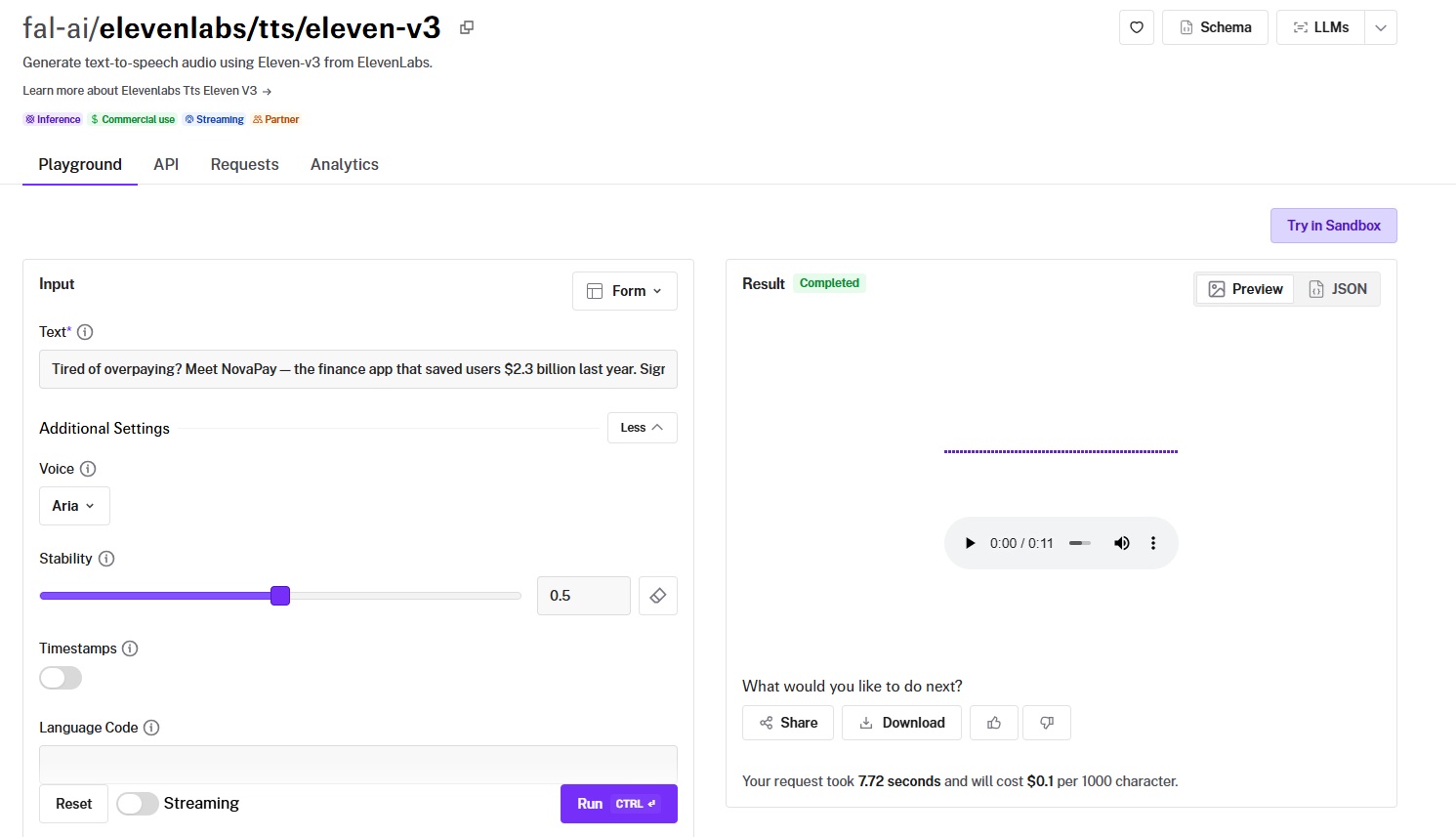
ElevenLabs Eleven v3 is the flagship model from ElevenLabs and the highest-rated ElevenLabs entry on the Artificial Analysis leaderboard at 1,182 Elo.
It pairs the natural pacing ElevenLabs built its reputation on with inline audio tag control: drop [laughs], [whispers], [excited], or [sad] directly into the text, and the model interprets those direction cues to shape delivery, emotion, and tone.
Performance
Generated using ElevenLabs Eleven v3 on fal, an AI model from ElevenLabs.
Voice naturalness and expressiveness: Pacing feels organic, emphasis lands on the right syllables, and the inline audio tag system executes. The voice catalog carries warmth across professional, conversational, and character-driven delivery.
Language and accent support: 70+ languages with native pronunciation, including English, Mandarin, Hindi, Arabic, Spanish, French, German, Japanese, Korean, and dozens more. The apply_text_normalization parameter handles number reading and abbreviations across languages.
Voice cloning accuracy: ElevenLabs offers voice cloning through its broader platform, with voice changer functionality also available on fal. The full ElevenLabs audio toolkit (TTS, voice changing, dubbing, Scribe V2 for speech-to-text, multi-speaker dialogue via text-to-dialogue/eleven-v3) runs on fal through the same SDK pattern.
How to access ElevenLabs Eleven v3 on fal
ElevenLabs Eleven v3 is available through fal's API and playground.
For streaming output, use fal.stream in place of fal.subscribe.
Audio tags drop inline anywhere in the text: emotional tags ([happy], [sad], [excited], [angry], [sarcastically]), delivery tags ([whispers], [shouting], [slowly], [quickly]), non-verbal sounds ([laughs], [chuckles], [sighs], [gasps], [coughs]), and accent tags ([british accent], [southern accent]).
For multi-speaker dialogue with matched prosody, you can pair Eleven v3 with the companion text-to-dialogue/eleven-v3 endpoint on fal.
Pricing
It costs $0.10 per 1,000 characters to use ElevenLabs Eleven v3 on fal.
#5: MiniMax Speech 2.8 HD
Best for: Production teams that need 30+ languages, voice cloning, granular emotion control, and interjection tags in a single ecosystem.
Similar to: ElevenLabs Eleven v3, Maya1.
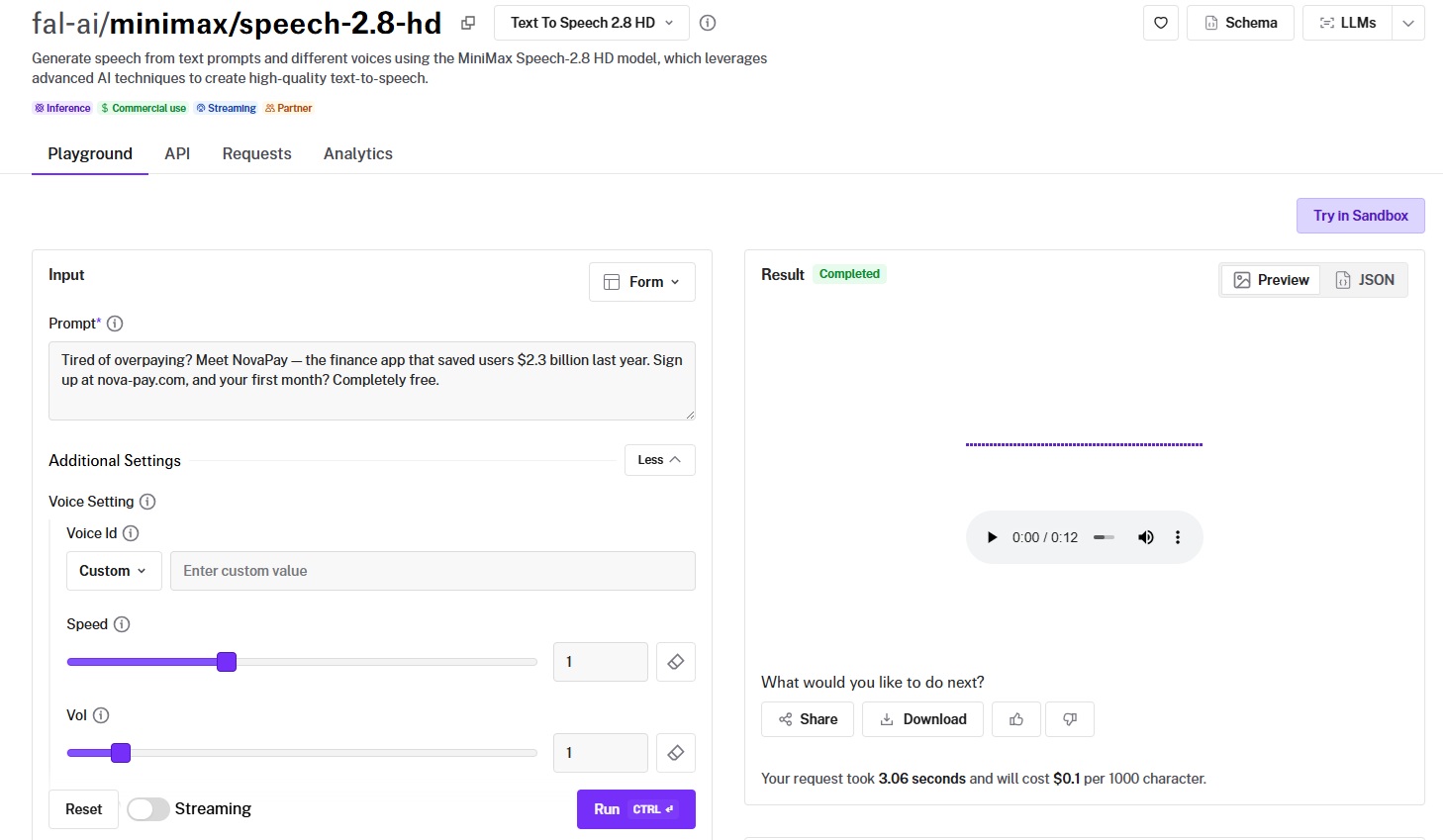
MiniMax Speech 2.8 HD is one of the most feature-complete TTS models in this roundup, packing 30+ languages, dozens of pre-built voices, emotion presets, interjection tags, custom pause markers, voice cloning, and voice modification through a single ecosystem.
Performance
Generated using MiniMax Speech 2.8 HD on fal, an AI model from MiniMax.
Voice naturalness and expressiveness: Among the most controllable models I tested. The emotion presets (happy, sad, angry, fearful, disgusted, surprised, neutral) produce audibly different intonation, not just volume changes. The interjection tags (laughs), (sighs), (coughs), (clears throat), (gasps), (sniffs), (groans), (yawns) drop into the script as parenthetical inserts and the model executes them as actual audio events. Custom pause markers using <#x#> syntax let you specify pause duration down to 0.01 seconds.
Language and accent support: 30+ languages with native pronunciation, including Mandarin (China and Cantonese), Japanese, Korean, Thai, Vietnamese, Indonesian, Hindi, Arabic, Russian, and most major European languages. The language_boost parameter improves recognition when input text mixes languages or uses dialect-specific vocabulary.
Voice cloning accuracy: MiniMax's dedicated voice clone endpoint creates a custom voice ID from a reference audio sample. The clone requires at least 10 seconds of audio and includes noise reduction and volume normalization. The voice ID can then be referenced across TTS calls.
How to access MiniMax Speech 2.8 HD on fal
API and playground are both available on fal for MiniMax Speech 2.8 HD.
The voice cloning workflow runs through a separate endpoint that takes a reference audio URL and returns a voice ID you can reuse.
Output format is configurable: MP3, PCM, or FLAC with adjustable sample rates from 8kHz to 44.1kHz and bitrates from 32kbps to 256kbps.
Voice modification parameters let you tweak pitch (-100 to +100), intensity (-100 to +100), and timbre (-100 to +100) on top of the base voice selection.
Pricing
It costs $0.10 per 1,000 characters to use MiniMax Speech 2.8 HD on fal.
#6: Maya1
Best for: Teams that need emotionally expressive voice generation with text-prompted voice design, where you describe the voice you want and the model creates it.
Similar to: ElevenLabs Eleven v3, MiniMax Speech 2.8 HD.
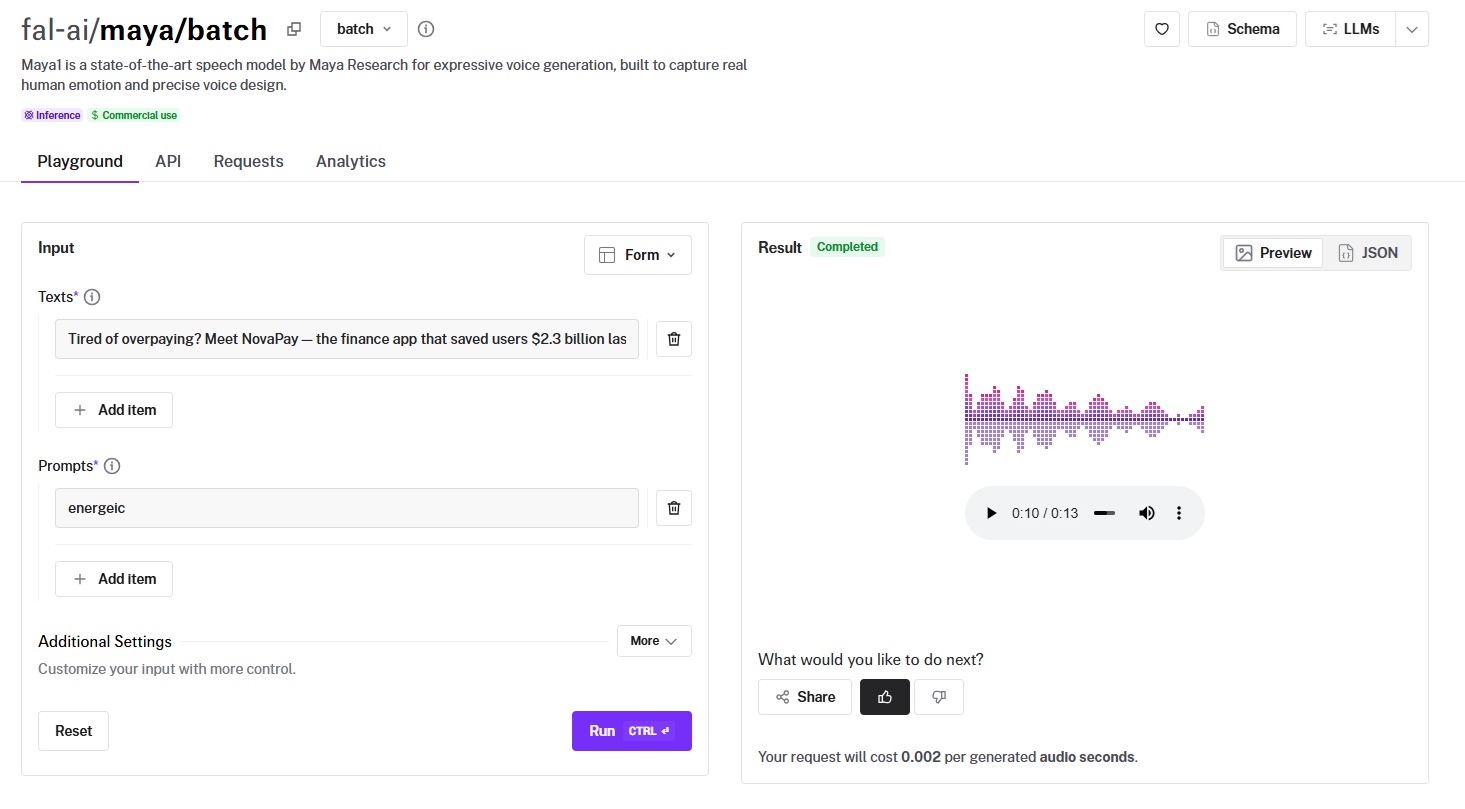
Maya1 is a speech model from Maya Research built around emotional fidelity and voice design through natural language.
You describe the voice you want (age, accent, pitch, timbre, pacing, tone, intensity) and Maya1 generates speech matching that description.
Performance
Generated using Maya1 on fal, an AI model from Maya Research.
Voice naturalness and expressiveness: Maya1's defining feature shows up here. Emotional range covers gradient nuance, not just discrete emotion buckets. A line marked as sad sounds sad in the way humans sound sad: slightly lower pitch, slower pace, slight tremor at the right moments. The embedded emotion tags work inline with the text, which keeps script editing simple.
Language and accent support: Tuned for English delivery, where the model's voice design and emotional control features are most refined. The text-prompt voice design system accepts natural language descriptions for accent, age, pitch, timbre, pacing, and tone in a single prompt.
Speed (real-time vs. batch): The batch endpoint (fal-ai/maya/batch) is designed for bulk processing, returning multiple generations efficiently when you need to produce dozens of audio samples in one call.
Voice design and cloning: Text-prompt voice design through the prompts field. You describe the voice you want and the model generates speech matching that description. Each text in your batch can pair with a different voice description.
How to access Maya1 on fal
Maya1 is available on fal via API and playground.
The batch endpoint takes a list of texts and a matching list of prompts (voice descriptions), generating multiple audio files in a single request.
Parameters include temperature (sampling variation), top_p (nucleus sampling), max_tokens (output length cap), repetition_penalty (anti-repeat), and output sample rate (48kHz or 24kHz).
Output formats are WAV or MP3.
Pricing
It costs $0.002 per generated audio second to use Maya1's batch endpoint on fal.
#7: Chatterbox
Best for: Creative teams making memes, short-form video, games, and AI agents where personality and voice cloning matter.
Similar to: Qwen3-TTS, Kling TTS.
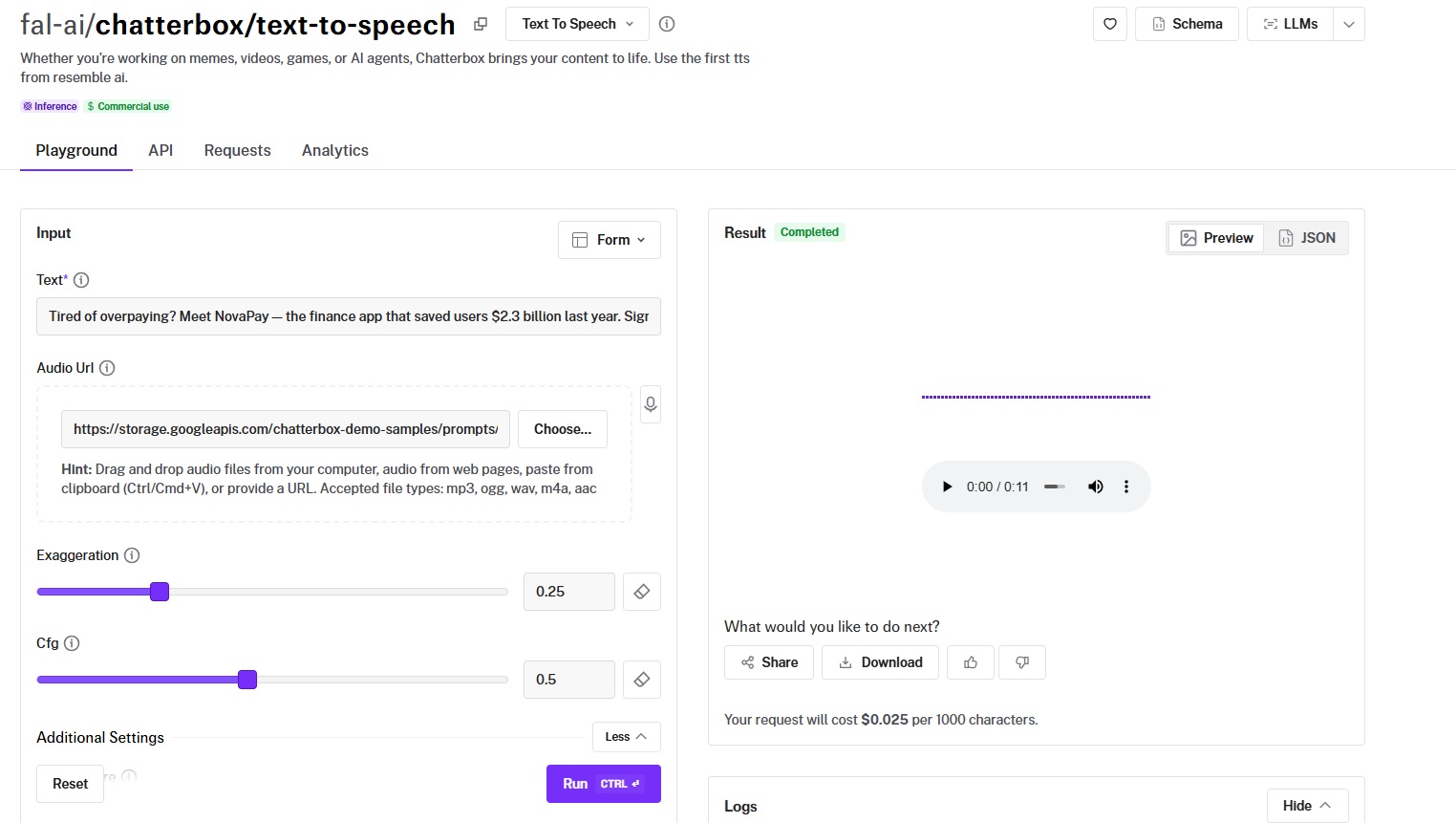
Chatterbox is Resemble AI's text-to-speech model built for content that needs character.
It offers exaggeration and cfg controls for creative range, paralinguistic tags (<laugh>, <sigh>, <gasp>, <chuckle>, <yawn>), voice cloning from short audio clips, and a multilingual variant covering 23 languages.
Performance
Generated using Chatterbox on fal, an AI model from Resemble AI.
Voice naturalness and expressiveness: Chatterbox brings personality. The exaggeration parameter lets you push voices into caricature territory for games and memes or dial them back for grounded narration. The paralinguistic tags add non-verbal audio events that feel natural in casual content: a <laugh> actually laughs, a <sigh> sighs. The output has a feel that fits character-driven content.
Language and accent support: The standard endpoint is tuned for English content. The multilingual variant covers 23 languages (Arabic, Chinese, Danish, Dutch, English, Finnish, French, German, Greek, Hebrew, Hindi, Italian, Japanese, Korean, Malay, Norwegian, Polish, Portuguese, Russian, Spanish, Swahili, Swedish, Turkish) with a custom_audio_language parameter for cross-lingual voice cloning.
Voice cloning accuracy: Reference audio cloning is supported through a URL input. The multilingual variant adds language-aware cloning, so a cloned voice can speak languages other than the reference.
How to access Chatterbox on fal
You can run Chatterbox on fal's API and playground.
The exaggeration, cfg, and temperature parameters are unique to Chatterbox and worth experimenting with in the playground before locking settings for production.
For multilingual output, you can use the multilingual variant endpoint. Commercial use is enabled.
Pricing
It costs $0.025 per 1,000 characters to use Chatterbox on fal.
#8: Qwen3-TTS 1.7B
Best for: Developers who want to design custom voices from text descriptions and clone them across outputs through a unified ecosystem.
Similar to: Chatterbox, MiniMax Speech 2.8 HD.
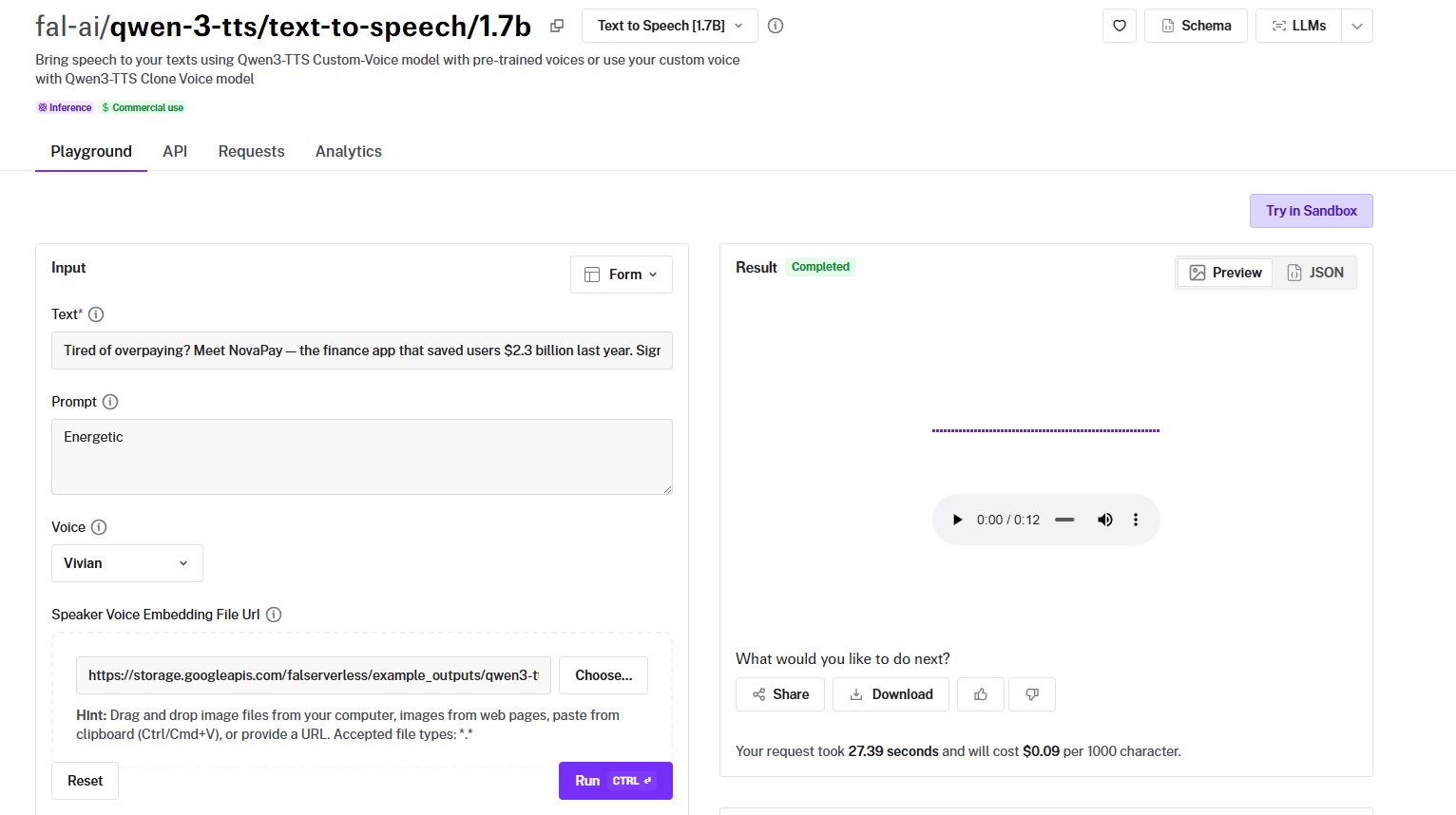
Qwen3-TTS is Alibaba's modular voice system that combines voice design, text-to-speech, and zero-shot cloning in a single ecosystem.
The 1.7B parameter variant on fal produces natural-sounding speech with good prosody across 10 supported languages, plus auto detection.
Performance
Generated using Qwen3-TTS 1.7B on fal, an AI model from Alibaba.
Voice naturalness and expressiveness: The 1.7B variant produces clean, natural speech with reasonable prosody on standard narration. The prompt field lets you guide delivery style with natural language ("Very happy," "Serious tone," "Excited and energetic"), which acts as a lightweight emotion control layer. Pre-trained voices include Vivian, Serena, Uncle_Fu, Dylan, Eric, Ryan, Aiden, Ono_Anna, and Sohee, with each voice tuned for specific languages.
Language and accent support: 10 languages (English, Chinese, Spanish, French, German, Italian, Japanese, Korean, Portuguese, Russian) plus auto language detection. Strong on Mandarin, which is expected given the training data lineage.
Voice cloning accuracy: Zero-shot cloning is available through a dedicated endpoint (fal-ai/qwen-3-tts/clone-voice). You provide a reference audio URL, the model returns a speaker embedding (saved as a safetensors file), and you reference that embedding in subsequent TTS calls. Reference text accompanying the audio improves clone quality.
How to access Qwen3-TTS 1.7B on fal
You can run Qwen3-TTS 1.7B through the fal API or test it in the playground first.
Three endpoints make up the ecosystem: voice design for creating voices from text descriptions, text-to-speech for generation, and clone voice for zero-shot cloning from audio samples.
The text input supports a generous character limit per request, with sampling parameters (top_k, top_p, temperature, repetition_penalty) for output variation control.
Pricing
Qwen3-TTS 1.7B pricing on fal is $0.09 per 1,000 characters.
#9: Kling TTS
Best for: Anime, gaming, and stylized character voice work where flat-rate per-generation pricing fits the workflow.
Similar to: Chatterbox, Index TTS 2.0.
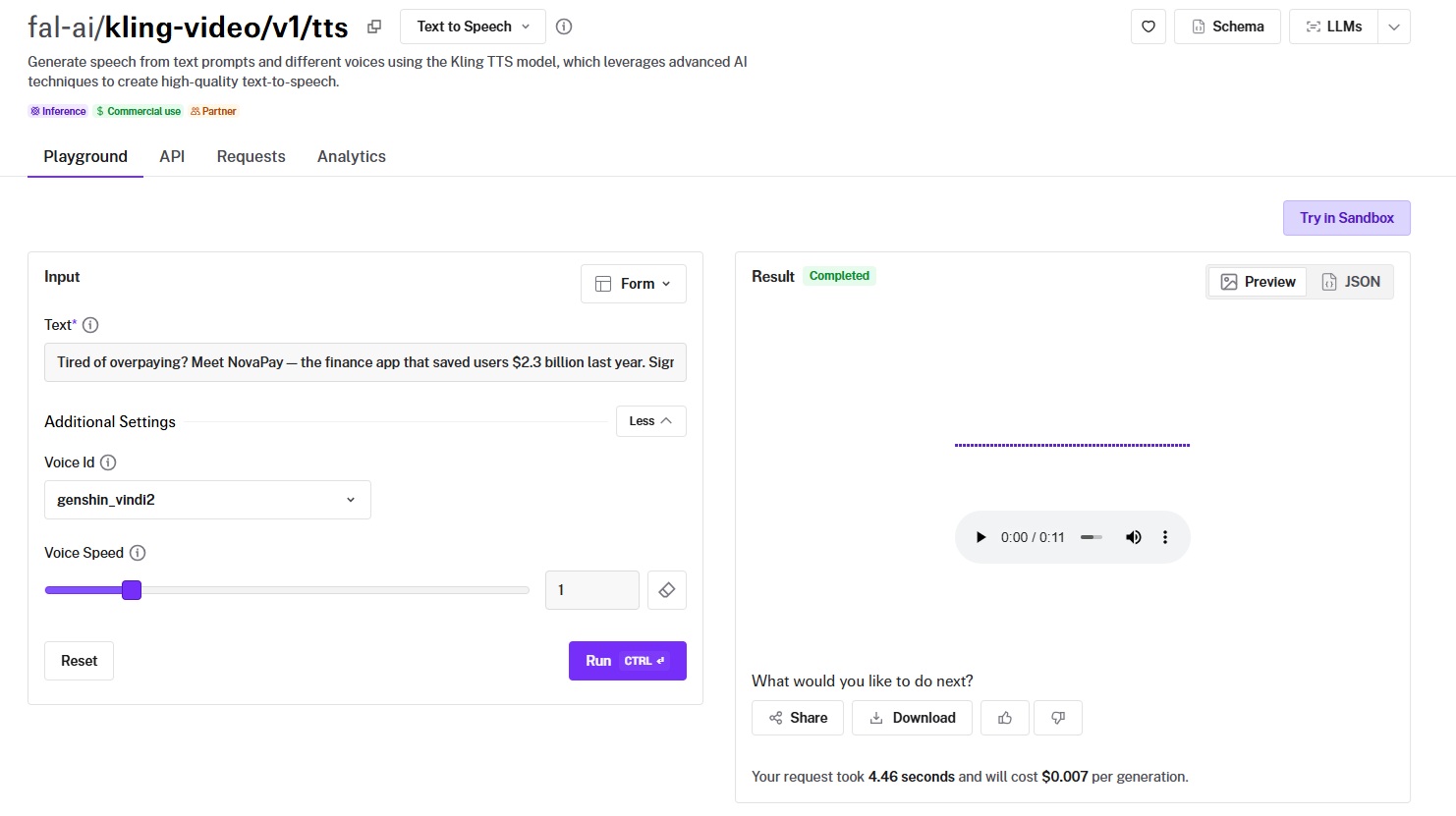
Kling TTS is the text-to-speech endpoint from Kuaishou's Kling video model lineup, built around a catalog of stylized character voices that fit anime, gaming, and animated content workflows.
Pricing is a flat $0.007 per generation, not per character, which makes cost prediction straightforward for short-clip use cases.
Performance
Generated using Kling TTS on fal, an AI model from Kuaishou.
Voice naturalness and expressiveness: The voice catalog leans into stylized delivery. Voices like genshin_vindi2, genshin_klee2, genshin_kirara, cartoon-boy-07, cartoon-girl-01, and PeppaPig_platform produce output tuned for animated content and game character work. For standard narration, the named voices like reader_en_m-v1 and calm_story1 deliver clean output.
Language and accent support: The catalog spans English, Mandarin, Cantonese, and a range of regional Chinese voices (dongbeilaotie_speech02, chongqingxiaohuo_speech02, chuanmeizi_speech02, chaoshandashu_speech02), plus UK and overseas English variants.
Speed (real-time vs. batch): The voice_speed parameter (default 1.0) lets you adjust playback rate, useful for matching audio to specific video timing.
Voice catalog and characters: 40+ named voices spanning anime archetypes, cartoon characters, regional Chinese dialects, and standard narration profiles. The catalog is the primary differentiator, giving you a wide range of pre-built character voices to choose from.
How to access Kling TTS on fal
Kling TTS is available through fal's API and playground.
You can pick a voice_id from the catalog of 40+ named voices, set voice_speed, and submit your text. The output is MP3 format.
Pricing
It costs $0.007 per generation to use Kling TTS on fal.
#10: Index TTS 2.0
Best for: Teams that want emotional reference audio control and per-second pricing for variable-length output.
Similar to: Maya1, Chatterbox.
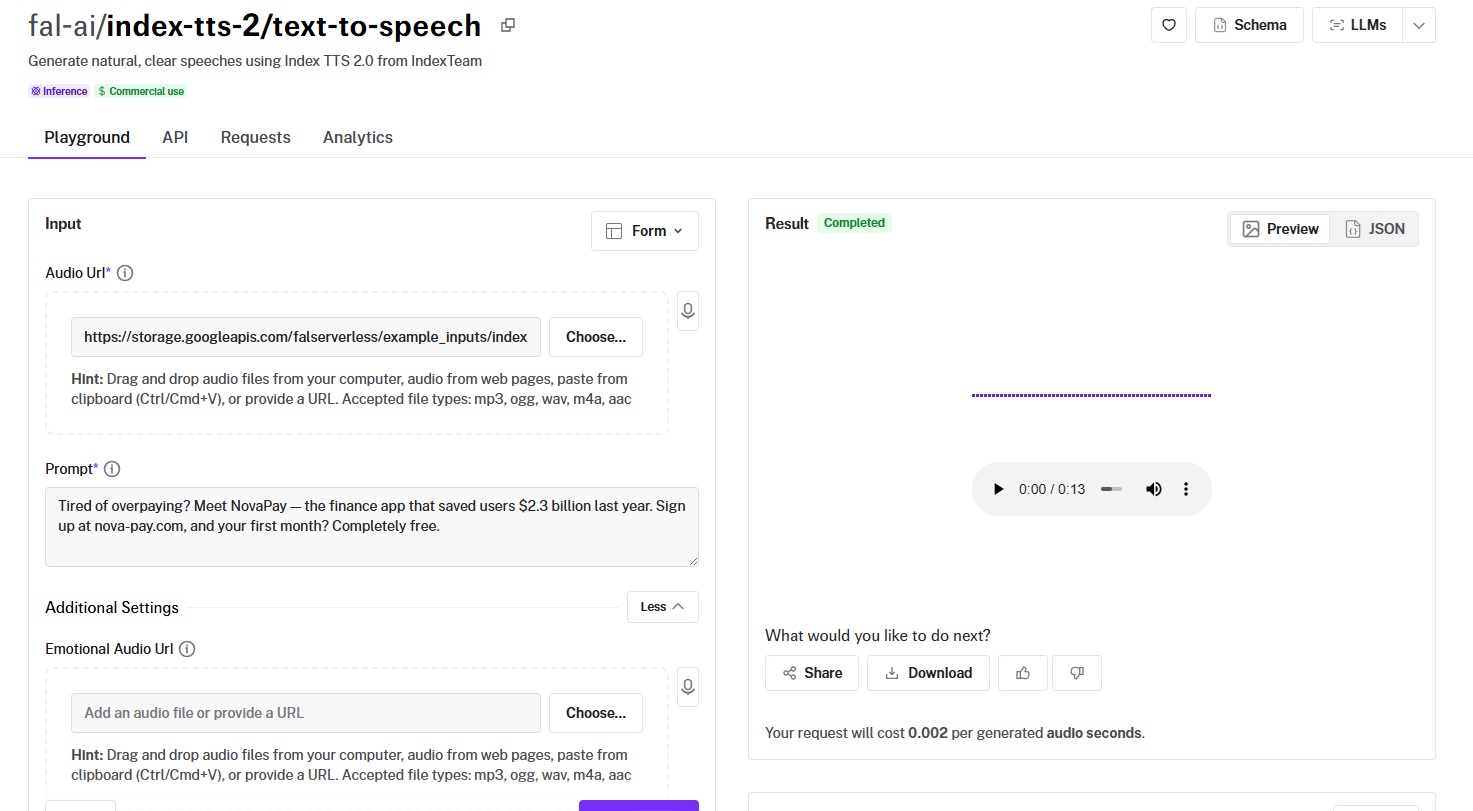
Index TTS 2.0 from IndexTeam combines voice generation with emotional reference audio: you provide a sample audio of the emotional style you want (or a text emotion prompt), and the model applies that emotional fingerprint to your generated speech.
Performance
Generated using Index TTS 2.0 on fal, an AI model from IndexTeam.
Voice naturalness and expressiveness: The emotional reference audio system sets this apart. You supply a sample audio file representing the emotional tone you want (panicked, sad, excited, calm), and the model applies that tonal style to your output. Alternatively, the emotion_prompt field accepts a natural language description of the emotion you want. Individual emotional strengths (happy, angry, sad, afraid, disgusted, melancholic, surprised, calm) can be tuned with floating-point values for fine control.
Language and accent support: Built for clear English output with strong intelligibility, useful for informational and educational content.
Voice cloning accuracy: The base voice for output is set by the audio_url parameter (your reference voice), with emotional_audio_url separately controlling the emotional style. This separation lets you maintain consistent speaker identity while varying emotional delivery across generations.
How to access Index TTS 2.0 on fal
Index TTS 2.0 is available on fal via API and playground.
Provide an audio_url (the voice you want), a prompt (the text to speak), and either an emotional_audio_url (reference audio of the emotion) or should_use_prompt_for_emotion: true with an emotion_prompt (natural language description).
The strength parameter controls how aggressively the emotional style transfers (1.0 default).
Pricing
Index TTS 2.0 pricing on fal is $0.002 per generated audio second.
Recently Added






























Generate voice at scale through a single API with fal
Choosing a text-to-speech model in 2026 has less to do with finding one that works and more to do with matching the model to the workflow you're building for.
Each one in this guide brings a specific strength: expressive control, multilingual coverage, streaming speed, voice design, character work, or per-second pricing.
You can run all 10 on fal through a single SDK, with pay-per-use billing and no GPU reservations to manage.
Open any model in the playground for a quick listen, or wire up the API, and you're generating speech the same afternoon.
![How To Use GPT-6 Astra for Video Editing [2026]](https://refinery.fal.media/url/https%3A%2F%2Fv3b.fal.media%2Ffiles%2Fb%2F0aaccd45%2FEjhkMmqNCeXgPjrrnRgU5.jpg/tr:w-1280,q-80/EjhkMmqNCeXgPjrrnRgU5.webp)

![10 Best Text-to-Video APIs in 2026 [Reviewed]](https://refinery.fal.media/url/https%3A%2F%2Fv3b.fal.media%2Ffiles%2Fb%2F0a9eafb8%2F3qcp8HOwM4xihN9STWNvq_best-text-to-video-apis-2026.jpg/tr:w-1280,q-80/3qcp8HOwM4xihN9STWNvq_best-text-to-video-apis-2026.webp)