
In this guide, I'll walk through the 5 fastest AI video generation models in 2026, covering what each speed tier trades away, what it holds onto, what a short clip actually costs, and which one suits an ecommerce or UGC workflow.
How this research was conducted: I ran the same vertical skincare UGC prompt through all five endpoints on fal and compared the outputs alongside what each endpoint charges. I've also added details on how long the videos took to generate.
What are the fastest AI video generation models in 2026?
The fastest AI video generation models in 2026 are H3 Max Turbo, H3 Max, and Kling V3 Turbo Pro.
Here's the shortlist, with the rate each one charges at its default resolution:
| AI video generator | Best for | Price on fal |
|---|---|---|
| H3 Max Turbo | The lowest per-second rate here, across 480p, 768p, and 1080p | $0.04 per second (768p) |
| H3 Max | The same H3 request schema and defaults, with a free Sandbox and an AsyncAPI spec | $0.08 per second (768p) |
| Kling V3 Turbo Pro | Cutting up to six shots inside one 1080p generation | $0.14 per second (1080p) |
| Seedance 2.0 Mini | Synchronized audio that adds nothing to the token count | Roughly $0.1547 per second (720p) |
| LTX-2.5 Fast | One endpoint spanning 720p to 4K with audio included at every step | $0.13 per second (1080p) |
TL;DR
H3 Max Turbo offers the fastest AI video generator, as fal post-trained it from MiniMax H3, tuning for stronger prompt adherence and better aesthetics. The throughput comes from co-tuning that post-train against our own inference stack, with no compromise on output quality.
Four of these are the explicit speed tier in their family: H3 Max Turbo, Kling V3 Turbo Pro, Seedance 2.0 Mini and LTX-2.5 Fast each have a slower sibling in the same line.
H3 Max Turbo charges the least at every resolution tier, $0.04 per second for 768p against H3 Max's $0.08 at the same size.
Kling V3 Turbo Pro cuts up to six shots into a single 1080p generation through one request field.
Seedance 2.0 Mini and LTX-2.5 Fast both return synchronized audio with the video, and neither charges extra for it.
One fal API key covers all five AI video generators, billed per use with no monthly plan, per second on four of them and per token on Seedance 2.0 Mini.
How can you access all five of these fast video models through one API?
fal hosts every endpoint in this guide, so one account and one API key cover all five without separate sign-ups at MiniMax, Kling, ByteDance, and Lightricks.
Billing lands per generation, so nothing keeps drawing money between projects.
That means you can run a draft pass on H3 Max Turbo at $0.04 per second and a delivery render on Kling V3 Turbo Pro at $0.14 differ by an endpoint string and a couple of request fields.
That lets developers and marketers route cheap iterations and finished takes through the same function.
In that same fal account, you'll be able to reach over 1,000 models spanning image generation, editing, audio, and 3D, so a video pipeline can pick up an upscaler or a voice model without onboarding a second vendor.
Here's a request against the fastest endpoint in the guide:
javascript
import { fal } from "@fal-ai/client";

const result = await fal.subscribe("minimax/h3-max-turbo/text-to-video", {
  input: {
    prompt: "A white kitten chases a butterfly across a sunlit garden. Gentle camera tracking, natural movement, soft afternoon light filtering through the leaves.",
    prompt_expansion_mode: "balanced"
  },
  logs: true,
  onQueueUpdate: (update) => {
    if (update.status === "IN_PROGRESS") {
      update.logs.map((log) => log.message).forEach(console.log);
    }
  },
});

console.log(result.data);
console.log(result.requestId);
Running that same brief on Seedance 2.0 Mini means pointing at bytedance/seedance-2.0/mini/text-to-video and dropping the two H3-specific fields, since that schema takes 720p in place of 768P and carries no prompt expansion setting.
There's a browser playground for each one, so you can see an output before writing any integration code.
The prompt I used across all five
The prompt is one product beat, a single continuous shot, no dialogue and no scene change, close to what most ecommerce UGC actually looks like.
Prompt: A woman holds a small white serum bottle up toward her phone camera and turns it slowly so the label faces the lens. Soft daylight from a window, a bare bedroom wall behind her. Vertical selfie framing, handheld, natural skin texture.
I ran it at 9:16 everywhere, at 5 seconds on four endpoints, and at 6 seconds on LTX-2.5 Fast, whose shortest explicit duration is 6.
Resolution stayed on each model's own default, because Kling V3 Turbo Pro has no resolution field to standardize against.
#1: H3 Max Turbo
Best for: High-volume text-to-video where you're burning through variants of one short clip and want the per-render cost as low as it goes.
Similar to: H3 Max, Seedance 2.0 Mini.
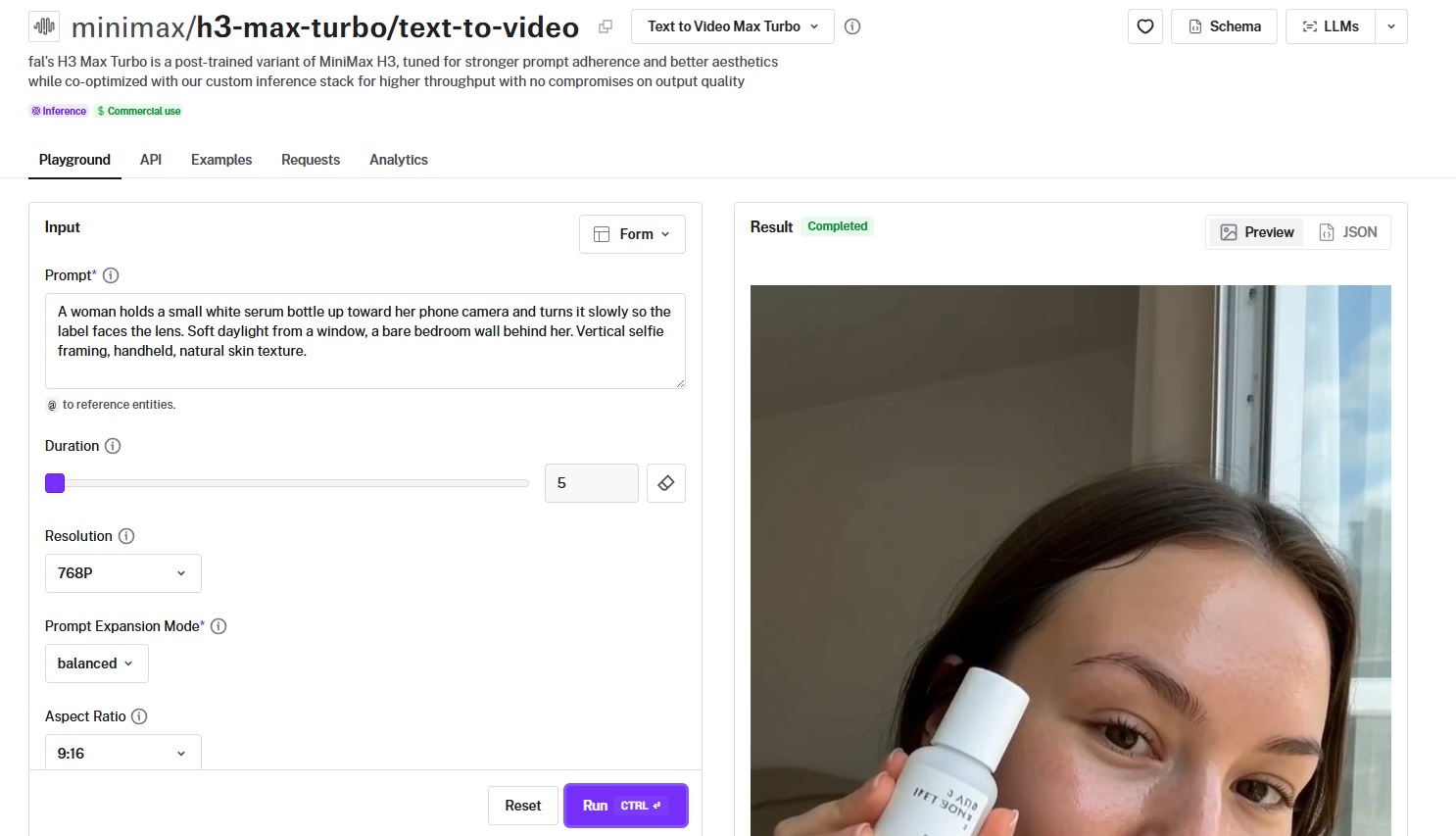
fal post-trained MiniMax H3 into H3 Max Turbo, tuning it for prompt adherence and aesthetics while co-tuning it against our own inference stack for throughput.
At every resolution tier, it charges less per second than anything else here, and its $0.025 floor at 480p is the lowest rate in the guide.
Performance
Generated using H3 Max Turbo on fal, an AI model from MiniMax.
-
Video generation time: 1.61 seconds.
-
Prompt expansion cost:
prompt_expansion_modedefaults to balanced, roughly a second of rewriting, while quality can spend up to around 30 seconds on a richer prompt before generation starts at all. -
Resolution ladder: 480P, 768P and 1080P, with the schema describing 1080P as a latent refinement over a native 768P source.
-
Framing: six aspect ratios reaching from 21:9 down to 9:16, so vertical UGC comes out of the model already framed.
-
Timing visibility: the output schema includes a
timingsobject whose inference field reports DiT denoising time on the GPU backend, and the same schema notes it returns null on routes that don't report backend timings. -
Audio: the input schema exposes no audio parameter on this route, so sound belongs to a separate step in the pipeline.
How to run H3 Max Turbo on fal
H3 Max Turbo is available at minimax/h3-max-turbo/text-to-video, with the browser playground and API docs as tabs on the same model page.
Duration defaults to 5 seconds and resolution to 768P, landing a prompt-only request close to standard social specs already.
Pricing
Resolution sets the rate.
$0.025 per second at 480p.
$0.04 at 768p.
$0.08 at 1080p.
At 5 seconds and 768p, the skincare brief costs $0.20. At 1080p, $0.40.
falMODEL APIs
The fastest, cheapest and most reliable way to run genAI models. 1 API, 100s of models
#2: H3 Max
Best for: Teams that want the H3 request schema with a free Sandbox and an AsyncAPI spec published alongside it.
Similar to: H3 Max Turbo, Kling V3 Turbo Pro.
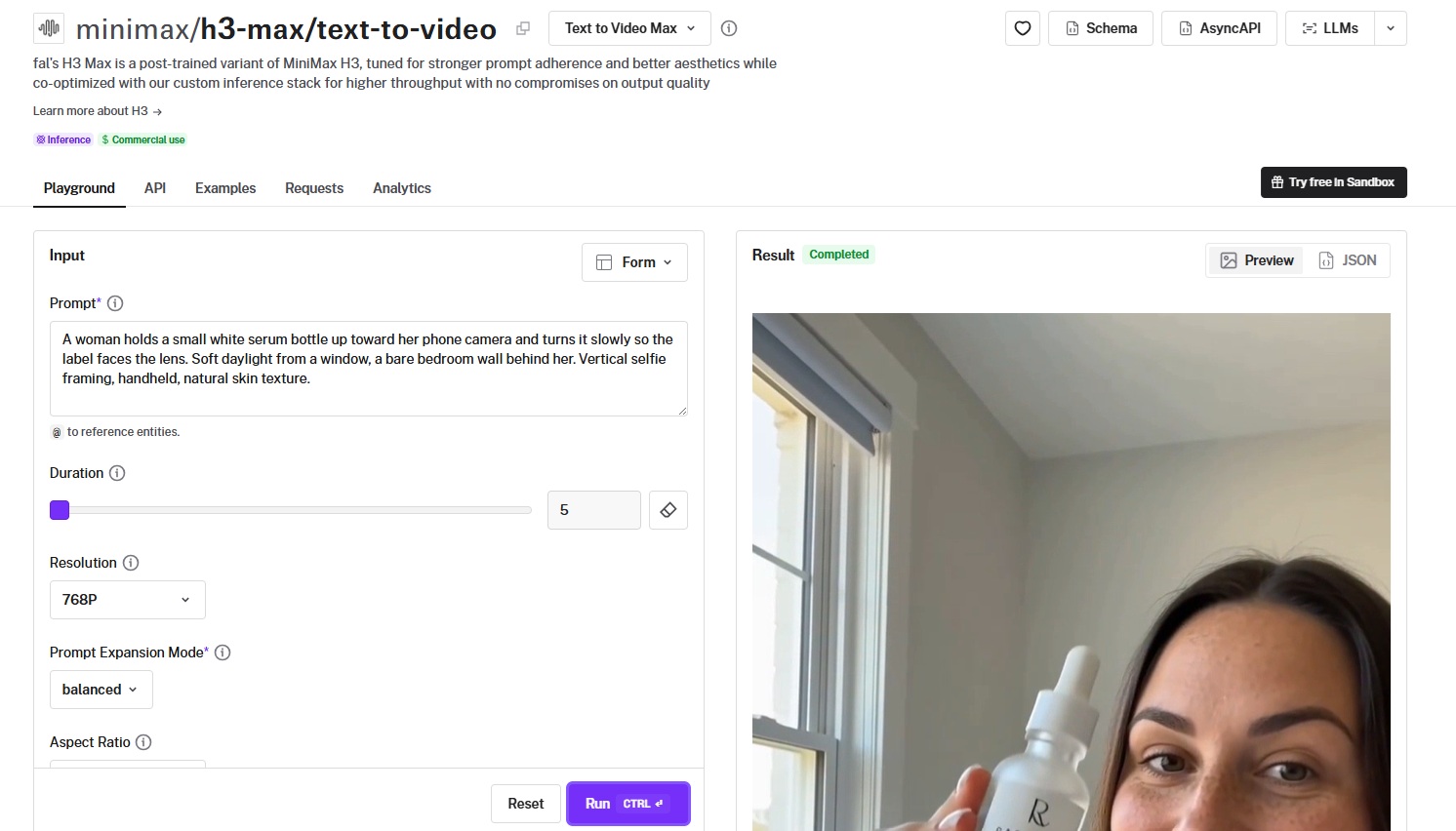
H3 Max takes exactly the same request body as H3 Max Turbo, field for field. The difference is price, plus some extra tooling around H3 Max.
Performance
Generated using H3 Max on fal, an AI model from MiniMax.
-
Video generation time: 2.82 seconds.
-
Identical controls: prompt, duration, resolution, seed, safety checker, sync mode, prompt expansion and aspect ratio, exactly as H3 Max Turbo exposes them.
-
Resolution behaviour: the same 480P, 768P and 1080P ladder, 1080P again documented as a latent refinement over a native 768P render.
-
Async spec: an AsyncAPI definition is published next to the standard API docs on this route.
How to run H3 Max on fal
H3 Max takes the same request body, at minimax/h3-max/text-to-video, so moving between the two tiers is an endpoint string change.
Defaults are unchanged at 5 seconds, 768P, balanced expansion and 16:9.
The expanded_prompt field in the response returns whatever the expander sent to the model, and it comes back null when expansion was disabled, left your prompt alone, or happened inside MiniMax's hosted API.
Pricing
H3 Max uses the same three resolution bands as H3 Max Turbo, one step up the price ladder.
$0.05 per second at 480p.
$0.08 at 768p.
$0.16 at 1080p.
That makes the 5-second 768p version of the skincare clip $0.40.
#3: Kling V3 Turbo Pro
Best for: 1080p clips needing several shots without a second generation or an edit pass.
Similar to: H3 Max, Seedance 2.0 Mini.
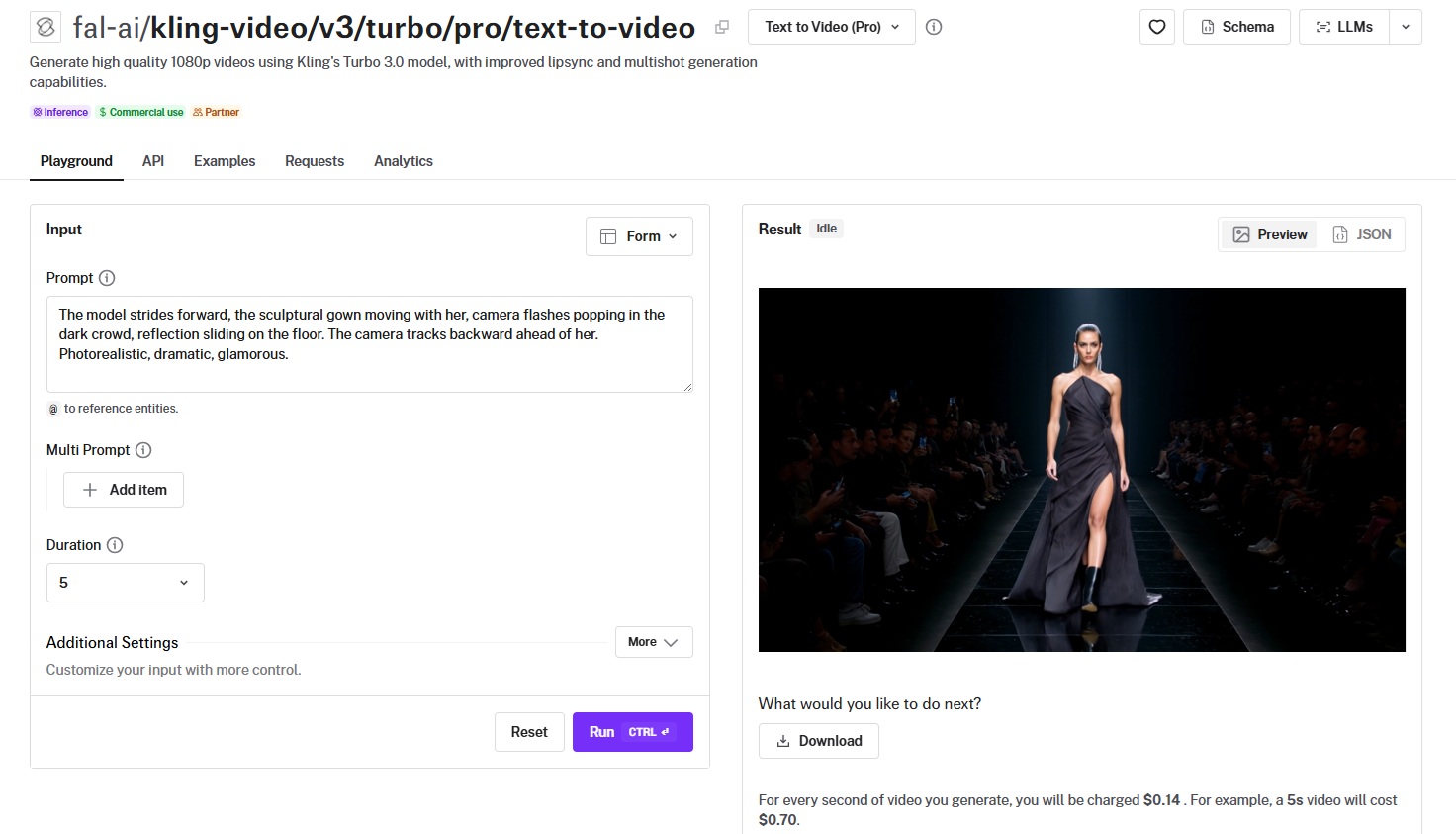
Kling V3 Turbo Pro runs on the Turbo 3.0 model from Kling, producing 1080p with improved lip-sync and multi-shot generation.
Performance
Generated using Kling V3 Turbo Pro on fal, an AI model from Kuaishou.
-
Video generation time: 60.72 seconds.
-
Multishot storyboard:
multi_promptaccepts 1 to 6 shots, each carrying its own prompt and duration, with the combined total capped at 15 seconds. -
Shot exclusivity:
promptandmulti_promptcan't both be set, so a request is either one continuous take or a storyboard. -
Duration range: any whole number of seconds from 3 to 15, defaulting to 5.
-
Resolution: the description names 1080p and the request carries no resolution field, so there's no lower tier to drop to and the rate holds at $0.14 either way.
-
Prompt length: the schema recommends staying under 2500 characters for best results.
How to run Kling V3 Turbo Pro on fal
You can call Kling V3 Turbo Pro at fal-ai/kling-video/v3/turbo/pro/text-to-video.
The endpoint carries fal's Partner tag and is cleared for commercial use.
For a single-take UGC clip like the skincare brief, pass prompt and leave multi_prompt unset.
For a two-beat version, the bottle in one shot and the application in the next, two multi_prompt entries handle the cut inside one generation.
Aspect ratio covers 16:9, 9:16 and 1:1, so vertical output needs 9:16 passed explicitly.
Pricing
One flat rate of $0.14 per second applies at every duration.
That means five seconds of video comes to $0.70 and a full 15-second storyboard runs $2.10.
#4: Seedance 2.0 Mini
Best for: Short product clips where the audio has to come out of the same generation as the picture.
Similar to: LTX-2.5 Fast, Kling V3 Turbo Pro.
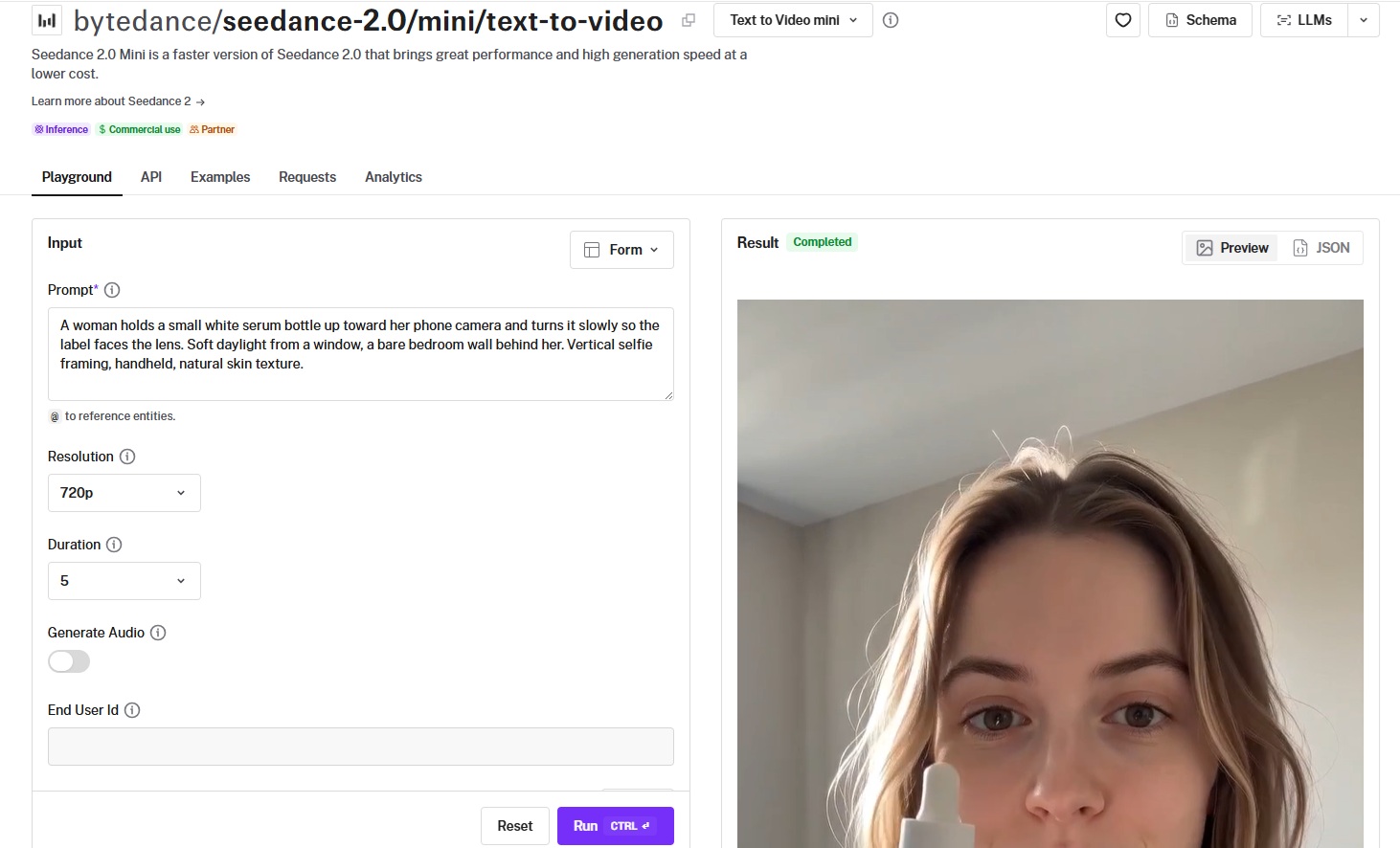
ByteDance ships Seedance 2.0 Mini as the faster, lower-cost route into Seedance 2.0.
Audio arrives with the video, covering sound effects, ambient sounds and lip-synced speech from the same request.
Performance
Generated using Seedance 2.0 Mini on fal, an AI model from ByteDance.
-
Video generation time: 117.32 seconds.
-
Audio costs nothing:
generate_audiodefaults to true, and the schema states generation costs the same whether or not audio is produced. -
Resolution choice: 480p or 720p, with the schema naming 480p the faster of the two and 720p the balanced default.
-
Duration: 4 to 15 seconds, or auto to hand length over to the model based on what the prompt describes.
-
Aspect ratios: seven fixed options from 21:9 through 9:16, plus auto.
-
End-user tagging: an
end_user_idfield records the unique ID of the end user behind a request.
How to run Seedance 2.0 Mini on fal
The Seedance 2.0 Mini endpoint is bytedance/seedance-2.0/mini/text-to-video.
Both duration and aspect_ratio default to auto, and both feed the token count, so pass explicit values whenever the bill needs to be predictable.
Resolution is the biggest lever on the per-second rate, and 480p roughly halves it, though the token formula reads height and width, so aspect ratio moves the number as well.
Pricing
Billing is token-based at $0.007 per 1000 tokens, applied at both 480p and 720p.
Token count comes from the output frame area multiplied by duration and by 24, then scaled down by 1024, so the per-second figure shifts with frame size.
In practice, that lands at roughly $0.0721 per second at 480p and roughly $0.1547 at 720p.
A 5-second 720p version of the skincare clip lands near $0.77, dropping to about $0.36 if you take it down to 480p.
#5: LTX-2.5 Fast
Best for: Iterating on previews with audio attached, on an endpoint that also reaches 1440p and 4K when a take is worth finishing.
Similar to: Seedance 2.0 Mini, H3 Max Turbo.
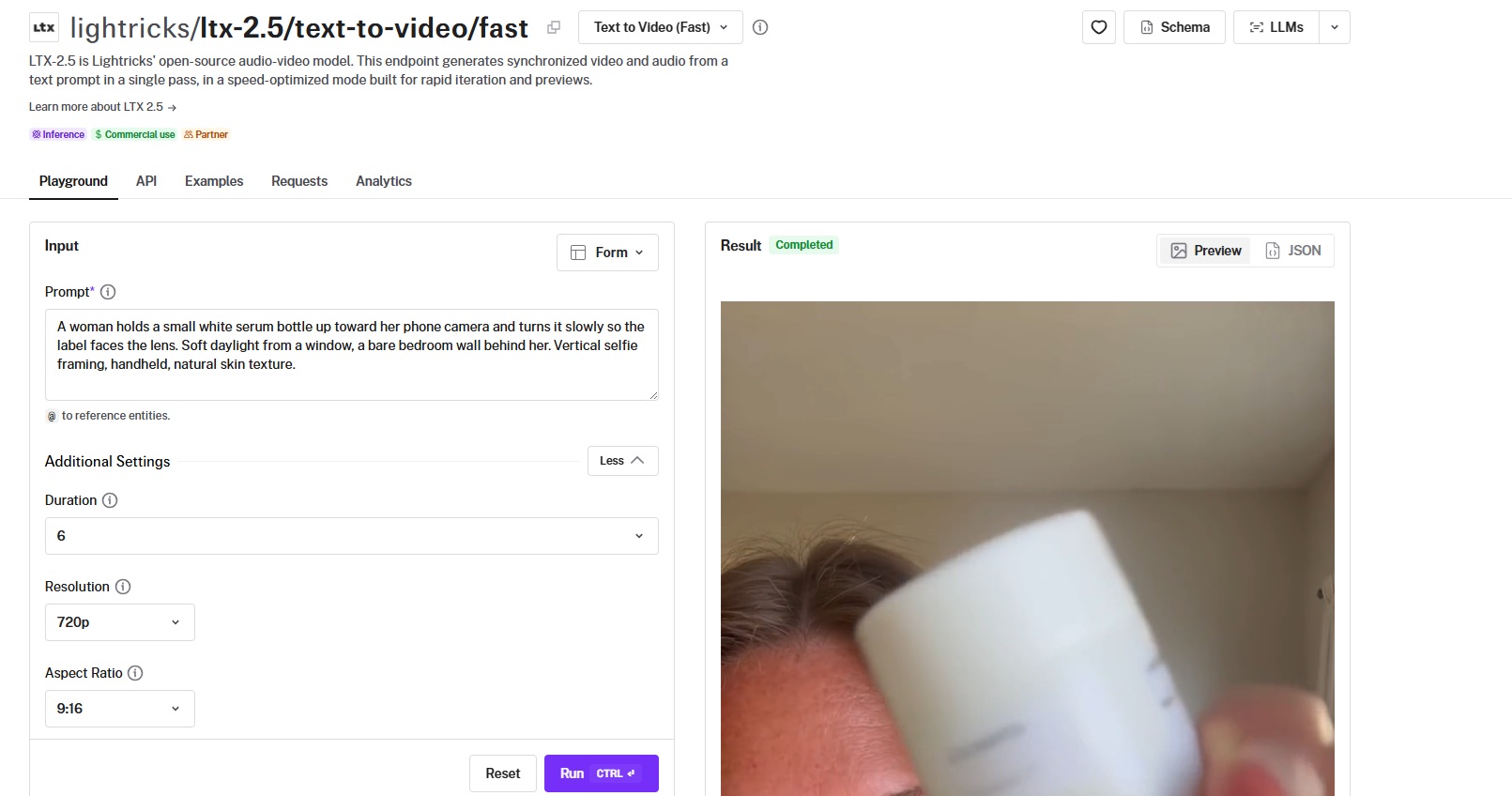
Fast is the speed-tuned route on LTX-2.5, the open-source audio and video model from Lightricks.
Picture and synchronized sound come out of one pass, in a mode built for rapid iteration and previews.
Performance
Generated using LTX-2.5 Fast on fal, an AI model from Lightricks.
-
Video generation time: 75.17 seconds.
-
Duration floor: 6 seconds is the shortest explicit setting, running up through 20 in even steps, and the reason the skincare test ran a second long here.
-
Resolution range: 720p, 1080p, 1440p and 2160p on one endpoint, with 1080p as the default.
-
Frame rate: 24, 25, 48 or 50 fps, where the schema caps the higher two at 10 seconds and lets 24 or 25 reach 20 seconds at 720p and 1080p.
-
Camera motion as a parameter: eight named moves,
dolly_in,dolly_out,dolly_left,dolly_right,jib_up,jib_down,staticandfocus_shift, all set on the request itself. -
Audio included:
generate_audiodefaults to true, and native audio is covered by the per-second rate at every resolution.
How to run LTX-2.5 Fast on fal
You'll find LTX-2.5 Fast at lightricks/ltx-2.5/text-to-video/fast.
The playground opens on 10 seconds, 1080p, 25 fps and 16:9, so a vertical 6-second clip means changing two of those, duration and aspect ratio, before your first run.
camera_motion is worth using on product work, since dolly_in arrives as a fixed enum value on the request.
The schema exposes the move as a parameter, so it never has to be inferred from your prompt text.
Pricing
Four resolution bands cover this endpoint: $0.09 per second at 720p, $0.13 at 1080p, $0.19 at 1440p and $0.30 at 4K.
A 6-second 1080p clip comes to $0.78, and the same clip at 720p to $0.54.
Recently Added























Put all five speed tiers behind one fal API key
Fast video models stopped being a lower-quality side category some time ago.
They're the tier most of the major labs now ship beside a flagship, and picking between them is mostly a question of what your per-render budget looks like at volume.
Testing that properly means running one brief through all of them, and separate sign-ups at four vendors are the usual obstacle.
On fal it costs one integration.
H3 Max Turbo, H3 Max, Kling V3 Turbo Pro, Seedance 2.0 Mini and LTX-2.5 Fast all answer to the same client library and the same pay-per-use billing.
Create your free account and start generating on fal.
Frequently asked questions
What is the fastest AI video generation model in 2026?
H3 Max Turbo takes the top slot in this guide, as our post-trained MiniMax H3 variant tuned for throughput against our own inference stack.
It also charges the least per second here at $0.04 for 768p, cheap enough to run dozens of variants of one clip.
The schema puts balanced prompt expansion at roughly a second of rewriting, against up to around 30 seconds for quality.
That 30-second ceiling is the largest time figure the schema attaches to any setting on either H3 route.
Do faster video models always cost less to run?
Inside a single family, yes.
H3 Max Turbo runs at half H3 Max's rate at every resolution.
Across families, it stops holding.
Kling V3 Turbo Pro is the turbo tier of its own line and still charges $0.14 per second at 1080p, against $0.08 for H3 Max Turbo at the same size.
Resolution and the billing model both move the number independently of the tier name on the endpoint.
What's the advantage of running all five on fal?
fal puts the MiniMax, Kling, ByteDance and Lightricks endpoints behind a single API key and one billing account (no need to manage different subscriptions or worry about seats and minimum usage).
Moving a project between them is a string change.
Comparing two speed tiers head-to-head costs you the generations and nothing beyond that.
All five open in a browser playground too, so a first comparison costs nothing beyond the generations.
![How To Use Wan 3: Prompts & Workflows [2026]](https://refinery.fal.media/url/https%3A%2F%2Fv3b.fal.media%2Ffiles%2Fb%2F0aa7ccdb%2FstMjxr_awCqm3GXMRo_pX.jpg/tr:w-1280,q-80/stMjxr_awCqm3GXMRo_pX.webp)