Below are eight shots I put through Seedance 2.5 and LTX-2.5 Pro on fal, six from text and three from a still, alongside the spec sheet and the per-second math behind choosing one over the other.
TL;DR
Seedance 2.5 holds a single take for 30 seconds and reaches 1080p, billing by token at $0.0214 per 1,000 up to 720p and roughly $0.0234 at 1080p.
LTX-2.5 Pro caps a generation at 10 seconds on the Pro endpoints and prices flat by the second, $0.12 at 720p and $0.17 at 1080p, with frame rate selectable at 24, 25 or 50.
Aspect ratio divides them, with six options on Seedance 2.5 against 16:9 and 9:16 on LTX-2.5 Pro, which also has no reference-input endpoint.
Both models reach 1080p, so I would reach for LTX-2.5 Pro on cost and iteration volume, and for Seedance 2.5 on a shot that has to run past 10 seconds without a join.
How research was conducted: every clip ran at 1080p and 10 seconds on both models, which is each one's ceiling and also puts them at matching resolution, with prompt text copied character for character between them.
How does Seedance 2.5 compare to LTX-2.5 Pro?
ByteDance built Seedance 2.5, and Lightricks built LTX-2.5, and fal hosts both as partner models cleared for commercial use under fal's terms.
The weights are the first real split: Seedance 2.5 is closed, and Lightricks publishes LTX-2.5 openly.
The table covers the rest:
| Seedance 2.5 | LTX-2.5 Pro | |
|---|---|---|
| Developer | ByteDance | Lightricks |
| Weights | Closed | Open, published by Lightricks |
| Best for | Single takes past 10 seconds, and aspect ratios beyond 16:9 and 9:16 | Cost per second, and frame rate control at 24, 25 or 50 fps |
| Resolutions | 480p, 720p, 1080p | 720p, 1080p |
| Duration | 4 to 30 seconds, or auto | 6, 8 or 10 seconds, or auto |
| Aspect ratios | 21:9, 16:9, 4:3, 1:1, 3:4, 9:16, or auto | 16:9 and 9:16, plus auto on image to video |
| Frame rate | 24 fps, fixed | 24, 25 or 50 fps |
| Billing unit | Tokens, $0.0214 per 1,000 at 480p and 720p, roughly $0.0234 at 1080p | Seconds of output |
| Price, 720p | ~$0.4730 per second | $0.12 per second |
| Price, 1080p | Roughly $0.0234 per 1,000 tokens, no per-second figure published | $0.17 per second |
| Price, 480p | ~$0.2205 per second | Not offered |
| Endpoints | Text, image and reference to video | Text, image and audio to video |
| Native audio | ✅ Co-processed in the same latent space as the picture | ✅ Generated with the picture in a single pass |
| Spoken dialogue | ✅ Lines in double quotes are voiced and lip-synced | Documented on the audio-to-video endpoint, where the picture is timed to a supplied track |
| End frame control | ✅ Yes, on image to video | ✅ Yes, on image to video |
| Camera motion parameter | ❌ Not exposed, direct it in the prompt | ✅ Yes, 8 presets |
| Reference inputs | ✅ Up to 50 across images, video and audio | ❌ Not offered on these endpoints |
| Audio to video | ❌ Not offered | ✅ Yes, billed per second of input audio, clips of 2 to 20 seconds |
| Fast variants | ❌ Not offered | ✅ Yes, ideal for testing at a lower price point |
| Commercial use | ✅ Yes | ✅ Yes |
Where can you access Seedance 2.5 and LTX-2.5 Pro?
You reach both Seedance 2.5 and LTX-2.5 Pro from the fal playground or the API, one key, nothing to provision and no minimum spend.
The client library treats them identically, so queueing, webhooks, uploads and error handling do not change when you swap the model string.
Here's what calling LTX-2.5 Pro looks like:
javascript
import { fal } from "@fal-ai/client";

const result = await fal.subscribe("lightricks/ltx-2.5/text-to-video/pro", {
  input: {
    prompt:
      "Through-the-veil shot of a bride's face during an Indian wedding ceremony, camera positioned behind the sheer red dupatta fabric, the embroidered pattern creating a textured overlay on her face, her eyes lined with kohl looking down at henna-covered hands, marigold garlands in soft background bokeh, 85mm f/1.2 focused through the fabric layer, warm tungsten and candlelight, Mira Nair Monsoon Wedding intimacy",
  },
  logs: true,
  onQueueUpdate: (update) => {
    if (update.status === "IN_PROGRESS") {
      update.logs.map((log) => log.message).forEach(console.log);
    }
  },
});

console.log(result.data);
console.log(result.requestId);
Seedance 2.5 vs. LTX-2.5 Pro: text-to-video tests
I'll go over six shots of Seedance 2.5 and LTX-2.5 Pro to show you how both video generators look side by side:
Test 1: A dolly past a bar window in the rain (16:9)
Glass doing two jobs at once is the hardest thing in this set.
The interior has to read through the window while the street reads off it, and the two have to travel at different rates as the camera moves.
A model that misses the parallax slides the reflection across the room like a decal.
Prompt: Ten seconds, 16:9, one unbroken lateral dolly, ordinary speed with nothing ramped. Late night on a city street in heavy rain, a bar with a large plate glass window across most of its frontage. Starting state: the camera is outside on the sidewalk, level, about two meters back from the glass, looking straight in. Inside, a man in a soaked overcoat sits alone at the far end of the bar with an untouched drink in front of him. Warm tungsten light inside. On the glass there is a blue neon sign from across the street, wet asphalt below it, and headlights passing. 0 to 4 seconds: the camera dollies left to right at a steady walking pace. The interior slides past at one rate and the reflected street slides past at another, both continuously. Rain runs down the outside of the glass throughout. 4 to 7 seconds: a car passes behind the camera. Its headlights travel across the reflection from right to left, crossing over the man's face on the far side of the glass, then leave. He does not react. 7 to 10 seconds: the dolly slows and stops with the man centered. He lifts the drink, does not drink from it, and sets it back down on the same ring of condensation. Camera: one continuous lateral move, left to right, level the whole way, decelerating only in the final block. No pan and no tilt. Glass rule: the window transmits and reflects at the same time for all ten seconds. Interior detail stays visible through it while the neon, the wet street and the passing headlights stay visible on it, each tracking its own source. Hold across the take: the man, the overcoat, the drink and its condensation ring, the bar interior, the neon color and the rain. Sound: rain on pavement and on glass, muffled interior room tone coming through the window, one car passing behind camera with tire noise on wet asphalt, a siren a long way off. Nothing musical. Last frame: dolly stopped, man centered behind the glass, drink back on its ring. Do not: cut, ramp the speed, lose either the reflection or the interior, move the reflection at the same rate as the room, add a second person inside, or put legible lettering on the neon.
Generated using Seedance 2.5 on fal, an AI model from ByteDance.
Generated using LTX-2.5 Pro on fal, an AI model from Lightricks.
Test 2: A ballast dump in a falling airship (9:16)
Two mouths in one frame is the standard lip-sync failure.
Asking for it while both characters are physically straining is harder again, because a model has to drive a jaw and a working body at the same time and keep them separate per character.
This is also the one I would put on a reel:
Prompt: Ten seconds, vertical 9:16, stylized 3D animation at feature quality, one continuous shot, ordinary speed. Setting: the rigging shaft running up the inside of a stricken airship at night. Riveted brass ribs, a ladder up one side, gas hoses crossing the space, a tear in the hull at the top of frame with cloud streaming through it. Emergency lamps throwing red. Cast: a stocky badger engineer in oiled canvas overalls, heavy fur, a wrench on a lanyard at his hip. A lean crane bird navigator in a cracked leather flight cap, long legs braced across two ribs. 0 to 3 seconds: the shaft lurches and drops. The badger comes off the ladder, catches a gas hose one-handed and swings out across the shaft. The camera tracks up with him from below. He shouts across: "The forward cell is gone, pull the ballast." 3 to 6 seconds: the bird throws his weight onto a brass release lever with both feet. The lever gives in two stages, the second further than the first. A column of ballast water dumps down past camera and out of frame. His beak stays shut through the whole effort. 6 to 8 seconds: the water clears. The badger lands back on the ladder, hooks an elbow through a rung, and the shaft steadies under them. The bird answers, flat: "That was the last of it." 8 to 10 seconds: both look up at the tear in the hull. Neither speaks. The camera keeps climbing past them toward the cloud coming through, and holds. Mouth rule: one mouth at a time. The badger's jaw moves only on his line and the bird's beak only on his, each holding still while the other talks. Through the final block neither mouth moves. Camera: one continuous climb up the shaft from low to high, accelerating slightly on the water dump and settling at the end. No cuts. Hold across the take: both characters, the overalls, the flight cap, the wrench on its lanyard, the rib spacing and the positions of the red lamps. Sound: two clearly separate voices, the badger low and strained under effort, the bird dry and thin. Structural groaning underneath the whole take, the hose creaking under load, the lever ratcheting in two stages, ballast water roaring past camera and falling away, wind through the tear. Nothing musical. Look: feature-quality stylized 3D, fur and feather detail holding through the motion, soft red emergency light against cold blue coming through the hull tear, real weight in the canvas overalls, water carrying volume. Do not: cut, ramp the speed, add dialogue beyond the two lines above, move both mouths together, or drop the wrench.
Generated using Seedance 2.5 on fal, an AI model from ByteDance.
Generated using LTX-2.5 Pro on fal, an AI model from Lightricks.
Test 3: A superbike through a mountain hairpin (16:9)
In this example, the bike has to hold its shape and its finish through the lean while the sunrise moves across it, and the audio is carrying an electric drivetrain and not a combustion engine.
Prompt: Ten seconds, 16:9, one continuous tracking shot, ordinary speed. Sunrise on a mountain pass, a narrow strip of asphalt cut into rock, valley cloud below the level of the road. Starting state: an unbranded matte black electric superbike with copper wheel accents runs up the straight toward a right-hand hairpin. Rider in black leathers and a mirrored visor. No badges, no numbers and no lettering anywhere on the bike or the leathers. 0 to 4 seconds: the camera tracks alongside at wheel height. Low sun rakes across the tank and the swingarm and the copper picks it up. The rider moves out wide to set up the corner. 4 to 7 seconds: the bike goes over onto its side through the hairpin, knee out, the front tire visibly loading. The camera arcs with it and rises to tank height, keeping the whole bike in frame. 7 to 10 seconds: it stands up out of the corner and accelerates away. The camera falls behind into a low three-quarter view as the valley and the cloud open up beyond the guardrail. Hold across the take: the same bike, the matte black finish, the copper accents, the leathers and the sunrise angle. Sound: an electric drivetrain climbing and dropping with the throttle, tires loading through the corner, wind across the camera, birds down in the valley underneath. Nothing musical. Look: sunrise commercial photography, long shadows, clean speculars on matte paint, a little haze in the valley. Do not: cut, ramp the speed, add traffic, or put lettering anywhere on the bike.
Generated using Seedance 2.5 on fal, an AI model from ByteDance.
Generated using LTX-2.5 Pro on fal, an AI model from Lightricks.
Test 4: Three shots on a granite big wall (16:9)
Three cuts in ten seconds, with the middle one carrying a movement across the join.
The wide shots also give both models somewhere to put scale, which is most of what makes a climbing shot land.
Prompt: Ten seconds, 16:9, three shots, hard cuts and no dissolves, ordinary speed. Sunrise on a granite big wall above a deep valley, a thousand meters of air below the climber. Shot 1, 0 to 4 seconds: wide from a drone position out in space, the whole face in frame with the climber small against it, chalk bag at her waist, rope running down out of shot. The valley floor is still in shadow while the top of the wall is lit. Shot 2, 4 to 7 seconds: cut on the movement to a tight shot of both hands in a granite crack as she jams and pulls through. Chalk dust, granite grain, the tendons working in her forearms. Shot 3, 7 to 10 seconds: cut to a high angle looking straight down past her helmet to the valley far below. She clips a piece of protection and looks up toward the next section. Hold across all three shots: the same climber, her clothing, the chalk, the rock texture and the sunrise light. Sound: wind moving across the face, rubber and chalk on granite, breathing, a carabiner clicking shut, a bird somewhere below. Nothing musical. Do not: dissolve, ramp the speed, or add a second climber.
Generated using Seedance 2.5 on fal, an AI model from ByteDance.
Generated using LTX-2.5 Pro on fal, an AI model from Lightricks.
Test 5: A hoverboard run down a neon canyon (9:16)
Vertical anime with the throttle open.
The thing to watch here is whether the signage actually lights her as she goes past it, since moving colored light on a moving subject is what sells this kind of shot.
Prompt: Ten seconds, vertical 9:16, stylized 2D anime action at feature quality, one continuous shot, ordinary speed. Night in a dense future city, a narrow canyon between towers, wet air, signage stacked from street level up into the cloud. Starting state: a courier in her late teens rides a hoverboard fast down the canyon, jacket cracking in the wind, a sealed package strapped across her back. Traffic drifts in lanes above and below her. 0 to 3 seconds: low angle from behind and beneath as she accelerates. Magenta and cyan signage passes on both sides and throws moving color across her jacket and the underside of the board. 3 to 6.5 seconds: she drops into the gap between two lanes of traffic, banks hard left around a tower corner and cuts inside a slow transport. Speed lines rake the frame. Rain beads off the board's leading edge. 6.5 to 10 seconds: the canyon opens onto a wide plaza and she comes out into the open, standing up off the board's rear edge with the whole lit city behind her. The camera pulls back and lets her get small in frame. Hold across the take: her jacket, the package on her back, the board and the colors of the signage. Sound: wind, the board's drive whining and changing pitch through each bank, traffic passing close, rain, one distant announcement echoing off the towers. Nothing musical. Look: cel-shaded anime over painted backgrounds, strong colored rim light off the signage, saturated night palette, visible line weight on the character. Do not: cut, ramp the speed, add a second courier, or lose the package from her back.
Generated using Seedance 2.5 on fal, an AI model from ByteDance.
Generated using LTX-2.5 Pro on fal, an AI model from Lightricks.
Test 6: Notes and dust in a rally car (16:9)
If I were picking one clip to demonstrate native audio, it would be this one.
A co-driver reads over an engine, a driver answers through a helmet mic, and neither of them should be talking at the same time.
Prompt: Ten seconds, 16:9, one continuous shot from inside a rally car, ordinary speed. Daytime, a fast gravel stage through pine forest, dust hanging in the light between the trees. Starting state: the camera is mounted on the roll cage behind the seats, framing both crew from behind and slightly right with the windscreen and the road visible between them. Driver in a white helmet on the left. Co-driver in a red helmet on the right with a route book open on her knee. Both harnessed in. No sponsor lettering anywhere in the car. 0 to 3.5 seconds: the car is loose over gravel, the wheel moving constantly in the driver's hands, the whole cabin shaking. The co-driver reads from the book without looking up: "Six left, tightens, do not cut." 3.5 to 6.5 seconds: the car crests a rise and lands, both crew compressing down into the seats. Gravel hammers the floorpan. The driver answers short, through the mic: "Got it." 6.5 to 10 seconds: neither speaks. The car turns into a fast left, the rear steps out, and gravel sprays past the side window into the sun. The co-driver turns a page. Dust fills the frame behind them. Mouth rule: one voice at a time. The co-driver speaks only on her line and the driver only on his, and neither talks through the final block. Hold across the take: both helmets and their colors, the harnesses, the route book, the cabin interior and the light coming through the trees. Sound: engine under load, gravel on the floorpan, suspension crashing on the landing, wind noise, and two voices over an intercom with the compression that gives them. Nothing musical. Look: real in-car footage, hard shake, wide dynamic range between the dark cabin and the bright stage, dust catching the sun. Do not: cut, ramp the speed, add a third person in the car, put sponsor lettering anywhere, or have both crew talk together.
Generated using Seedance 2.5 on fal, an AI model from ByteDance.
Generated using LTX-2.5 Pro on fal, an AI model from Lightricks.
falMODEL APIs
The fastest, cheapest and most reliable way to run genAI models. 1 API, 100s of models
Seedance 2.5 vs. LTX-2.5 Pro: image-to-video tests
Here, I'll go over two shots from a still, same image and same prompt text going to both endpoints.
Seedance 2.5 takes its aspect ratio from the input image on this endpoint, and LTX-2.5 Pro does the same when aspect ratio is left on auto, so the source still decides the frame either way.
Test 7: Out of the blocks (16:9)
One still, then an explosion out of it.
The first three strides are the whole shot, and what to watch is whether the drive phase reads as force going into the track.
Seedream 5.0 Pro prompt for the start frame: A 16:9 photoreal still, female sprinter set in the starting blocks on a blue running track at night under stadium lights, seen from a low angle just ahead of her and to the side. Unbranded black and orange kit with no numbers and no lettering. Both hands on the line, head down, back flat, muscles loaded. Deep stadium darkness behind her with the lit crowd falling out of focus. No text, no branding.
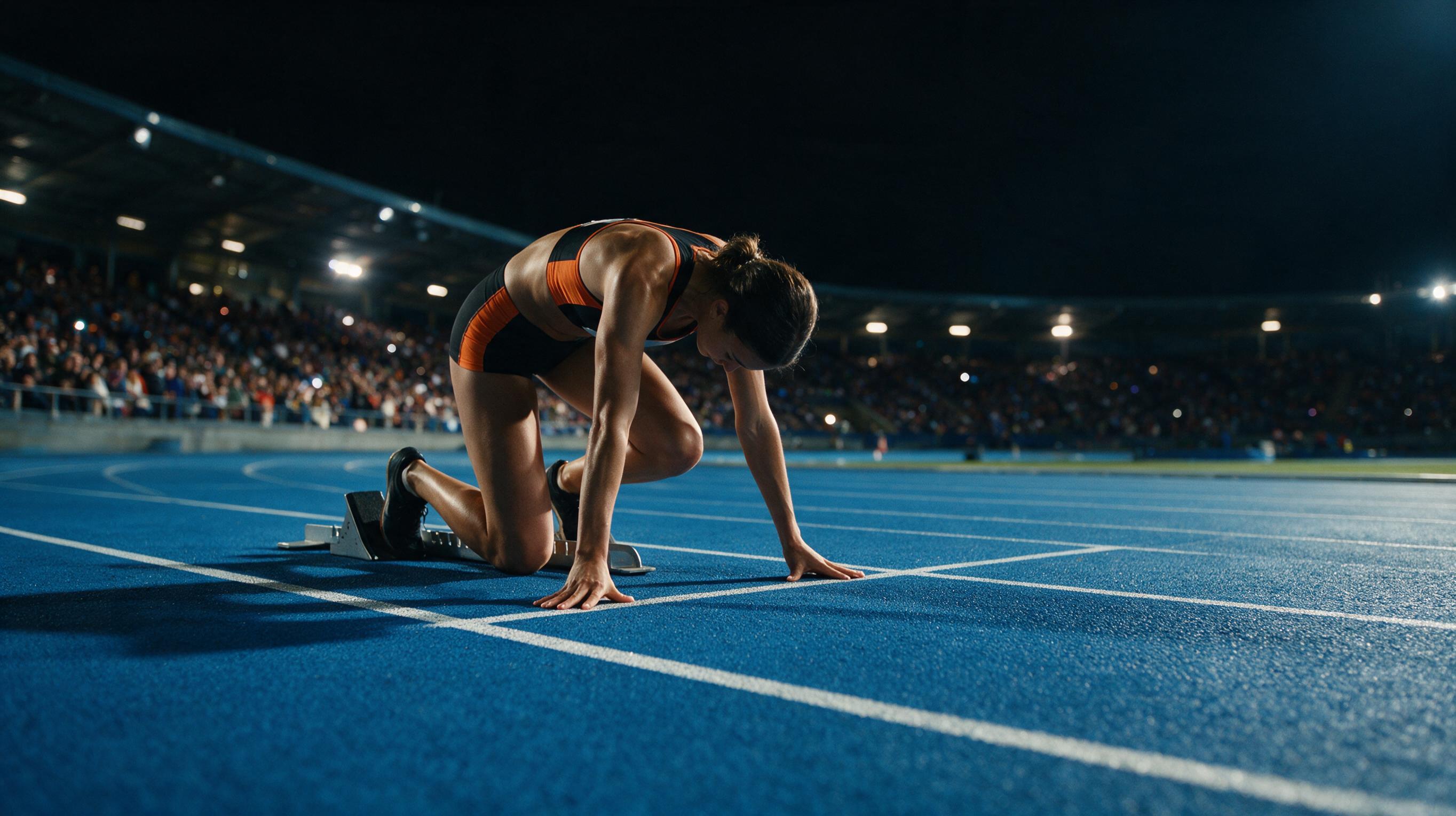
Generated using Seedream 5.0 Pro on fal, an AI model from ByteDance.
Video prompt: Ten seconds, ordinary speed, one continuous shot. 0 to 2 seconds: she holds the set position. The crowd noise drops away. Nothing moves except her breathing. 2 to 5 seconds: the gun. She drives out of the blocks, hands leaving the line, first foot striking behind her, the blocks kicking back slightly. Three long strides with the body still low and the shins driving forward. 5 to 8 seconds: she comes up out of the drive phase into full stride. The camera tracks alongside and slightly ahead, rising to hip height, the track and the lit stadium sliding past behind her. 8 to 10 seconds: the camera settles and holds her at full speed with the stadium lights flaring past. Hold across the take: the same athlete, the kit and its colors, the lane markings and the stadium lighting. Sound: the crowd going quiet, the starter's gun with a stadium echo behind it, spikes striking the track, breathing, the crowd coming back up underneath. Nothing musical. Do not: ramp the speed, add other runners, put numbers or lettering on the kit, or start her before the gun.
Generated using Seedance 2.5 on fal, an AI model from ByteDance.
Generated using LTX-2.5 Pro on fal, an AI model from Lightricks.
Test 8: A dragon leaves the cliff (9:16)
This is the shot both models should want on their own landing page.
Watch the first wingbeat.
The downstroke has to move enough air to explain why the body rises.
Seedream 5.0 Pro prompt for the source image: A 9:16 vertical still rendered in feature animation style: a large slate-grey dragon perched on a granite sea cliff at sunset, wings folded, head turned out toward the ocean. Textured hide carrying dust and old scars, amber eye catching the low sun, spray coming off the rocks far below. Painted cloud and a wide sky above the cliff line. No text, no branding, no people.
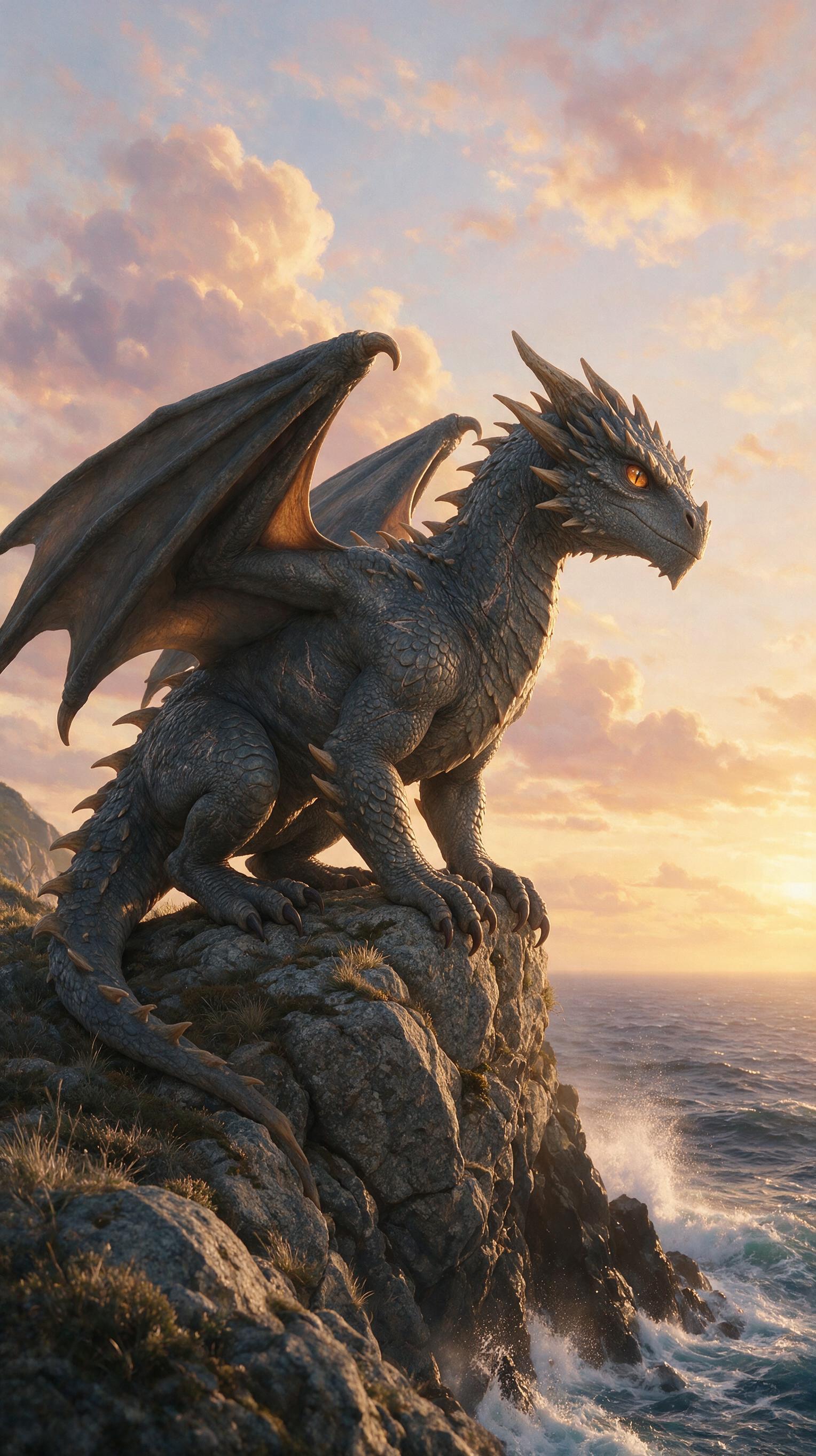
Generated using Seedream 5.0 Pro on fal, an AI model from ByteDance.
Video prompt: Ten seconds, ordinary speed, one continuous shot. 0 to 3 seconds: the dragon shifts its weight on the rock and spreads both wings wide. The membranes stretch and catch the low sun from behind. 3 to 6 seconds: it pushes off the cliff with both hind legs and takes one heavy downstroke. Loose grit lifts off the rock and blows back. The body rises with the beat and drops a little between beats. 6 to 10 seconds: it banks away from the cliff out over the water, climbing on two more wingbeats. The camera tilts up to follow and it gets small against the cloud. Hold across the take: the same hide texture and color, the scars, the amber eye, the cliff geometry and the sunset light. Sound: wind across the cliff, the heavy snap of each wingbeat, grit blowing off rock, sea working below, one low call as it turns away. Nothing musical. Do not: ramp the speed, add a second dragon, add a rider, or let the wings pass through the cliff.
Generated using Seedance 2.5 on fal, an AI model from ByteDance.
Generated using LTX-2.5 Pro on fal, an AI model from Lightricks.
How do Seedance 2.5 and LTX-2.5 Pro compare on pricing?
Seedance 2.5 and LTX-2.5 Pro bill on different units, so a comparison needs a fixed shot before it means anything.
Seedance 2.5 counts tokens:
tokens = (output height x output width x duration x 24) / 1024
The rate is $0.0214 per 1,000 tokens at 480p and 720p, and ~$0.0234 at 1080p.
For 16:9 output that comes to ~$0.21 a second at 480p, ~$0.46 at 720p and ~$1.14 at 1080p.
Frame area drives the token count, and the spread between crops is narrow: at 720p all six aspect ratios land within one percent of the 16:9 figure, and at 480p the square crop is the cheapest by about 4%.
LTX-2.5 Pro bills per second of output with no formula involved, at $0.12 for 720p and $0.17 for 1080p.
Audio is included in the price on both, and switching it off saves nothing either way.
| Shot | Seedance 2.5 | LTX-2.5 Pro |
|---|---|---|
| 6 seconds, 1080p | ~$6.82 | $1.02 |
| 10 seconds, 480p | ~$2.15 | Not offered |
| 10 seconds, 720p | ~$4.62 | $1.20 |
| 10 seconds, 1080p | ~$11.37 | $1.70 |
| 30 seconds, 720p | ~$13.87 in one pass | $3.60 across three generations |
| 30 seconds, 1080p | ~$34.12 in one pass | $5.10 across three generations |
Those 30-second rows read differently depending on the job.
Three separate beats are three separate shots, and three LTX-2.5 Pro generations reach that runtime for less.
One continuous take is a different piece of work, since three generations then need matching light, matching wardrobe, matching camera height and matching performance, and two joins have to disappear, against a single pass that arrives finished.
The 480p tier is worth knowing about for the same reason.
At ~$0.21 a second a ten-second Seedance 2.5 test takes ~$2.15, which is a cheap place to lock a composition and a timing before committing to 1080p.
💡 All rates confirmed on the 18th of August, 2026.
Which one should you use: Seedance 2.5 or LTX-2.5 Pro?
There is no clearly 'better' model here, and picking a winner was never what these eight shots were for.
Here is how the split reads to me:
Choose Seedance 2.5 if
The take cannot be cut: 30 seconds arrive in a single pass, enough room for a demo to establish something and then pay it off, or for a piece to camera to reach its last line with no join anywhere in it.
The frame is not 16:9 or 9:16: six aspect ratios against two, so 21:9 for a cinematic crop, 4:3 and 1:1 for placements that predate widescreen, 3:4 for anything print-adjacent.
A start and an end frame are not enough control: reference-to-video accepts 50 files in one generation, with images capped at 30, video at 10 and audio at 10, which is the gap between pinning one subject for one shot and pinning a recurring cast, a wardrobe and a location across a run of them.
Choose LTX-2.5 Pro if
Price is what decides it: a finished ten-second 1080p clip is $1.70, and ten seconds of 720p is $1.20 against $4.73 on Seedance 2.5, which buys a handful of wrong attempts before the right one.
Frame rate is part of the spec: 24, 25 or 50 fps, where 50 leaves headroom to slow footage down in post and Seedance 2.5 outputs a fixed 24.
You are running a batch and want camera moves repeatable: eight camera motion presets are exposed as a parameter, which holds steadier across a run of generations than the same instruction retyped into every prompt.
The picture has to follow an existing track: audio-to-video takes 2 to 20 seconds of audio and times the visuals to it, with no counterpart on Seedance 2.5.
You may want to run it on your own hardware one day: Lightricks publishes the LTX-2.5 weights, though read the license terms before planning around that.
💡 No subscription is needed for either model on fal, and only successful generations are billed.
Recently Added














Get started with Seedance 2.5 and LTX-2.5 Pro on fal
With fal, you can open either one in the playground, then switch to the API once the prompt is settled (or play around with our fal Agent and MCP!).
Seedance 2.5 runs at bytedance/seedance-2.5/text-to-video, bytedance/seedance-2.5/image-to-video and bytedance/seedance-2.5/reference-to-video.
LTX-2.5 Pro runs at lightricks/ltx-2.5/text-to-video/pro, lightricks/ltx-2.5/image-to-video/pro and lightricks/ltx-2.5/audio-to-video/pro.
You can get started for free at fal.
Seedance 2.5 vs. LTX-2.5 Pro FAQs
What's the main difference between Seedance 2.5 and LTX-2.5 Pro?
Each model writes its soundtrack in the same pass as the picture, so effects, ambience and impact timing arrive already synchronized on either one.
They differ in the envelope each draws around a shot: Seedance 2.5 runs to 30 seconds across six aspect ratios, while LTX-2.5 Pro stops at 10 seconds and two but hands you frame rate and camera motion as parameters.
Both reach 1080p, and LTX-2.5 Pro costs less per second at every resolution the two share.
Seedance 2.5 adds a reference-to-video endpoint that accepts up to 50 images, videos and audio clips in one generation.
Lightricks publishes the LTX-2.5 weights openly, where Seedance 2.5 is closed, which matters if you expect to self-host later.
Check Lightricks' license terms before planning around that, since running the weights on your own hardware falls outside fal's terms.
Which one is cheaper?
LTX-2.5 Pro, at every duration both models offer.
A 10-second 720p clip is $1.20 on LTX-2.5 Pro against $4.73 on Seedance 2.5, and a 10-second 1080p clip is $1.70 on LTX-2.5 Pro.
Past 10 seconds, the question changes, since reaching 30 seconds on LTX-2.5 Pro takes three generations and two joins, while Seedance 2.5 produces it as one take for $14.19.
Do both models generate audio?
Yes, and at no extra cost on either.
Picture and soundtrack are produced together and not layered on afterward, covering effects and ambience on each.
On Seedance 2.5, any line inside double quotes is voiced and lip-synced.
What makes fal the best place to run Seedance 2.5 and LTX-2.5 Pro?
The practical case is that these two models come from different labs, bill on different units and expose different parameters, and on fal they still share one API key and one invoice.
Moving between them is an endpoint string, and not an integration.
On pricing, nothing is reserved, and nothing sits idle.
A ten-second test costs a ten-second test, and there is no floor under it.
As for getting at the models, both have a browser playground carrying the full input form, and I would shape a prompt there before writing any code.
From there you have the API through the JavaScript or Python client, a queue with webhook callbacks for the longer generations, a Sandbox for running a shot without leaving the model page, and an MCP server for driving fal from an AI assistant or an editor.
fal Agent will also take a description in ordinary language and pick the endpoint itself, which is the quickest way to try a shot when you have not decided which of the two you want.
One key covers all of it, including LTX-2.5 Pro's audio-to-video endpoint and Seedance 2.5's reference-to-video, so feeding one model's output into the other is a second request and not a second contract.