![10 Best Image-to-Video APIs in 2026 [Reviewed]](https://refinery.fal.media/url/https%3A%2F%2Fv3b.fal.media%2Ffiles%2Fb%2F0a9eafb7%2FvhLf9ukH8MQphlcPiVSOi_best-image-to-video-apis-2026.jpg/tr:w-1920,q-80/vhLf9ukH8MQphlcPiVSOi_best-image-to-video-apis-2026.webp)
I ranked and tested the 10 best image-to-video APIs in 2026 below using the Artificial Analysis Image to Video leaderboard (with audio), and added a few models at the end that the board does not track yet.
TL;DR
Seedance 2.0: Consistently tops the Artificial Analysis Image to Video leaderboard, animating a still image into cinematic motion with synchronized native audio in one pass.
Happy Horse 1.0: Alibaba's high-rated entry on the board, turning a first frame into 1080p video with native audio and lip-sync across seven languages.
Veo 3.1: Google DeepMind's image animator with native audio, lip-synced dialogue, and resolution up to 4K.
fal runs every image-to-video model in this guide behind one API, on its own inference engine, with pay-per-use billing.
⚠️ How the research was conducted to make this list: The way these AI models were ranked was based on my testing of the image-to-video APIs inside of fal, where I generated the videos from an image, and also the Elo ratings from the Artificial Analysis Image to Video leaderboard, where users can anonymously rate AI models. The Elo ratings are true as of June 14th, 2026.
What is the best place to generate video from images?
fal offers the best place to generate video from images with its unified API for every model in this guide, custom-built inference engine, and pay-per-use pricing.
Normally, running ten different image-to-video models can mean dealing with ten provider accounts, ten billing relationships, and ten integrations to maintain.
On fal that collapses to one account and one integration, with the model picked by the endpoint string you pass.
The integration is a single @fal-ai/client call, and switching between models reduces to editing the endpoint string.
The same setup also reaches over 1,000 models for image, music, editing, and 3D beyond the ten covered here.
As the code path does not change between models, your team can draft on a fast, low-cost AI video model and switch to a higher-fidelity one for the final output for cost savings over the long run.
A request for video generation looks like this:
javascript
import { fal } from "@fal-ai/client";

const result = await fal.subscribe("bytedance/seedance-2.0/image-to-video", {
  input: {
    prompt: "The cat slowly turns its head and blinks in a gentle breeze.",
    image_url: "https://your-host.com/cat.jpg",
  },
});
What are the best image-to-video APIs in 2026?
The best image-to-video APIs in 2026 are Seedance 2.0, Happy Horse 1.0, and Veo 3.1, all of which run on fal with pay-per-use pricing.
Here's the full shortlist:
| AI Model | Best For | Price on fal | Elo |
|---|---|---|---|
| Seedance 2.0 | Cinematic motion from a still with native audio | $0.3034 per second (720p) | 1,194 |
| Happy Horse 1.0 | 1080p animation with native audio and seven-language lip-sync | $0.14 per second (720p) | 1,092 |
| Veo 3.1 | Image animation with native audio and 4K output | $0.40 per second (1080p, audio on) | 1,088 |
| Grok Imagine Video | Fast, low-cost short clips with audio | $0.07 per second (720p) | 1,082 |
| Veo 3.1 Fast | Lower-cost Veo passes with audio | $0.15 per second (1080p, audio on) | 1,078 |
| Kling v3 Pro | Multi-shot narrative with custom element injection | $0.168 per second (audio on) | 1,075 |
| Kling 2.6 Pro | Prompt-driven speech baked into the animation | $0.14 per second (audio on) | 1,010 |
| Sora 2 Pro | Longer clips up to 20 seconds with synchronized audio | $0.50 per second (1080p) | Not ranked |
| Kling O3 Pro | Start-frame to end-frame transitions with audio | $0.14 per second (audio on) | Not ranked |
| Seedance 1.0 Pro | Single-image animation at a lower price point | $0.62 per 1080p 5-second clip | Not ranked |
I ran the same image and motion brief through every ranked model so the comparison holds up across all of them.
Start image: a frosted glass water bottle on a wet slate slab, beads of condensation on the glass, a single sprig of mint resting at its base, soft studio lighting with a clean gradient backdrop in cool blue, premium commercial product-shot styling.
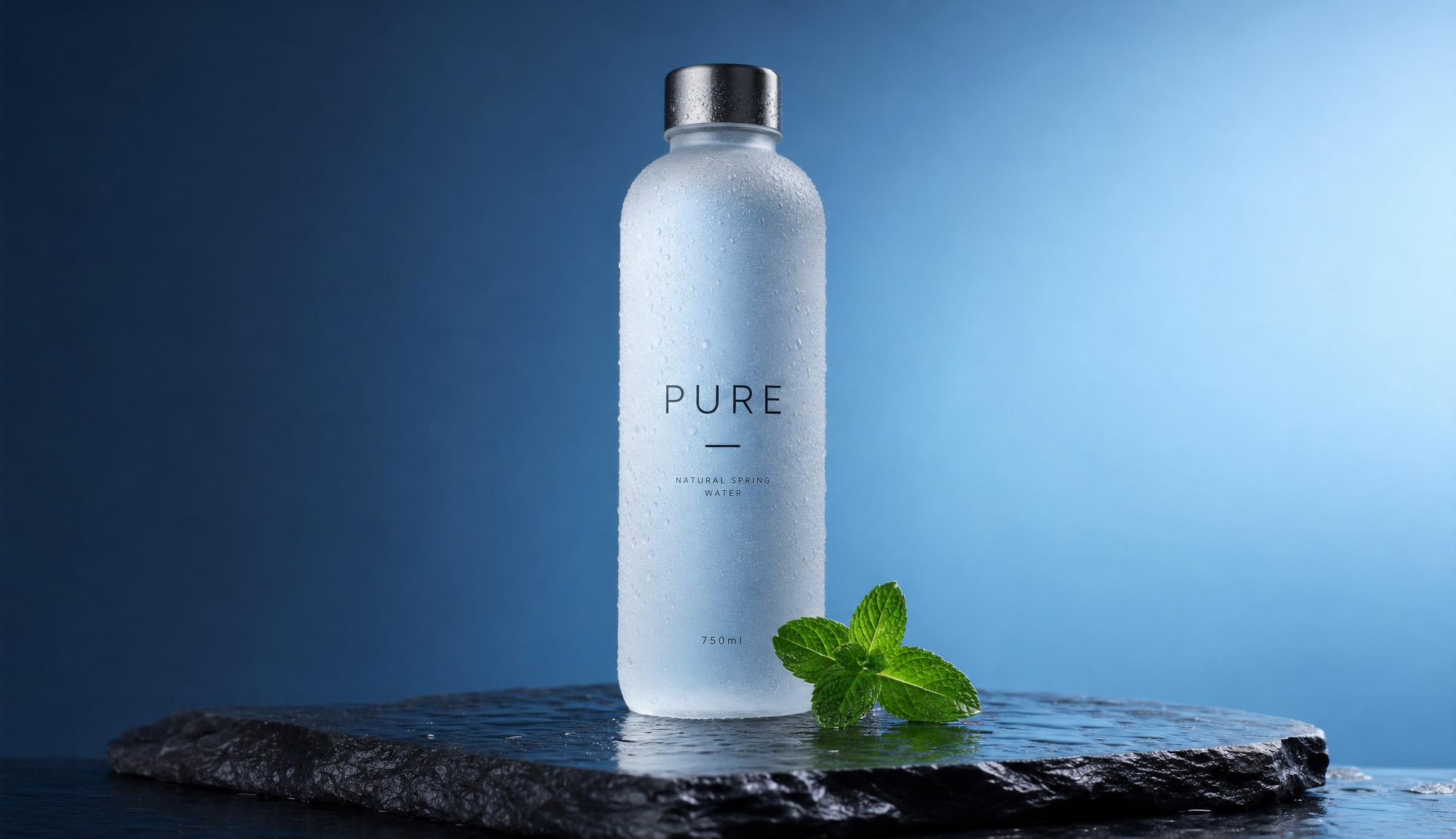
Generated using GPT Image 2 on fal, an AI image model from OpenAI.
Motion brief: a slow 180-degree orbit around the bottle, condensation beads catching the light as the camera moves, a drop of water rolling down the glass, the mint leaf shifting slightly in a faint breeze. A calm female voiceover in Korean reads the tagline, "순수함, 한 방울씩." ("Purity, drop by drop.") The shot ends on the bottle centered with the backdrop brightening behind it.
The reason why I decided to go ahead with Korean was that I wanted to test the AI video generators' capabilities to produce non-English content, and I happen to know a little Korean, so let's see how they perform.
#1: Seedance 2.0
Best for: A still photo that needs to become cinematic motion with audio generated in the same pass, plus start and end frame control.
Similar to: Happy Horse 1.0, Veo 3.1.
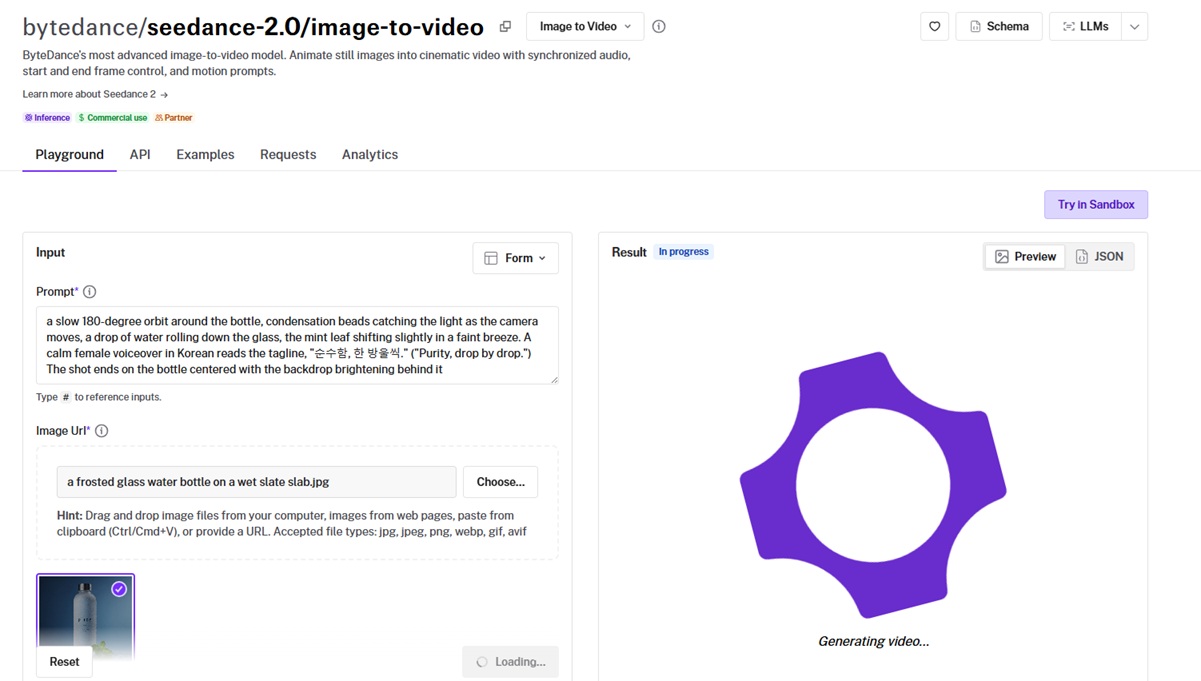
ByteDance built Seedance 2.0 to animate a starting image with director-level camera control, realistic physics, and synchronized audio in a single generation.
Native audio, music, and lip-synced dialogue come at no extra cost.
Performance
Generated using Seedance 2.0 on fal, an AI model from ByteDance.
Motion and physics: The orbit moved smoothly around the bottle, and the water drop rolled down the glass on a believable path.
Visual fidelity: Crème de la crème, the kind of frame you would expect from a high-end brand commercial.
Native audio: The Korean voiceover came through clean and on pace with the orbit, and the soft studio ambience sat under it without any hiss.
Start and end frame control: An optional end_image_url lets the clip transition from your opening still to a target frame, which I think is handy when you have a specific closing beat in mind.
How to run Seedance 2.0 on fal
Seedance 2.0 is available through fal's API and playground.
Resolution runs 480p, 720p, or 1080p, with duration from 4 to 15 seconds or an auto setting that lets the model pick based on the prompt.
A faster, lower-cost sibling endpoint covers 720p work when you do not need the 1080p tier.
Pricing
Seedance 2.0 costs $0.3034 per second at 720p and $0.682 per second at 1080p on fal, with audio included at no extra charge.
falMODEL APIs
The fastest, cheapest and most reliable way to run genAI models. 1 API, 100s of models
#2: Happy Horse 1.0
Best for: Animating a first frame into 1080p video with native audio and lip-sync across several languages.
Similar to: Seedance 2.0, Kling v3 Pro.
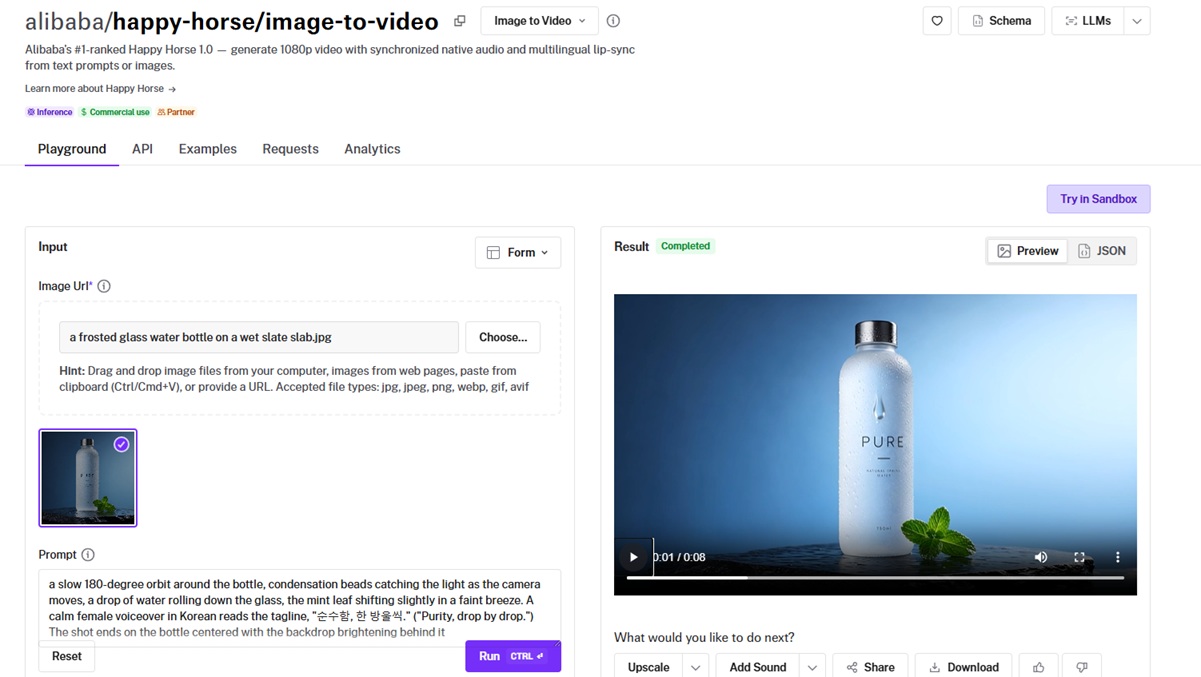
Happy Horse 1.0 takes a still image as its opening frame and animates it with synchronized native audio, Foley sounds, and multilingual lip-sync.
Performance
Generated using Happy Horse 1.0 on fal, an AI model from Alibaba.
Read of the brief: The AI model shows strong sequencing, as the orbit timed cleanly to the voiceover and the backdrop brightened on the closing frame just as the line landed.
Detail at 720p: Expressions and fabric texture held up well, close to Seedance 2.0 on the emotional read of the scene.
Korean voiceover: Korean is a native audio language here, not a translation pass, and the read sounds natural to me.
Language coverage: Lip-sync typically spans English, Mandarin, Cantonese, Japanese, Korean, German, and French, wider than most animators here.
How to run Happy Horse 1.0 on fal
You can run Happy Horse 1.0 on fal via API and playground.
The first-frame image needs at least 400px on its shortest side and stays under 10 MB, in JPEG, PNG, BMP, or WEBP.
Prompts run up to 2,500 characters and duration spans 3 to 15 seconds at 720p or 1080p.
Pricing
Happy Horse 1.0 costs $0.14 per second at 720p and $0.28 per second at 1080p on fal.
#3: Veo 3.1
Best for: An input image that needs native audio and lip-synced dialogue, with resolution headroom up to 4K.
Similar to: Veo 3.1 Fast, Seedance 2.0.
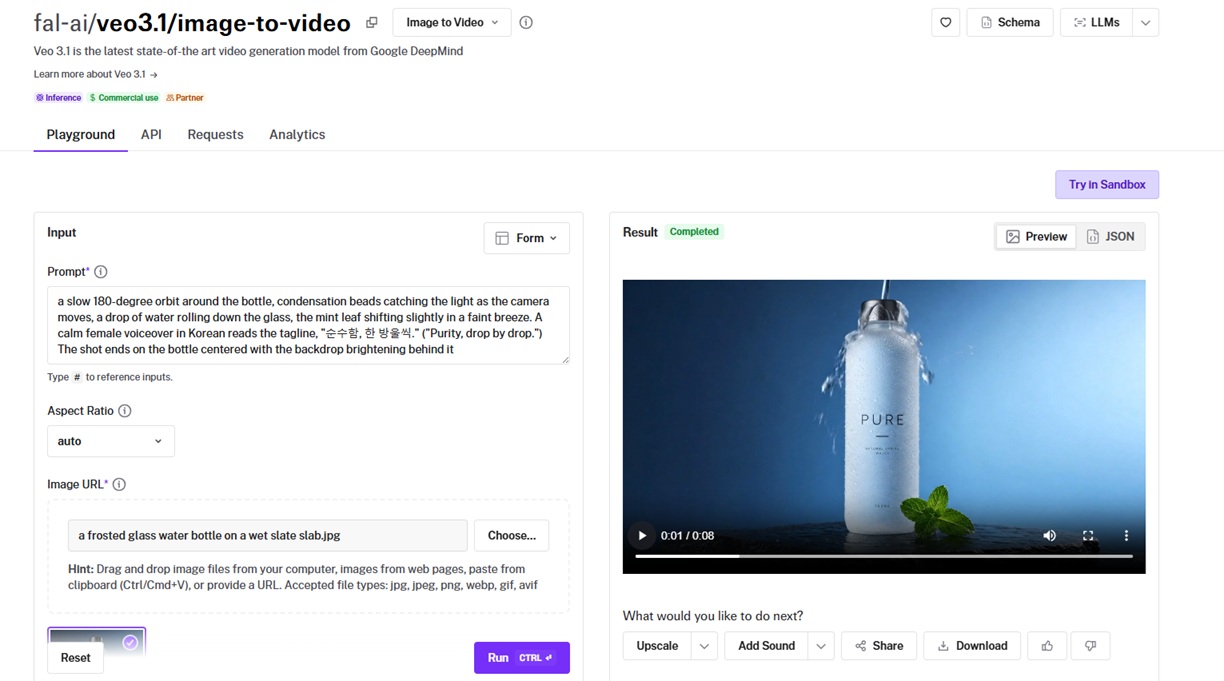
Google DeepMind's Veo 3.1 animates an input image from a text prompt that describes action, style, camera motion, and mood.
It pairs native audio and lip-synced dialogue with output up to 4K.
Performance
Generated using Veo 3.1 on fal, an AI model from Google.
Read of the brief: The product styling and cool-blue backdrop landed as described, and the orbit held a steady radius around the bottle without drifting in or out. The only piece of criticism I'd have here is that it took "drop of water" as a splash in the beginning, but I could have better worded the prompt.
Realism: Clean and sharp, though the reflections on the glass read a shade too perfect for a real studio setup.
Native audio: I felt the voiceover carried the calm tone I wanted, and the light studio ambience sat well underneath it.
Resolution range: Output runs 720p, 1080p, and 4K, sharp enough for professional delivery without a separate upscale.
How to run Veo 3.1 on fal
API and playground are both available for Veo 3.1 on fal.
A cinematic prompt structure works well here: action, then style, then camera motion, then ambiance, with any spoken line written out for lip-sync.
Duration options are 4, 6, or 8 seconds, and a Fast tier covers the same modes at a lower price.
Pricing
On fal, Veo 3.1 costs $0.20 per second without audio and $0.40 per second with audio at 720p or 1080p, with 4K at $0.40 to $0.60 per second.
#4: Grok Imagine Video
Best for: Fast, low-cost short clips with audio from a single image, across a wide range of aspect ratios.
Similar to: Veo 3.1 Fast, Seedance 1.0 Pro.
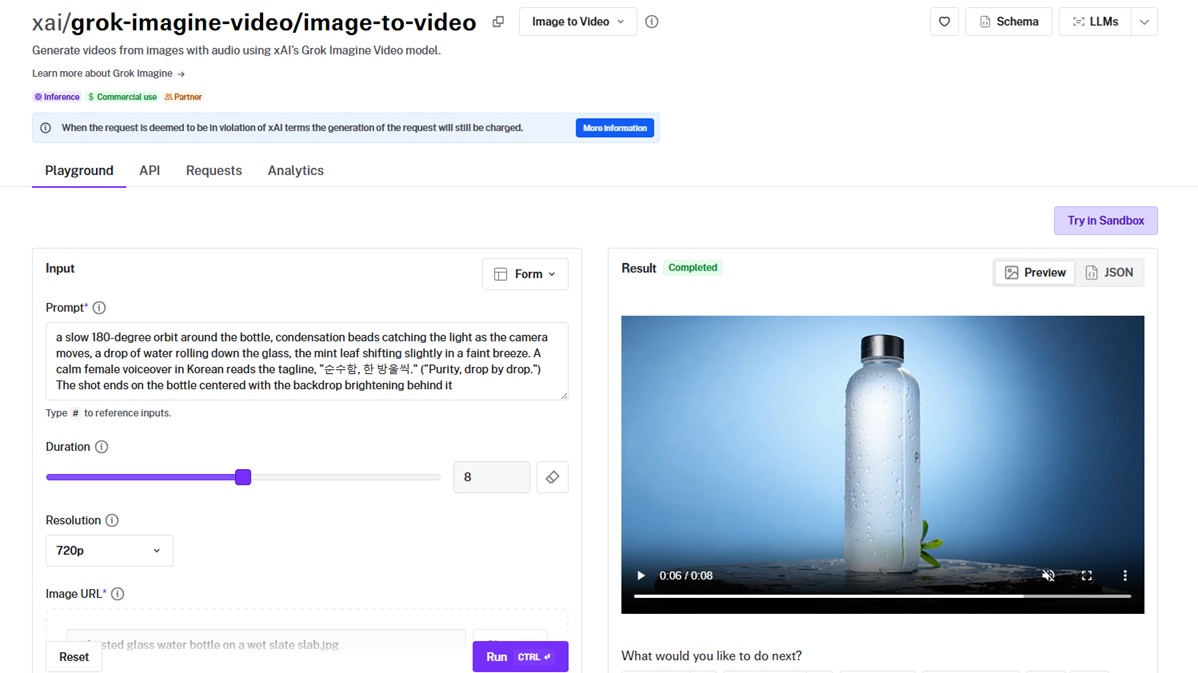
Grok Imagine Video animates an image into a short clip with audio, built around speed and breadth over long runtimes.
It covers a wide spread of aspect ratios at 480p and 720p.
Performance
Generated using Grok Imagine Video on fal, an AI model from xAI.
Read of the brief: The spot came through, and I feel like the AI model followed my directions quite accurately.
Motion: The flow was about what I expected at this tier, with the water drop rolling down the glass.
Sound: Handled cleanly, including the emotional tone of the spoken line, with no artifacts worth flagging.
Aspect ratio range: Supports 16:9, 9:16, 4:3, 3:2, 1:1, 2:3, and 3:4, so landscape, vertical, and square all come off one endpoint.
How to run Grok Imagine Video on fal
Grok Imagine Video is on fal via API and playground.
You set the prompt, duration, resolution, and aspect ratio, with a six-second clip as the default.
One thing worth knowing before you scale up: a request that violates xAI's terms is still charged even when it gets blocked.
Pricing
Grok Imagine Video costs $0.05 per second at 480p and $0.07 per second at 720p on fal, with a small per-image input fee on top.
#5: Veo 3.1 Fast
Best for: Veo's image animation and native audio at a lower per-second rate for higher-volume work.
Similar to: Veo 3.1, Grok Imagine Video.
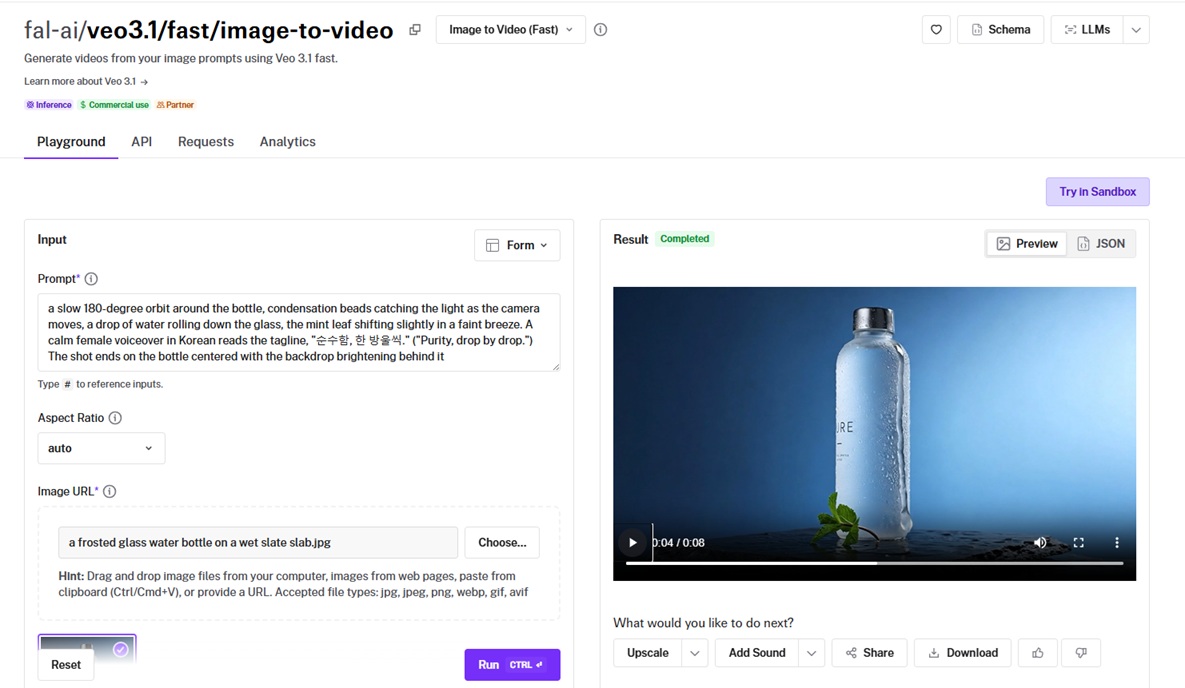
Veo 3.1 Fast is the speed-focused tier of Google's Veo 3.1, animating an input image with the same prompt structure at lower latency.
It keeps native audio and the 16:9 or 9:16 framing.
Performance
Generated using Veo 3.1 Fast on fal, an AI model from Google.
Versus the standard tier: The brief came through close to full Veo 3.1, but I feel like the model took too much creative freedom with that generation round.
Native audio: The Korean voiceover and the studio ambience held together with no obvious timing issues.
Resolution range: Output covers 720p, 1080p, and 4K, the same span as the standard tier.
How to run Veo 3.1 Fast on fal
Run Veo 3.1 Fast through the fal API, or test it in the playground first.
Duration options are 4, 6, or 8 seconds, with an auto-fix toggle that rewrites prompts that trip content checks.
Pricing
Veo 3.1 Fast costs $0.10 per second without audio and $0.15 per second with audio at 720p or 1080p, with 4K at $0.30 to $0.35 per second.
#6: Kling v3 Pro
Best for: Multi-shot narrative clips from a start frame, with custom characters or objects injected into the scene.
Similar to: Kling 2.6 Pro, Happy Horse 1.0.
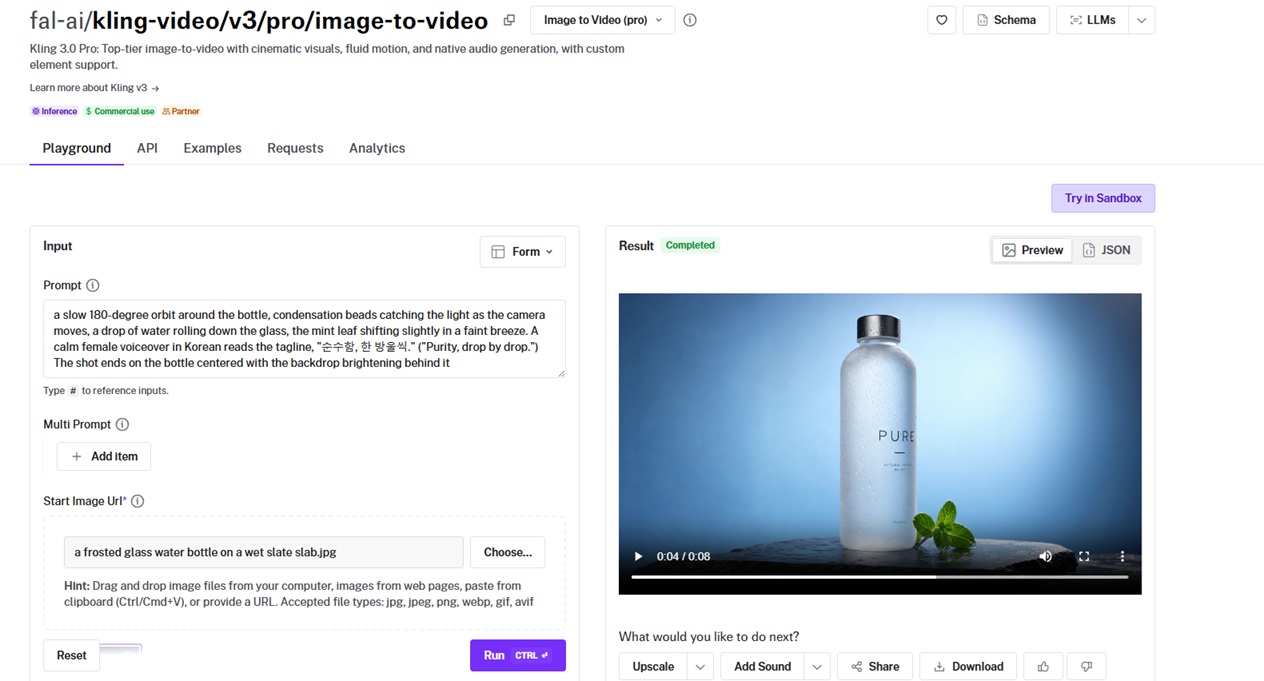
Kuaishou's Kling v3 Pro animates a start image into cinematic 1080p video with native audio and a custom element system for injecting reference characters or objects.
Performance
Generated using Kling v3 Pro on fal, an AI model from Kuaishou.
Motion and timing: I'd say that the AI video generation model did a reasonable job at rotating the bottle, although I can see that the water drop did not fully come down.
Color and detail: Cinematic and detailed, with the warm afternoon light and soft shadows reading the way the brief intended.
Native audio: The Korean voiceover read cleanly over the visuals; however, I wouldn't say that I was too happy with its pronunciation.
Custom elements: You can bind a reference character or object and call it in the prompt as @Element1, which holds identity across the clip.
How to run Kling v3 Pro on fal
You can reach Kling v3 Pro on fal through the API or test it in the browser playground.
Duration runs 3 to 15 seconds, and the aspect ratio comes from the start image, not a separate parameter.
For multi-scene clips, pass a multi_prompt list with a prompt and duration per shot.
Pricing
Kling v3 Pro costs $0.112 per second with audio off and $0.168 per second with audio on, rising to $0.196 per second when voice control is used.
#7: Kling 2.6 Pro
Best for: Spoken dialogue written straight into the prompt and rendered as native audio over the animation.
Similar to: Kling v3 Pro, Kling O3 Pro.
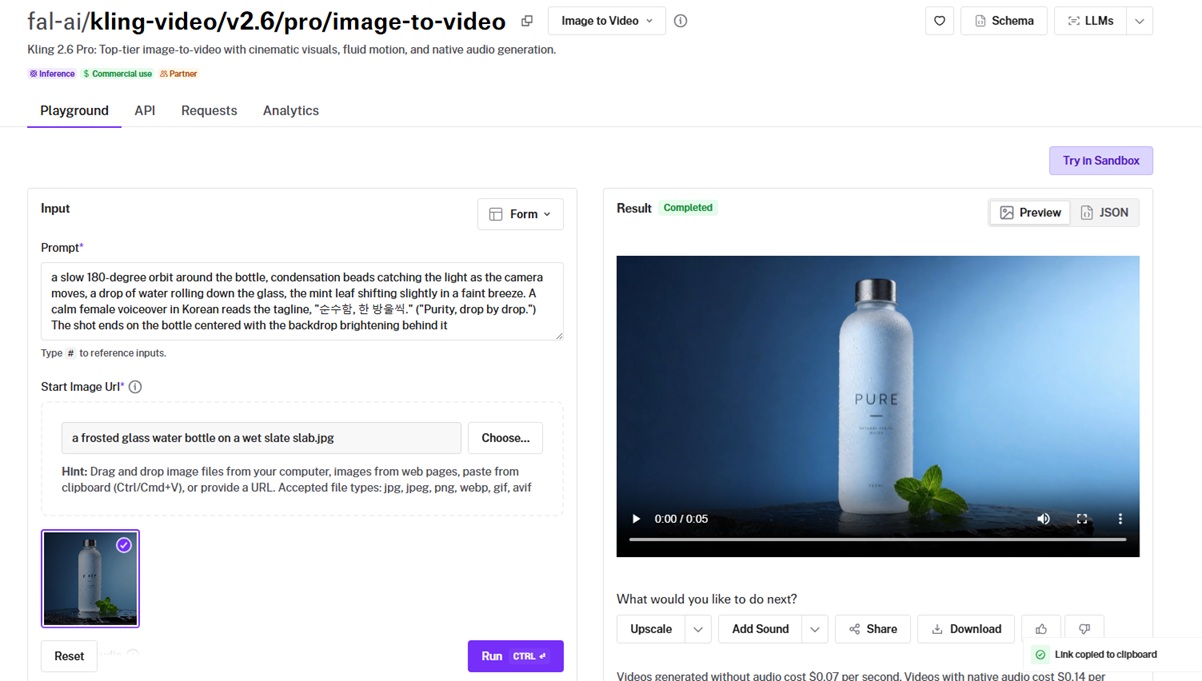
Kling 2.6 Pro animates a single image with cinematic motion and adds speech synthesis into the generation pipeline.
You write the dialogue directly in the prompt, and the model produces matching voice output.
Performance
Generated using Kling 2.6 Pro on fal, an AI model from Kuaishou.
Finish: Production-grade motion, tuned more for a finished render than rapid iteration, although you can only select between a 5 or 10-second video.
Voice control: Optional voice IDs let you assign up to two voices and reference them in the prompt.
Prompt-to-speech: You write the dialogue straight into the prompt, and the model renders a matching voice with no separate audio step, and the animation itself follows the brief.
How to run Kling 2.6 Pro on fal
Kling 2.6 Pro is available on fal through the API and playground.
Duration is 5 or 10 seconds, and you can add an end-frame image for a defined closing beat.
For English speech, write the line in lowercase and reserve uppercase for acronyms or proper nouns, which the model reads as a pronunciation cue.
Pricing
Kling 2.6 Pro costs $0.07 per second with audio off and $0.14 per second with audio on, rising to $0.168 per second with voice control.
#8: Sora 2 Pro
Best for: Longer image-driven clips, up to 20 seconds, with synchronized audio and consistent characters.
Similar to: Veo 3.1, Seedance 2.0.
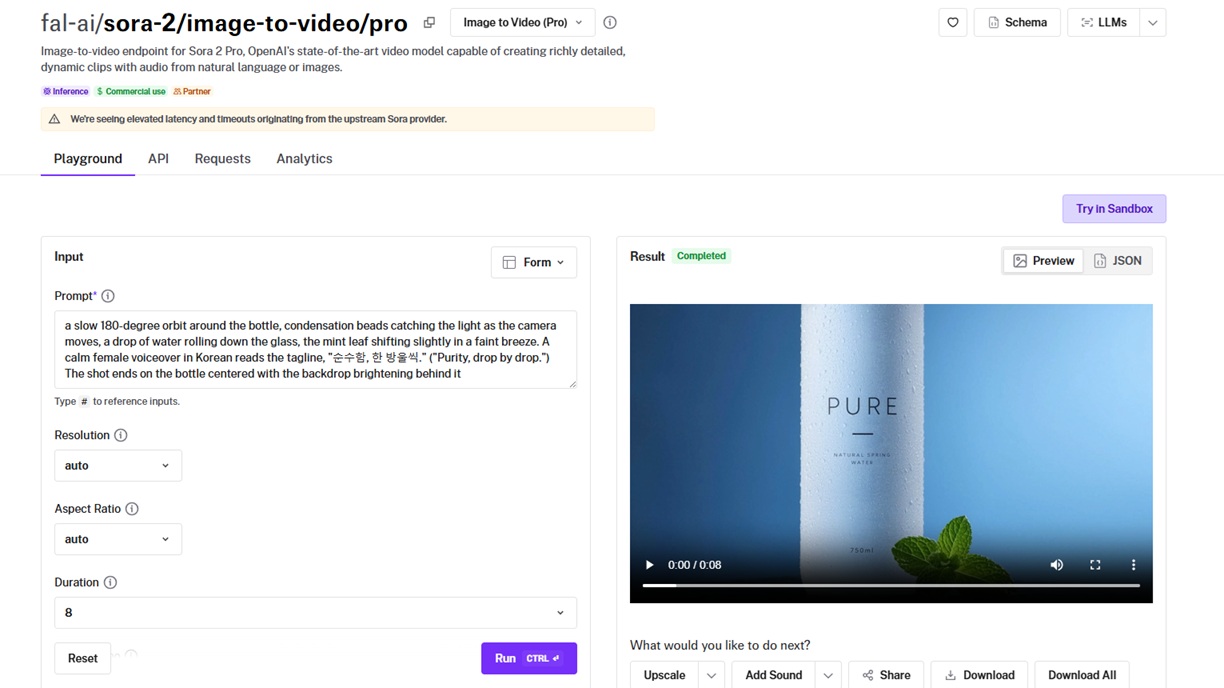
Sora 2 Pro is OpenAI's model for animating an image into longer scenes, generating up to 20 seconds of video with synchronized audio from one starting frame.
Performance
Generated using Sora 2 Pro on fal, an AI model from OpenAI.
Read of the brief: The model rendered the bottle as the clear hero of the frame with the premium styling intact, although perhaps I wasn't clear enough on the specific order in which I want the voiceover, water drop, and rotation to be.
Sound: Dialogue came through cleanly, and the ambient choice suited the scene.
Privacy and IP controls: A delete-after-generation option keeps clips out of remixing, and an IP-detection setting can block prompts that reference known intellectual property.
How to run Sora 2 Pro on fal
Sora 2 Pro runs on fal via the API, with a playground for quick tests.
Duration options are 4, 8, 12, 16, or 20 seconds, and resolution covers 720p, 1080p, and true 1080p.
A 20-second job runs long, so submit it through the queue and let a webhook ping you when the clip is ready.
Pricing
Sora 2 Pro costs $0.30 per second at 720p, $0.50 per second at legacy 1080p, and $0.70 per second at true 1080p on fal.
#9: Kling O3 Pro
Best for: A transition that animates from a start frame to an end frame, with text-driven style guidance over the move.
Similar to: Kling 2.6 Pro, Kling v3 Pro.
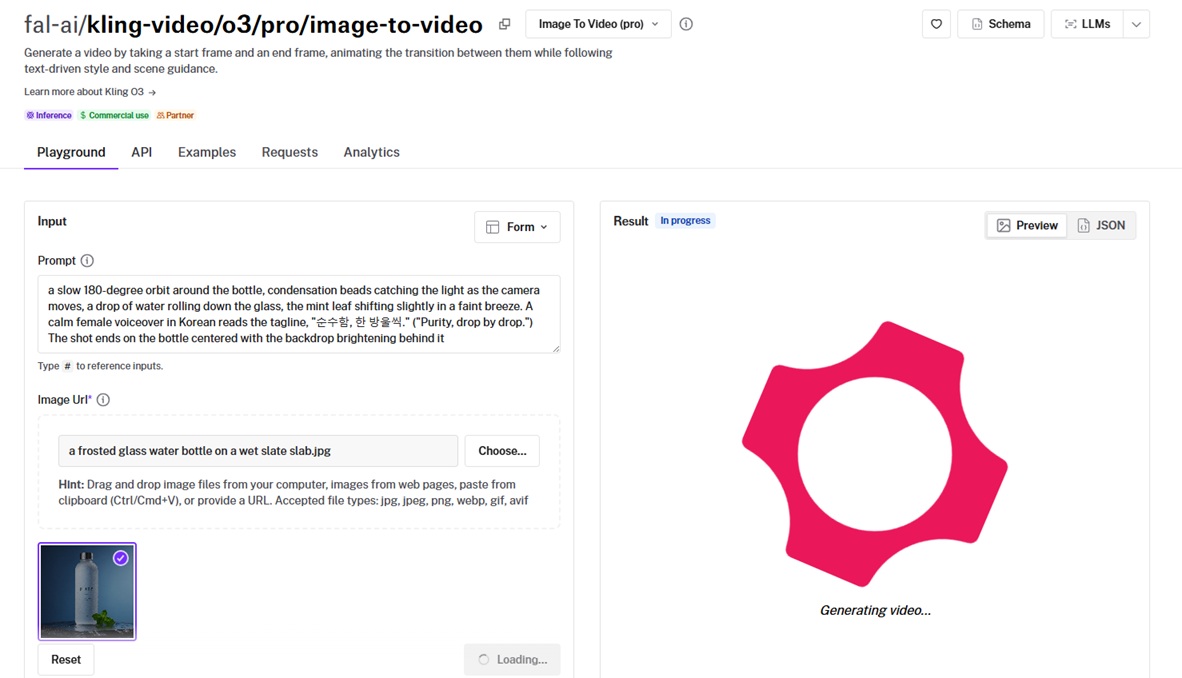
Kling O3 Pro takes a start frame and an end frame and animates the transition between them, following your prompt for style and scene direction.
It runs in professional mode at 1080p with extended duration and native audio.
Performance
Generated using Kling O3 Pro on fal, an AI model from Kuaishou.
Read of the brief: The AI model did a really good job at the voiceover, although I wanted to see the product move.
Transition handling: You give it a start and an end frame, and it can animate the path between them.
Output quality: 1080p professional-mode output with clean motion across the whole transition.
Frame bounds: The end_image_url sets the closing frame, which suits a planned beat where you already know how the shot should land.
How to run Kling O3 Pro on fal
You can run Kling O3 Pro on fal through the API and playground.
Duration runs 3 to 15 seconds, and a multi_prompt list breaks the clip into shots when you need more than one beat.
Provide a start image, and optionally an end image, to set the bounds of the transition.
Pricing
Kling O3 Pro costs $0.112 per second with audio off and $0.14 per second with audio on.
#10: Seedance 1.0 Pro
Best for: Straightforward single-image animation at 1080p for a lower per-clip cost.
Similar to: Grok Imagine Video, Seedance 2.0.
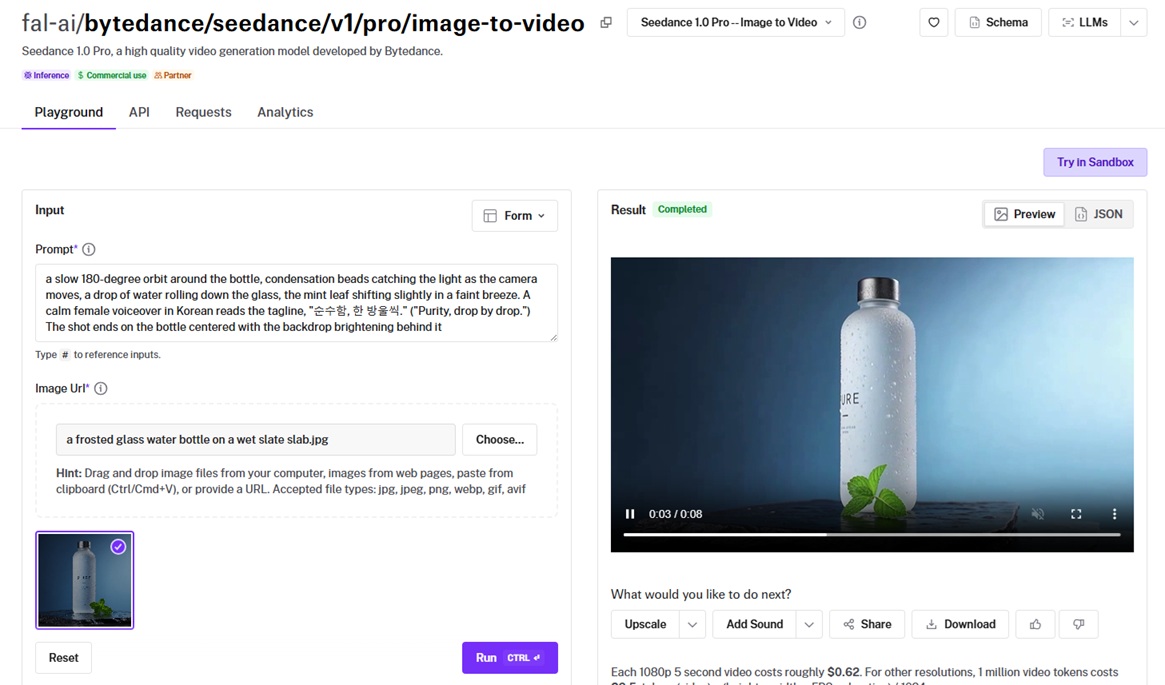
Seedance 1.0 Pro is the earlier Seedance animator from ByteDance, turning a single image into natural motion while holding visual quality and temporal consistency, although there's no sound.
Performance
Generated using Seedance 1.0 Pro on fal, an AI model from ByteDance.
Read of the brief: The model caught the motion and kept the scene stable, with believable movement that respected the objects in frame.
Dynamic range: A wide dynamic range that handles large-scale movement while keeping the frame stable.
Input flexibility: Accepts JPEG, PNG, WebP, and several other formats, with an optional end frame for a defined closing image.
How to run Seedance 1.0 Pro on fal
Seedance 1.0 Pro runs on fal through the API and playground.
The Pro endpoint outputs 1080p, while a Lite endpoint covers 720p at a lower cost.
Duration runs from 2 to 12 seconds, with an aspect ratio that can hold the input image's original framing.
Pricing
Seedance 1.0 Pro costs roughly $0.62 per 1080p 5-second clip on fal, billed by video tokens for other resolutions.
Recently Added




Generate video at scale through a single API with fal
The right model comes down to the clip in front of you, whether that is a 4K product hero shot, a quick vertical ad for social, or a longer branded spot with a voiceover.
Each one is a fal endpoint away, with per-second pricing and no servers of your own to keep warm.
The playground lets you line up a few outputs side by side before you settle on an endpoint.
Create your free account and start animating your images on fal.
![What is H3 Max Camera Controls (Multi-Angle) & How To Use It? [2026]](https://refinery.fal.media/url/https%3A%2F%2Fv3b.fal.media%2Ffiles%2Fb%2F0aabbf2b%2Fq8usbuG4heGtr4-AYyqfk.jpg/tr:w-1280,q-80/q8usbuG4heGtr4-AYyqfk.webp)
![10 Best Text-to-Image APIs In 2026 [Reviewed]](https://refinery.fal.media/url/https%3A%2F%2Fv3b.fal.media%2Ffiles%2Fb%2F0a9eafbe%2FB4vvwLBImuOfSepWIVfwO_best-text-to-image-apis-2026.jpg/tr:w-1280,q-80/B4vvwLBImuOfSepWIVfwO_best-text-to-image-apis-2026.webp)