Today we're releasing H3 Max, a post-trained version of MiniMax H3 developed by fal Research and optimized for maximum speed by fal's inference team. H3 Max & H3 Max Turbo are the fastest video generation models on the market right now.
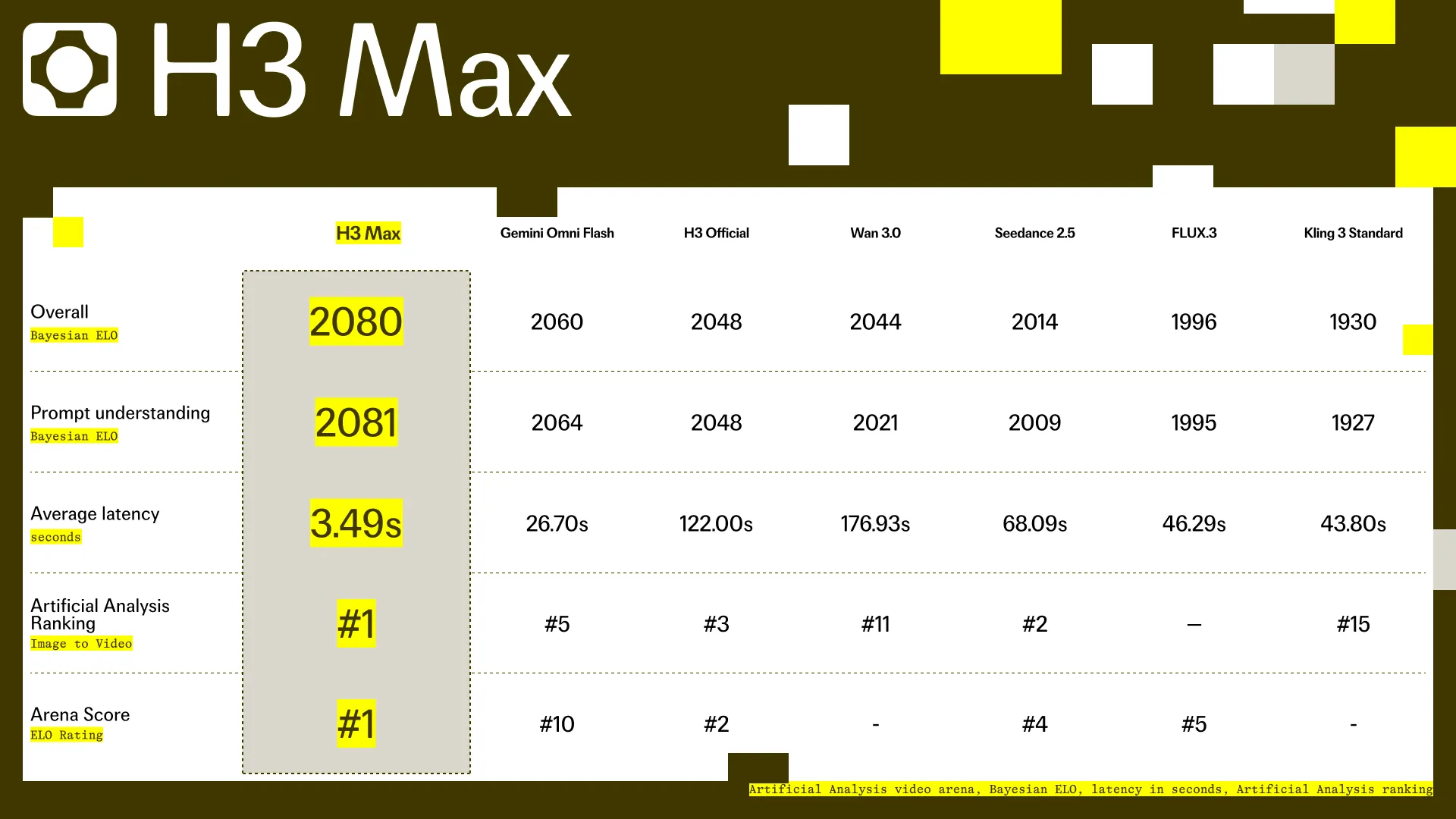
In our human preference evaluations, H3 Max ranks #1 across overall quality, prompt understanding, and aesthetics against leading video models. It does so while generating a 5-second video under 3 seconds of wall time, which is roughly 35x the throughput of the official MiniMax H3 endpoint and on average 15x faster than anything with comparable quality. H3 Max generates a 768p 5 second video in 2.78 seconds while the original model, MiniMax H3 generates the same video in 53.20 seconds making H3 Max 180% faster than the original.
These results challenge a common tradeoff in generative video: that higher quality has to come at the cost of slower inference.
H3 Max is the result of working on both sides of that problem at once. We optimized the model for stronger real-world performance while co-designing the inference system around it to make sure faster than real-time is still possible. This required two capabilities that rarely sit under the same roof: frontier model research and deep inference optimization/kernel work.
What is the fastest AI video generation model?
H3 Max & H3 Max Turbo by fal are the fastest AI video generators on the market.
| Video Length | Quality | Modality | H3 Max Turbo by fal | H3 Max by fal |
|---|---|---|---|---|
| 5 second clip | 480p | Text to Video | 0.44 seconds | 0.75 seconds |
| 10 second clip | 480p | Text to Video | 1.00 seconds | 1.72 seconds |
| 15 second clip | 480p | Text to Video | 1.71 seconds | 3.14 seconds |
| 5 second clip | 768p | Text to Video | 1.54 seconds | 2.46 seconds |
| 10 second clip | 768p | Text to Video | 4.29 seconds | 7.55 seconds |
| 15 second clip | 768p | Text to Video | 8.44 seconds | 15.17 seconds |
| 5 second clip | 1080p | Text to Video | 2.33 seconds | 3.12 seconds |
| 10 second clip | 1080p | Text to Video | 6.81 seconds | 8.89 seconds |
| 15 second clip | 1080p | Text to Video | 13.56 seconds | 17.63 seconds |
Post-training H3 Max
We started with the open-weights MiniMax H3 model and introduced substantial new data during post-training, with a particular focus on prompt adherence and visual quality. Traditional step-distillation methods aim to match their base model while we aim for a better model at much faster speed.After our work, the base model's core capabilities remain intact, especially its unified multimodal context and natively synchronized audio and video.
Throughout post-training, we continuously evaluated checkpoints through head-to-head preference studies across three dimensions: overall quality, prompt understanding, and aesthetics.Evaluating these dimensions independently gave us a much clearer signal than optimizing against a single aggregate score. We could see not only whether a checkpoint improved, but where it improved, and catch regressions that a single score might hide.
The result is a model that meaningfully improves on the original H3 across the qualities people actually notice when generating video: understanding what you asked for and producing something you want to use.
Co-designing the inference engine
A common approach to serving a new model is to take its final weights and optimize the inference stack in a vacuum. With H3 Max, the research and inference work was deeply connected.
Our inference team has spent the past four years optimizing diffusion and generative media workloads. For H3 Max, we applied those systems techniques while the model itself was still being developed, allowing decisions on either side of the stack to inform the other.
The objective wasn't just to minimize latency, it was to maximize throughput subject to preserving the quality gains from post-training.
That distinction shaped the entire optimization process.
There are straightforward ways to make a video model faster: reduce precision, remove sampling steps, or approximate expensive operations. Some produce impressive benchmark numbers while degrading the output. For H3 Max, an optimization only survived if the resulting model continued to hold its position in our internal quality evaluations. The result is an inference system specifically optimized around H3 Max rather than a generic serving stack running H3 Max weights.
Measuring quality
Evaluating generative video is inherently difficult. Automated metrics capture only part of what makes one generation better than another, so our primary evaluation uses head-to-head human preferences.
We benchmarked H3 Max against twelve leading video models, including the official MiniMax H3 endpoint, Gemini Omni Flash, Wan 3.0, Seedance 2.5, Kling 3, and Veo 3.1.
Evaluators compared generations across three dimensions:
- Overall preference: which video they preferred as a whole
- Prompt understanding: which generation more faithfully followed the instruction
- Aesthetics: which generation was visually stronger
We aggregated these comparisons using Bayesian Elo ratings with 95% confidence intervals.
H3 Max ranks #1 across all three dimensions and wins the majority of head-to-head matchups against every model we tested, including the original H3.
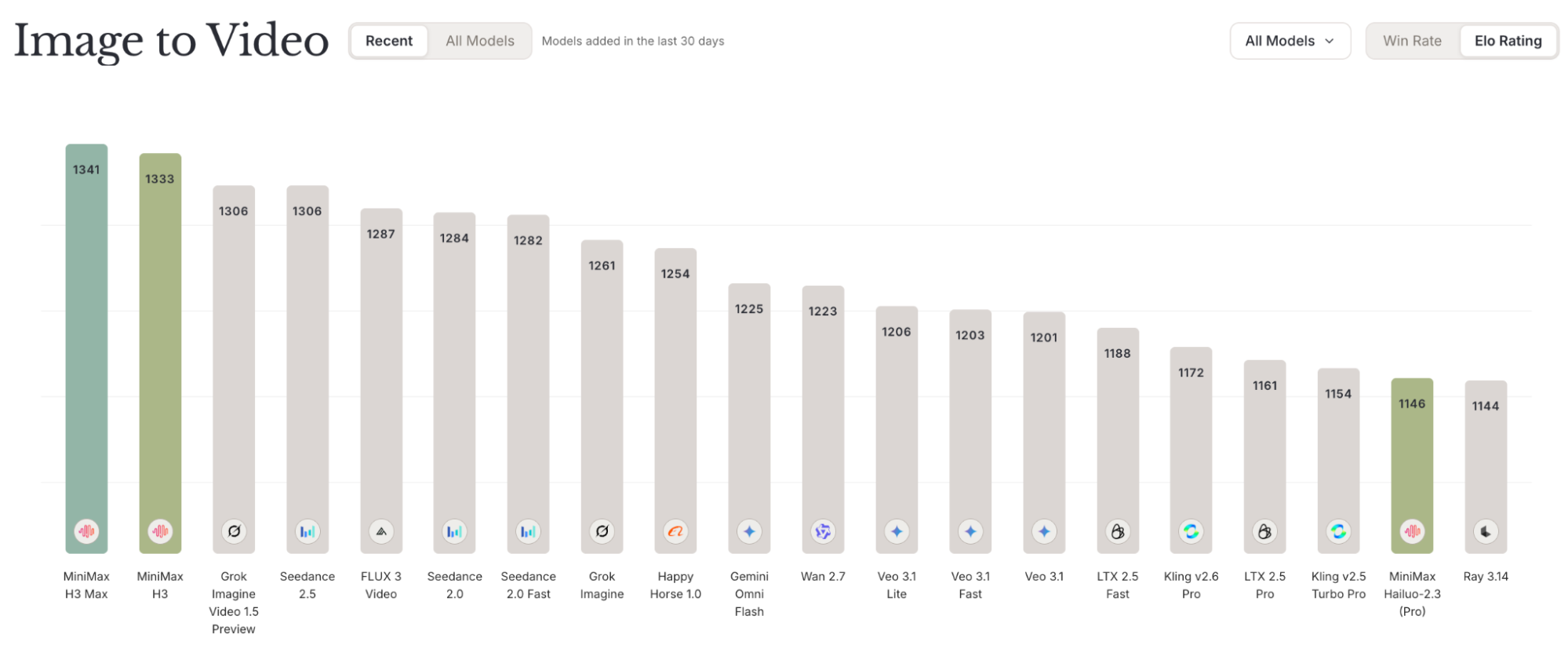
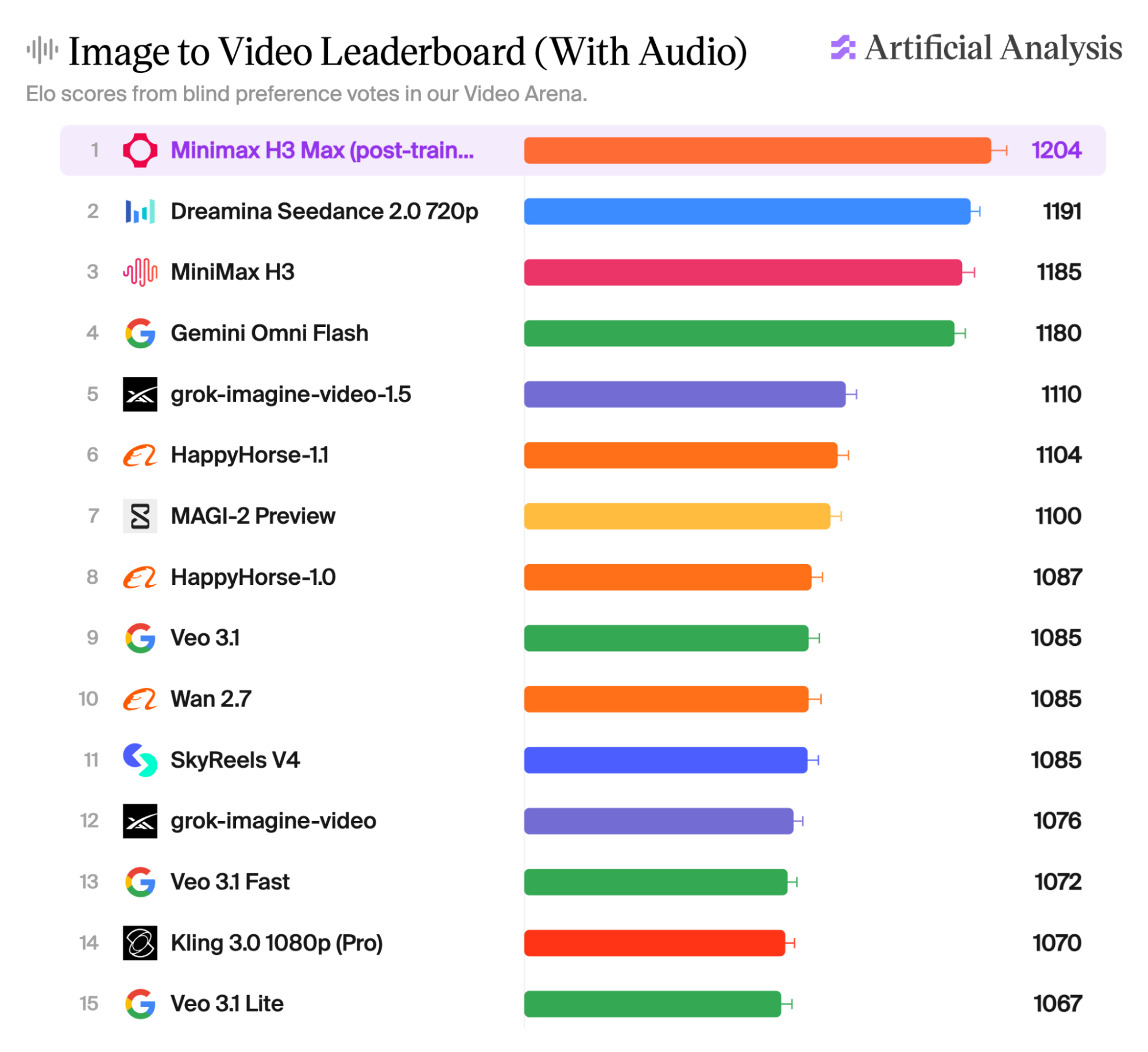
The results hold up outside our own evaluations. In independent benchmarks from Artificial Analysis and Design Arena, H3 Max also ranks #1 against other video models.
Quality without the latency tradeoff
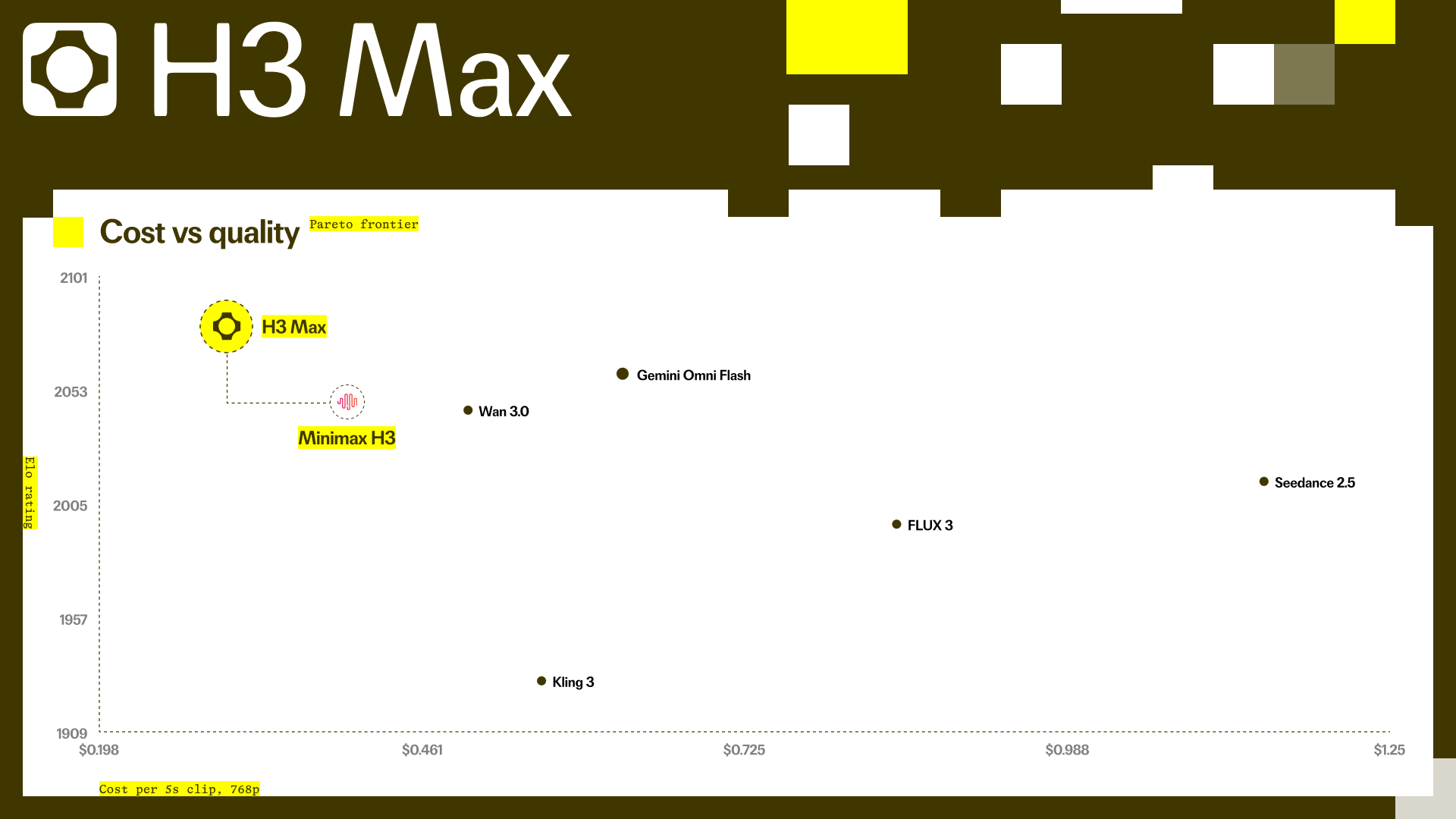
The more interesting result is when we look at quality and speed together.
H3 Max generates a 5-second video in approximately 3 seconds. That's roughly 35x the throughput of the official H3 endpoint and faster than every other model in our comparison.
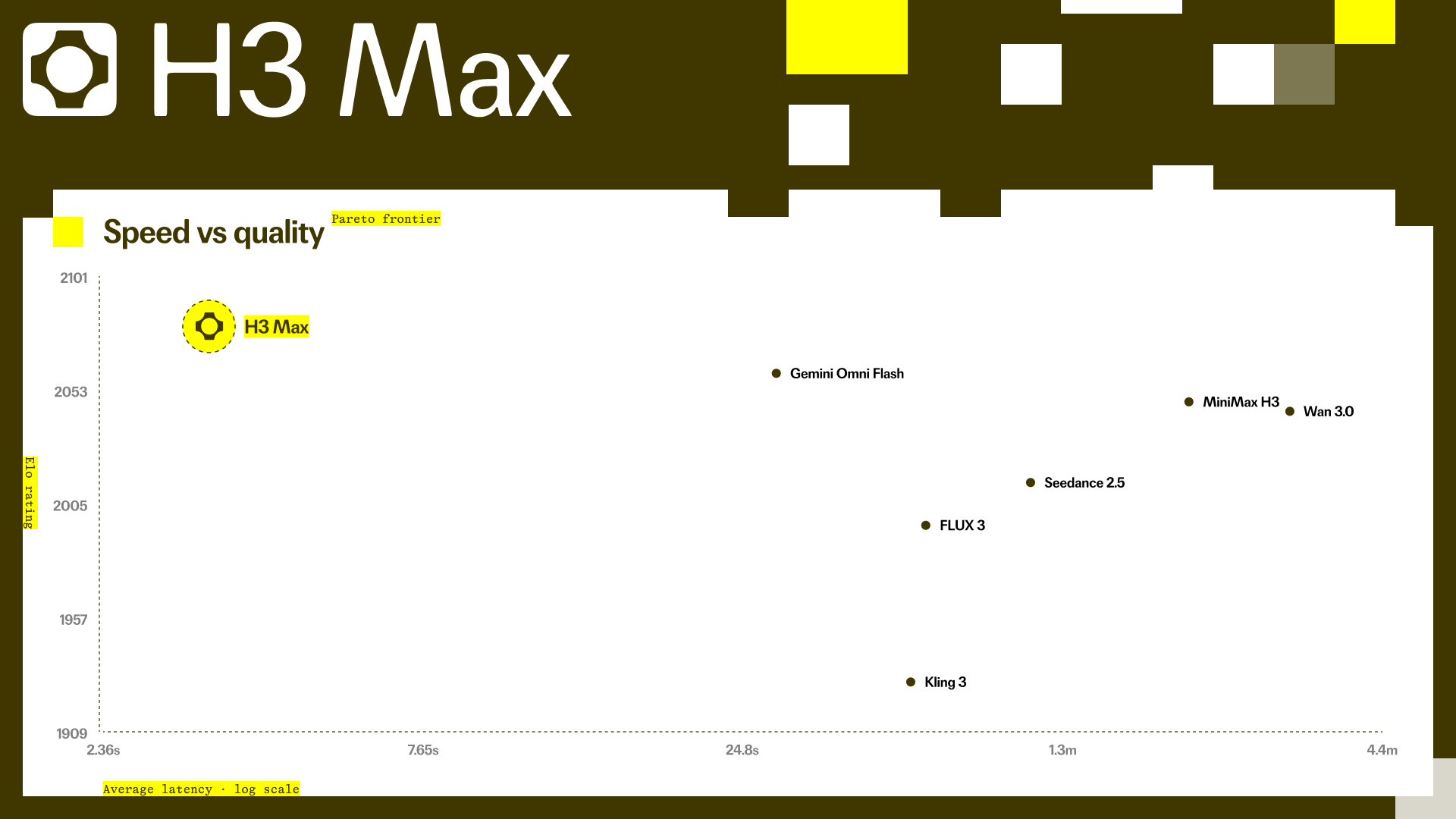
Typically, the frontier forces a choice: faster models occupy one end of the curve and higher-quality models occupy the other.
H3 Max moves the frontier.
It achieves the highest human-preference score in our evaluation while simultaneously delivering the highest throughput.
This is the advantage of treating model research and inference optimization as the same problem. Post-training gives us control over the quality of the model. Systems work gives us control over how efficiently that model executes. Co-designing the two means improvements don't have to come at each other's expense.
For generative media, this will increasingly matter. Models are getting larger and more computationally demanding at the same time that video generation is moving into interactive and high-volume production workloads.
A model isn't useful in production because it tops the benchmark in isolation. What matters is the frontier across quality, latency, and cost.
Our goal at fal is to push all three.
Try H3 Max
H3 Max is available today on fal. Try it in the Playground, via fal Agent, or call it from the API.
For the first week, we're offering H3 Max at 50% off.
Text to Video: https://fal.ai/models/minimax/h3-max/text-to-video
Image to Video: https://fal.ai/models/minimax/h3-max/image-to-video