In this article, I'll compare Seed Audio 1.0 and ElevenLabs v3 on fal, covering output type, voice control, language support, audio editing, pricing, and the use cases each model fits to help you select the right model for the right use case.
TL;DR
ElevenLabs v3 is a text-to-speech model that supports over 70 languages, streaming output, and controls delivery through inline audio tags.
The model bills at $0.10 per 1,000 characters on fal, which puts a 10,000-character input at $1.00.
It's ideal for single-voice work: narration, voiceover, and dubbing.
Seed Audio 1.0 is a text-to-audio model that generates multi-speaker dialogue, sound effects, music, and ambience in one generation, edits existing audio (inpaint, extend, stitch, line swap), and supports English and Chinese.
The audio model bills at $0.1875 per minute of output. It fits multi-layer scene production and audio editing.
➡️ I'll also show you how both models perform next to each other on the same prompt so you can see for yourself.
What is the difference between Seed Audio 1.0 and ElevenLabs v3?
Here's how both of them stack up:
| Seed Audio 1.0 | ElevenLabs v3 | |
|---|---|---|
| Provider | ByteDance | ElevenLabs |
| What it generates | A multi-layer scene: several voices, sound effects, music, and ambience in one generation | One voice performance from text |
| Best for | Multi-layer audio scenes, audio repair and editing, audio-first production | Narration, voiceover, dubbing, and agent voices across many languages |
| Price (raw) | $0.1875 per minute of output | $0.10 per 1,000 characters |
| Price per spoken minute (approx) | $0.1875 | ~$0.07 to $0.10 |
| Languages | English and Chinese (broader support planned) | Over 70 |
| Multi-character in a single call | Native | The text-to-dialogue endpoint covers multi-speaker |
| Sound effects and music in the same output | Yes | No. Voice only on this endpoint. There's another ElevenLabs Music endpoint for that. |
| Audio editing (inpaint, extend, stitch, line swap) | Yes | No. Generation-focused endpoint. |
| Emotional control method | Add voice direction to the prompt | Inline audio tags such as [whispers], [laughs], [excited] |
| Reference voice input | Up to 3 clips at 30s each via @Audio1 to @Audio3, plus 20 presets | Large built-in voice library |
| Image-to-voice | Single reference image | No (voice selected from the library) |
| Streaming | No (standard fal queue) | Yes |
| Commercial use | Yes | Yes |
Where can you access Seed Audio 1.0 and ElevenLabs v3?
Both models run on fal, which provides one API for audio generation alongside its video models, including Seedance 2.0 and Happy Horse 1.0, billed per use with no GPU management.
Seed Audio 1.0 output can be paired with those video models to produce podcasts, audiobooks, short films, features, TV episodes, and documentaries.
ElevenLabs v3 covers voice-led work across over 70 languages on the same platform.
For this comparison, I'll be running both Seed Audio 1.0 and ElevenLabs v3 in fal's playground and comparing the outputs.
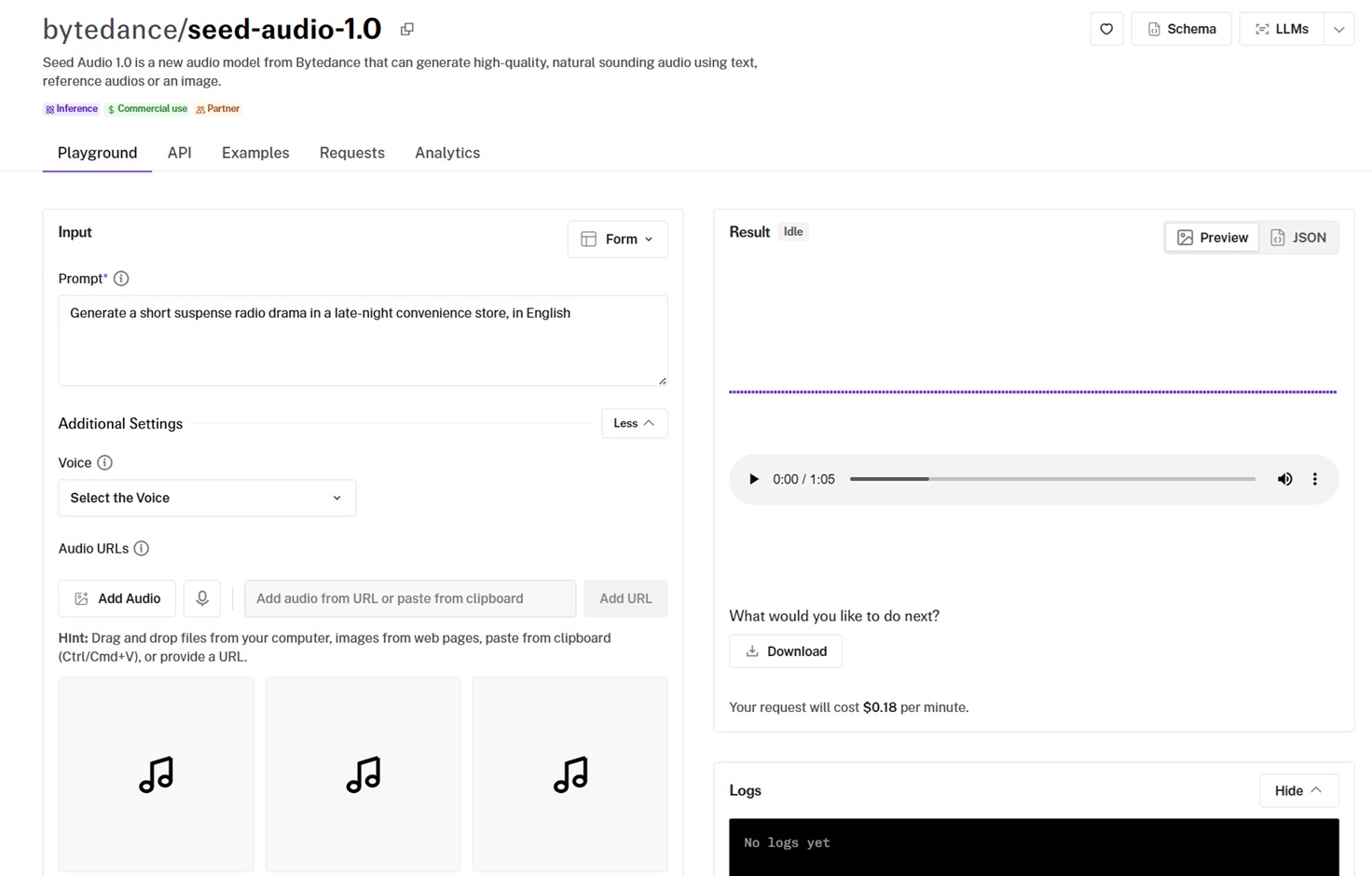
Seed Audio 1.0 is available at the endpoint bytedance/seed-audio-1.0, and reference audio inputs are addressed in the prompt as @Audio1, @Audio2, and @Audio3.
Here's how it looks to use our API with JavaScript:
javascript
import { fal } from "@fal-ai/client";

const result = await fal.subscribe("bytedance/seed-audio-1.0", {
  input: {
    prompt:
      "Generate a short suspense radio drama in a late-night convenience store.",
  },
  logs: true,
  onQueueUpdate: (update) => {
    if (update.status === "IN_PROGRESS") {
      update.logs.map((log) => log.message).forEach(console.log);
    }
  },
});

console.log(result.data);
console.log(result.requestId);
What is the difference between Seed Audio 1.0 vs. ElevenLabs v3 side-by-side?
I ran the following tests across the same script through both models on fal to see how both models perform under the same circumstances.
Although, do note that I used ElevenLabs Music to compare music vs. music capability and also Eleven v3 text-to-dialogue to compare these capabilities as well:
Test 1: Neutral narration
Here's my test with a single line with no tags or direction to test the models' baseline output.
Prompt: "Across the river, the old mill had stood empty for forty years, its wheel frozen mid-turn, the water sliding past like it had somewhere better to be."
Generated using Seed Audio 1.0 on fal, an AI model from ByteDance.
Generated using ElevenLabs v3 on fal, an AI model from ElevenLabs.
Notes: I can see how Seed Audio 1.0 produced a longer clip by adding a few seconds of suspension in the beginning and in the end, although I'm happy with its overall build up and dramatic execution.
With ElevenLabs v3, it was as professional as I expected it to be.
Test 2: Emotional delivery
The same line with a bright-to-hushed shift, driven through each model's control method:
Prompt for ElevenLabs v3: "Hello! [excited] You will not believe what just happened. [whispers] I think the package finally arrived."
Prompt for Seed Audio 1.0: "Nina (female, late 20s, American accent, bright voice, excited then dropping to a hush) says: 'Hello! You will not believe what just happened. I think the package finally arrived."
Generated using Seed Audio 1.0 on fal, an AI model from ByteDance.
Generated using ElevenLabs v3 on fal, an AI model from ElevenLabs.
Notes: I'm happy with both models' execution, even though they approached it differently. I have to say that I'm a bigger fan of Seed Audio 1.0's execution in this instance since it felt more emotional and movie-like.
falMODEL APIs
The fastest, cheapest and most reliable way to run genAI models. 1 API, 100s of models
Test 3: Mandarin delivery
Here's a short line in Mandarin, supported by both models.
Prompt: "今天天气很好,我们一起去公园散步吧。"
(English gloss: "The weather is nice today, let's go for a walk in the park.")
Generated using Seed Audio 1.0 on fal, an AI model from ByteDance.
Generated using ElevenLabs v3 on fal, an AI model from ElevenLabs.
Notes: For ElevenLabs, I had to add a Language Code for this, so I added 'zh' for this example. I couldn't help but notice how quicker ElevenLabs' execution was in this example (almost instant), while I had to wait for some time for Seed Audio 1.0.
Test 4: Two-character scene
Here's a two-speaker exchange:
Prompt for Seed Audio 1.0: "A late-evening train platform, light rain, a distant announcement echoing under the canopy and a train idling on the far track. Sound: steady rain, low platform hum, the soft hiss of brakes. Marcus (man, 40s, tired warm voice) says quietly: 'You actually came.' Dana (woman, 30s, breathless, half-laughing) answers: 'I said I would. I just didn't say I'd be on time.'"
Build for ElevenLabs: text-to-dialogue for the two voices, Aria voicing "You actually came." and Charlotte voicing "[softly] I said I would. [chuckles] I just didn't say I'd be on time."
Generated using Seed Audio 1.0 on fal, an AI model from ByteDance.
Generated using ElevenLabs v3 on fal, an AI model from ElevenLabs.
Notes: Seed Audio 1.0 managed to recreate that scene from a single prompt, although I like the way ElevenLabs has a dedicated text-to-dialogue endpoint, where you can add multiple speakers with their own quotes. In this instance, I prefer Seed Audio 1.0's response, but that's because the prompt was more complex in the first place, using our best practices for prompting Seed Audio 1.0.
Test 5: Music, with ElevenLabs Music
ElevenLabs Music is a dedicated text-to-music model with composition plans, length control, section-level styles, and an instrumental option, billed at $0.8 per output minute, rounded up to the nearest minute.
Seed Audio 1.0 generates music as a layer of its audio output.
Let's do a test between a standalone track from ElevenLabs Music with a music-led output from Seed Audio 1.0:
Prompt: "A 20-second upbeat indie-folk instrumental, acoustic guitar and light percussion, warm and bright, building to a small lift at the end, no vocals."
Generated using Seed Audio 1.0 on fal, an AI model from ByteDance.
Generated using ElevenLabs Music on fal, an AI model from ElevenLabs.
Notes: Overall strong performance by both models, as they listened to the prompt pretty well. Do note that on ElevenLabs Music, you have to select the Music Length Ms, otherwise the model will generate a longer song than you might have expected.
What is Seed Audio 1.0 and ElevenLabs v3's pricing on fal?
The two models bill on different units.
Seed Audio 1.0 bills per minute of generated audio at $0.1875, and that rate covers the full output regardless of how many speakers or layers it contains.
A 2-minute output is $0.375, and a 10-minute output is $1.875.
ElevenLabs v3 bills per 1,000 characters of input text at $0.10, with no seats or subscriptions.
A 500-character input is $0.05, and a 10,000-character input is $1.00.
For a per-minute comparison, ByteDance's guidance of roughly 1,400 to 2,000 characters per two-minute read gives about 700 to 1,000 characters per spoken minute.
Applied to v3's rate, that is approximately $0.07 to $0.10 per spoken minute.
Monthly cost for spoken narration at scale:
1,000 minutes per month: approximately $70 to $100 on ElevenLabs v3, and $187.50 on Seed Audio 1.0.
10,000 minutes per month: approximately $700 to $1,000 on ElevenLabs v3, and $1,875 on Seed Audio 1.0.
The difference reflects the billing unit: v3 charges for a voice track by character count, and Seed Audio 1.0 charges for a multi-layer output by duration.
When the output includes effects, music, and additional speakers, those layers are part of Seed Audio 1.0's per-minute rate, generated together with the dialogue.
💡 Per-character billing on ElevenLabs v3 fits long narration and multilingual voiceover, while Seed Audio 1.0's per-minute billing fits multi-layer scenes and audio editing.
What are Seed Audio 1.0 and ElevenLabs v3's model-specific capabilities?
The following capabilities are present on one model and not the other:
Audio editing (Seed Audio 1.0)
Seed Audio 1.0 processes supplied audio in addition to generating new audio.
You can inpaint a missing or damaged section using surrounding audio as context, extending a recording in the same voice, joining two takes into one track, and replacing a spoken line while preserving timbre and room tone.
Inputs are up to three reference clips of 30 seconds and 10MB each, referenced as @Audio1 through @Audio3.
Image-to-voice (Seed Audio 1.0)
A single reference image can be supplied to generate a voice.
This input is used on its own and is not combined with audio references in the same request.
Inline audio tags (ElevenLabs v3)
Bracketed tags are placed in the text to control delivery at specific points, including [whispers], [laughs], [sighs], and accent cues such as [british accent].
Tag response varies by voice.
Language coverage (ElevenLabs v3)
The model supports over 70 languages for dubbing and localization, holding emotional delivery consistent across the text.
When should you use Seed Audio 1.0 and ElevenLabs v3?
I'd use Seed Audio 1.0 when
The output is a multi-layer audio scene with more than one speaker, although ElevenLabs' text-to-dialogue did a good job as well.
Sound effects or music are part of the output.
Existing audio needs inpainting, extension, stitching, or line replacement.
A voice is generated from a reference image.
I'd use ElevenLabs v3 when
The target language falls within the set of over 70 supported languages, beyond English and Chinese.
Streaming playback is required.
Per-character billing fits the input length.
You want to select a specific voice from its built-in library.
Both models share the fal SDK, so routing between them requires an endpoint change and a field remap.
Recently Added



























Run Seed Audio 1.0 and ElevenLabs v3 on fal
Both models are available on fal with playground access and API endpoints.
Seed Audio 1.0 is at bytedance/seed-audio-1.0, and ElevenLabs v3 is at fal-ai/elevenlabs/tts/eleven-v3.
Both use the same SDK, authentication, and queue pattern, billed per use with no GPU provisioning.
You can test each model in the playground, or integrate through the API.
Seed Audio 1.0 vs. ElevenLabs v3 FAQs
What's the main difference between Seed Audio 1.0 and ElevenLabs v3?
Seed Audio 1.0 is a text-to-audio model that generates a multi-layer scene, with characters, sound effects, music, and ambience, and edits existing audio.
ElevenLabs v3 is a text-to-speech model that produces a single voice performance from text, with inline-tag control and coverage of over 70 languages.
Can ElevenLabs v3 generate sound effects and music?
The eleven-v3 endpoint on fal produces voice output.
ElevenLabs offers separate endpoints for sound effects and music.
Seed Audio 1.0 produces dialogue, sound effects, music, and ambience in one output.
Do both models allow commercial use?
Yes. Output from both Seed Audio 1.0 and ElevenLabs v3 on fal carries commercial-use rights.
How is each model priced on fal?
Seed Audio 1.0 is $0.1875 per minute of generated audio.
ElevenLabs v3 is $0.10 per 1,000 characters, approximately $0.07 to $0.10 per spoken minute once characters are converted to runtime.